• HOME
  • NEWS
  • EXPLORE
    • CAREER
      • Companies
      • Jobs
    • EVENTS
    • iGEM
      • News
      • Team
    • PHOTOS
    • VIDEO
    • WIKI
  • BLOG
  • COMMUNITY
    • FACEBOOK
    • INSTAGRAM
    • TWITTER
Saturday, February 7, 2026
BIOENGINEER.ORG
No Result
View All Result
  • Login
  • HOME
  • NEWS
  • EXPLORE
    • CAREER
      • Companies
      • Jobs
        • Lecturer
        • PhD Studentship
        • Postdoc
        • Research Assistant
    • EVENTS
    • iGEM
      • News
      • Team
    • PHOTOS
    • VIDEO
    • WIKI
  • BLOG
  • COMMUNITY
    • FACEBOOK
    • INSTAGRAM
    • TWITTER
  • HOME
  • NEWS
  • EXPLORE
    • CAREER
      • Companies
      • Jobs
        • Lecturer
        • PhD Studentship
        • Postdoc
        • Research Assistant
    • EVENTS
    • iGEM
      • News
      • Team
    • PHOTOS
    • VIDEO
    • WIKI
  • BLOG
  • COMMUNITY
    • FACEBOOK
    • INSTAGRAM
    • TWITTER
No Result
View All Result
Bioengineer.org
No Result
View All Result
Home NEWS Science News

AI technology can predict vanadium flow battery performance and cost

Bioengineer by Bioengineer
September 28, 2020
in Science News
Reading Time: 2 mins read
0
IMAGE
Share on FacebookShare on TwitterShare on LinkedinShare on RedditShare on Telegram

IMAGE

Credit: LI Tianyu

Vanadium flow batteries (VFBs) are promising for stationary large-scale energy storage due to their high safety, long cycle life, and high efficiency.

The cost of a VFB system mainly depends on the VFB stack, electrolyte, and control system. Developing a VFB stack from lab to industrial scale can take years of experiments due to complex factors, from key materials to battery architecture.

Novel methods to accurately predict the performance and cost of a VFB stack and further system are needed in order to accelerate the commercialization of VFBs.

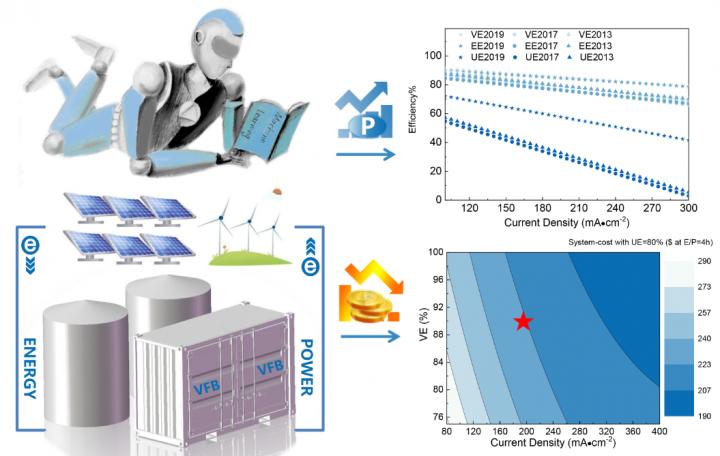
Recently, a research team led by Prof. LI Xianfeng from the Dalian Institute of Chemical Physics (DICP) of the Chinese Academy of Sciences proposed a machine learning-based strategy to predict and optimize the performance and cost of VFBs.

“We use AI technology to improve efficiency, reduce research time, and provide important guidance for the research and development of VFBs” said Prof. LI. “It may accelerate the commercialization of VFBs.”

This work was published in Energy & Environmental Science on Sept. 22.

The proposed strategy takes operating current density as the main feature, and the material and structure of the stack as auxiliary features.

This machine learning model can predict the voltage efficiency, energy efficiency, and electrolyte utilization ratio of the VFB stack, as well as the power and energy cost of the VFB system with high accuracy.

In addition, a future R&D direction for the VFB stack was proposed based on model coefficients of machine learning, i.e., developing high-power density VFB stacks under conditions of higher voltage efficiency and higher electrolyte utilization ratio.

This work not only has great significance for the R&D of VFB stacks, but also highlights the prospects for combining machine learning and experiments for optimizing and predicting the dynamic behavior of complex systems.

###

This study was supported by the National Natural Science Foundation of China, the Strategic Priority Research Program of the Chinese Academy of Sciences, the CAS Engineering Laboratory for Electrochemical Energy Storage, and the Liaoning Revitalization Talents Program.

Media Contact
WANG Yongjin
[email protected]

Original Source

http://english.cas.cn/

Related Journal Article

http://dx.doi.org/10.1039/D0EE02543G

Tags: Chemistry/Physics/Materials SciencesEnergy/Fuel (non-petroleum)Robotry/Artificial Intelligence
Share12Tweet8Share2ShareShareShare2

Related Posts

Palmitoylation of Tfr1 Drives Platelet Ferroptosis and Exacerbates Liver Damage in Heat Stroke

February 7, 2026

Oxygen-Enhanced Dual-Section Microneedle Patch Improves Drug Delivery and Boosts Photodynamic and Anti-Inflammatory Treatment for Psoriasis

February 7, 2026

Scientists Identify SARS-CoV-2 PLpro and RIPK1 Inhibitors Showing Potent Synergistic Antiviral Effects in Mouse COVID-19 Model

February 7, 2026

Neg-Entropy: The Key Therapeutic Target for Chronic Diseases

February 7, 2026
Please login to join discussion

POPULAR NEWS

  • Robotic Ureteral Reconstruction: A Novel Approach

    Robotic Ureteral Reconstruction: A Novel Approach

    82 shares
    Share 33 Tweet 21
  • Digital Privacy: Health Data Control in Incarceration

    63 shares
    Share 25 Tweet 16
  • Study Reveals Lipid Accumulation in ME/CFS Cells

    57 shares
    Share 23 Tweet 14
  • Breakthrough in RNA Research Accelerates Medical Innovations Timeline

    53 shares
    Share 21 Tweet 13

About

We bring you the latest biotechnology news from best research centers and universities around the world. Check our website.

Follow us

Recent News

Palmitoylation of Tfr1 Drives Platelet Ferroptosis and Exacerbates Liver Damage in Heat Stroke

Oxygen-Enhanced Dual-Section Microneedle Patch Improves Drug Delivery and Boosts Photodynamic and Anti-Inflammatory Treatment for Psoriasis

Scientists Identify SARS-CoV-2 PLpro and RIPK1 Inhibitors Showing Potent Synergistic Antiviral Effects in Mouse COVID-19 Model

Subscribe to Blog via Email

Enter your email address to subscribe to this blog and receive notifications of new posts by email.

Join 73 other subscribers
  • Contact Us

Bioengineer.org © Copyright 2023 All Rights Reserved.

Welcome Back!

Login to your account below

Forgotten Password?

Retrieve your password

Please enter your username or email address to reset your password.

Log In
No Result
View All Result
  • Homepages
    • Home Page 1
    • Home Page 2
  • News
  • National
  • Business
  • Health
  • Lifestyle
  • Science

Bioengineer.org © Copyright 2023 All Rights Reserved.