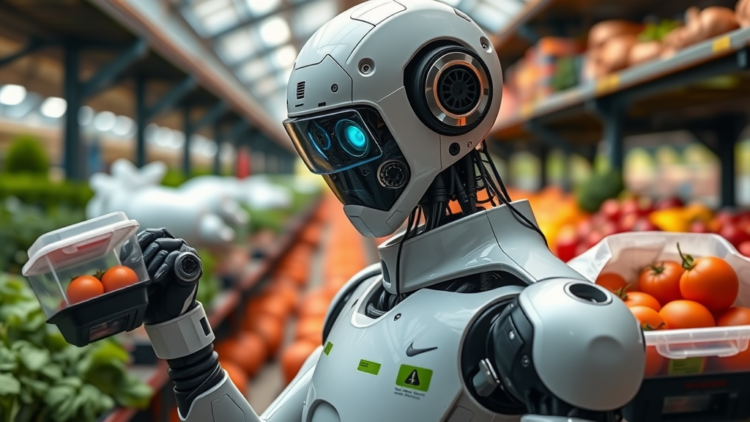
Every year, contaminated food sickens more than one in ten people worldwide and is estimated to cause over 4.2 million deaths, according to figures from the World Health Organization cited in a sweeping new review published in Food Science & Nutrition. Against that backdrop, researchers argue that artificial intelligence is no longer a futuristic curiosity for the food industry but a necessary line of defense. The review, led by Harsh B. Jadhav and colleagues, surveys how machine learning, computer vision, natural language processing, smart sensors, and blockchain are converging to transform food safety and quality assurance across the entire supply chain, from the farm field to the consumer’s plate.
The stakes are enormous. Foodborne pathogens such as Salmonella, Escherichia coli, and Listeria pose particular dangers to children, the elderly, and immunocompromised individuals, and failures in quality control can trigger recalls, reputational collapse, and even criminal prosecution for food companies. Traditional verification methods, which rely heavily on laboratory analysis, are slow, expensive, and prone to human error. As global supply chains stretch across continents, contamination introduced at a farm in one country can spark illness outbreaks among consumers thousands of kilometers away, making consistent oversight a formidable challenge. The authors contend that AI, a hallmark of the Industry 4.0 revolution, offers the speed, scale, and precision that conventional approaches cannot match.
At the heart of this transformation lies machine learning, the branch of AI that allows algorithms to learn patterns from data rather than following fixed rules. The review describes how machine learning techniques, spanning supervised, unsupervised, semi-supervised, and reinforcement learning, are being deployed to monitor and predict food safety hazards. Convolutional neural networks excel at analyzing image data, while algorithms such as support vector machines and k-nearest neighbors have been applied to biosensors that detect antibiotic residues and even differentiate Salmonella concentrations in smartphone-based lateral flow assays. Unlike chromatography or spectroscopy, which deliver reliable results but demand lengthy sample preparation and technical expertise, machine learning models can flag suspicious samples in near real time, tracking contaminants from pesticides, additives, toxins, and pathogens.
Artificial neural networks, the most widely adopted AI architecture in food assessment, are proving especially versatile. The review notes their success in predicting quality attributes of products ranging from coconuts and potatoes to olive oil and dried mango, and in restoring nutritional parameters such as frying time, temperature, and oil content for fried fish. In agriculture, AI-enabled sensors evaluate soil quality and detect plant diseases before they spread, while studies cited in the paper report pest and disease detection in maize with around 75 percent accuracy and coffee bean grading reaching 96 percent accuracy. These predictive capabilities allow farmers and producers to intervene early, reducing waste and protecting harvests.
Computer vision brings a different dimension to quality control: sight. Automated inspection systems now detect and eject foreign objects, soil, and even aflatoxin mold in roasted peanuts by selectively distinguishing infected from normal grains through spectral imaging. Vision-guided robotic systems sort and pack food with a precision that human workers, laboring in hazardous processing environments, cannot safely match. The review highlights a meat processing case study in which AI-driven image recognition achieved contamination detection rates above 98 percent, automatically removing suspect products from the line. Beyond the factory, similar systems have been used to grade mushrooms on multiple quality attributes and even to track honeybee activity, coloration, and temperature in apiculture research.
A quieter revolution is unfolding in the realm of text. The food industry generates mountains of unstructured data, including regulatory reports, equipment maintenance logs, supplier certifications, and a torrent of customer reviews and social media posts. Natural language processing, the review explains, can automate the extraction and validation of compliance data, interpret complex standards such as FDA and ISO 22000 requirements, and perform sentiment analysis that reveals recurring complaints about freshness, taste, or packaging before they snowball into quality crises. In one cited beverage manufacturing case, an NLP-based document system cut audit preparation time by 40 percent while minimizing compliance errors, freeing quality teams to focus on the highest-risk areas.
Sensors and the Internet of Things supply the raw data that makes all of this intelligence possible. Electronic noses and tongues, once laboratory curiosities, now capture temperature, humidity, and aroma profiles in production and distribution, reporting sensory events as electronic signals. Cloud-connected IoT devices allow storage operators to maintain optimal transit conditions and estimate shelf life with unprecedented frequency, while integrated blockchain systems such as the Food Trail blockchain create immutable, decentralized records that trace products from fishing boats to retail shelves. A seafood supplier case study combining AI with blockchain reported a 45 percent improvement in traceability accuracy and a 30 percent reduction in fraud, demonstrating how transparency can be engineered into high-risk supply chains.
Perhaps the most striking application is AI’s role in predicting outbreaks before they happen. Predictive analytics models trained on historical and real-time data can forecast when and where foodborne illness risk will spike, accounting for temperature fluctuations, seasonal trends, and geographic patterns. NLP systems monitoring news, health forums, and social media have detected clusters of gastrointestinal complaints linked to fresh produce, enabling preventive action before formal reports were filed. In a dairy processing case study, AI sensors tracking temperature, pH, and bacterial counts reduced spoilage by 25 percent and improved quality consistency by 30 percent, while AI-enhanced environmental monitoring of processing plants has been credited with significant reductions in contamination rates.
The authors are candid about the obstacles. Globalized supply chains, shifting consumer preferences for additive-free foods, fragmented regulations across jurisdictions, climate-driven disruptions, chronic undertraining of workers, and the financial constraints facing small and medium-sized enterprises all complicate the AI transition. There are ethical dimensions too: because true contamination in any given sample is vanishingly rare, machine learning systems risk cascading false rejections, and biases embedded in training data can go unexamined. Existing AI regulatory frameworks, the review warns, often fail to address the unique requirements of food safety applications, and opaque or unaccountable models remain too hazardous to deploy outside controlled environments.
Still, the trajectory is unmistakable. From classifying barley grains and identifying fraudulent ingredients to automating cleaning verification in breweries and tracing contamination through blockchain-verified ledgers, AI technologies are reshaping what food safety means in the twenty-first century. The review concludes that continued progress will depend on developing consumer-friendly sensors that communicate product freshness directly to shoppers, harmonizing international standards, and building transparency into every algorithm. If those challenges are met, the researchers argue, Industry 4.0’s intelligent machines could deliver what traditional methods never could: safe, nutritious, and verifiably high-quality food for a global population at scale.
Subject of Research: Artificial intelligence applications for food safety and quality assurance in the food industry
Article Title: Artificial Intelligence for Food Safety and Quality Assurance: Technologies, Applications and Future Directions
Article References: Artificial Intelligence for Food Safety and Quality Assurance: Technologies, Applications and Future Directions. (n.d.). https://doi.org/10.1002/fsn3.72377
Image Credits: AI Generated
DOI: 10.1002/fsn3.72377
Keywords: artificial intelligence, food safety, machine learning, computer vision, natural language processing, Internet of Things, blockchain, food quality assurance, foodborne illness, smart sensors, traceability, Industry 4.0
Cite Scienmag News
APA MLA Chicago
Alan Morgan. (September 25, 2026). AI Steps In to Guard the World’s Food Supply From Farm to Fork. Scienmag. https://scienmag.com/ai-steps-in-to-guard-the-worlds-food-supply-from-farm-to-fork/
Alan Morgan. “AI Steps In to Guard the World’s Food Supply From Farm to Fork.” Scienmag, 25 September 2026, https://scienmag.com/ai-steps-in-to-guard-the-worlds-food-supply-from-farm-to-fork/. Accessed 25 September 2026.
Alan Morgan. “AI Steps In to Guard the World’s Food Supply From Farm to Fork.” Scienmag. September 25, 2026. https://scienmag.com/ai-steps-in-to-guard-the-worlds-food-supply-from-farm-to-fork/
Copy citation Download RIS
Tags: AI-based food recall managementAI-driven food safety monitoringArtificial Intelligenceautomation in food safety testingblockchainblockchain for food traceabilitycomputer visioncomputer vision for contamination detectionfood quality assurancefood safetyfoodborne illnessfoodborne pathogen detection technologyglobal food safety risk mitigationIndustry 4.0Internet of ThingsMachine learningmachine learning in food quality assurancenatural language processingnatural language processing in food regulationreducing foodborne illnesses with AIsmart sensorssmart sensors in food supply chainsupply chain transparency in food industrytraceability