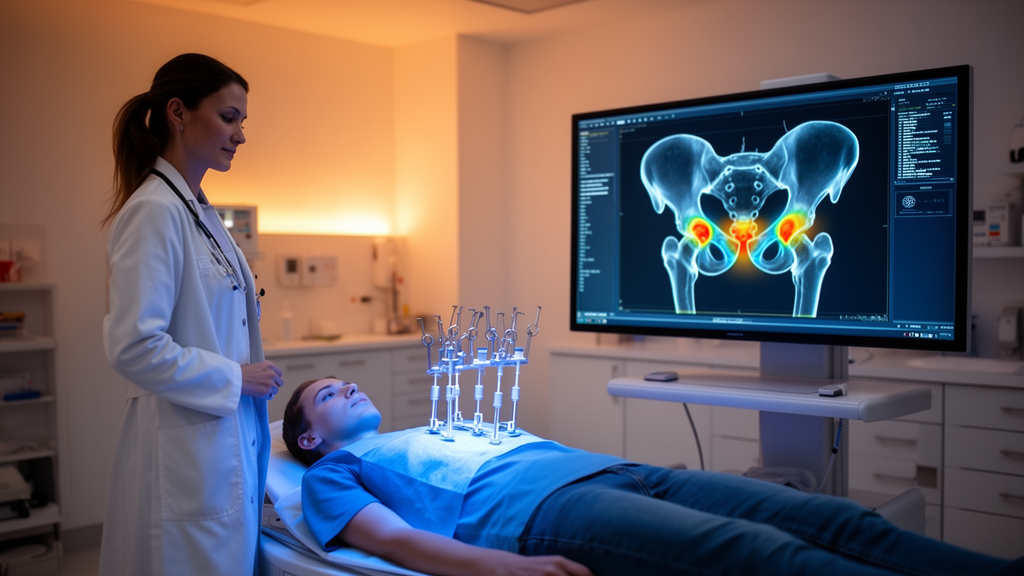
Image-guided interventional radiotherapy has transformed the treatment of locally advanced cervical cancer, allowing clinicians to deliver highly conformal radiation doses directly to tumors while sparing surrounding healthy organs. Yet the procedure remains one of the most technically demanding workflows in radiation oncology, involving painstaking target delineation, organ-at-risk segmentation, applicator reconstruction, and treatment planning, all of which are time-consuming and prone to variability between operators. A new systematic review now takes stock of whether artificial intelligence can change that, and the answer is both encouraging and cautionary.
The review, conducted according to PRISMA 2020 guidelines, searched PubMed, Scopus, and Web of Science for studies published between 2010 and 2026 investigating AI-based imaging applications in cervical interventional radiotherapy. From 353 initial records, the researchers identified 52 eligible studies covering five major application domains: segmentation of targets and organs at risk, treatment planning, applicator and catheter reconstruction, applicator selection, and image registration. More than 2,900 patients were represented across the segmentation studies alone.
The most extensively investigated application was automated segmentation. Deep learning architectures ranging from U-Net derivatives and transformer-based models to multimodal frameworks and even large language model-guided approaches were evaluated for delineating the high-risk clinical target volume, clinical target volume, gross tumor volume, and critical organs such as the bladder, rectum, sigmoid, and bowel. Performance varied considerably, but the best-performing models achieved Dice similarity coefficients approaching or exceeding 0.90 for certain organs at risk and target volumes. One multimodal framework reached a Dice coefficient of 0.947, while a slice-prompted interactive segmentation tool achieved values up to 0.948 across multicenter test sets, reducing contouring time by more than 84 percent.
Bladder segmentation consistently showed the strongest reported performance, with Dice coefficients of 0.92 to 0.96 across individual studies. Transfer learning strategies significantly improved generalizability across bladder, rectum, sigmoid, and bowel structures after fine-tuning. Several studies reported that automatic contours were dosimetrically equivalent to manual ones, with differences in key dose parameters generally below one percent. One study reported contouring completed in approximately 1.5 seconds per patient, and another achieved full segmentation in under 13 seconds, compared with manual delineation times that can exceed 17 minutes.
Treatment planning represented the second largest research area, with 14 studies exploring automated optimization, dose prediction, plan quality assurance, and adaptive planning. The BRIGHT framework, which employs multi-objective optimization with artificial intelligence, achieved 100 percent adherence to EMBRACE-II protocol limits compared with 88.9 percent for clinical plans while enabling rapid re-optimization in roughly 30 seconds. Automated adaptive planning systems generated physician-preferred plans in most cases, significantly reducing bladder and rectum doses, and fully automated workflows produced clinically acceptable plans in as little as 1.4 minutes. Deep-learning dose prediction models achieved mean absolute errors as low as 0.37 Gy for target dose metrics, and attention-gated 3D U-Net models generated complete dose distributions within five seconds per patient.
Applicator and catheter reconstruction studies demonstrated some of the most striking efficiency gains. Deep-learning-assisted catheter reconstruction in MRI-guided workflows reduced reconstruction times from approximately 46 minutes to 11 minutes without compromising accuracy, with more than 98 percent of dwell positions within 2 millimeters of reference values. Automated needle digitization achieved Dice coefficients of 0.88 to 0.93 with Hausdorff distances generally below 1 millimeter and negligible dosimetric differences compared with manual reconstruction. These findings are clinically significant because applicator reconstruction remains among the most technically demanding components of MRI-guided interventional radiotherapy.
Applicator selection emerged as a promising but less mature domain. A deep-learning model achieved 96 percent accuracy in selecting between Syed and tandem-and-ovoid applicators, while machine-learning approaches for choosing between intracavitary and hybrid intracavitary-interstitial techniques reached accuracies up to 0.849 with area under the curve values of 0.903. Notably, this domain included the first prospective validation study identified in the review, in which machine learning-guided needle selection achieved 82.5 percent accuracy and reduced organ-at-risk doses by an average of 2.0 Gy. AI-guided 3D-printed templates also improved target coverage and reduced bladder and rectum doses compared with free-hand insertion.
Despite these encouraging technical results, the review’s methodological assessments revealed substantial concerns. Task-adapted QUADAS-AI and PROBAST+AI evaluations identified predominantly high risk of bias across all five domains, driven by retrospective single-center designs, limited sample sizes, non-independent reference standards, and the near-complete absence of independent external validation. In the segmentation studies, 68 percent were judged at high risk of bias in the index-test domain, primarily because models were validated only on institution-specific datasets. Certainty of evidence, assessed using a GRADE-informed approach, ranged from low to very low across all application domains.
The authors emphasize a critical distinction between technical performance and demonstrated clinical benefit. Most studies reported geometric or dosimetric surrogate endpoints such as Dice coefficients and dose-volume parameters, whereas relatively few investigated clinically meaningful outcomes including toxicity, local control, or physician acceptability. High geometric accuracy is a prerequisite for clinical implementation but does not necessarily translate into improved patient outcomes. Explainability poses an additional barrier, as many deep-learning models generate predictions without transparent information about the underlying decision processes, potentially limiting clinician confidence in high-stakes tasks.
The review concludes that no AI approach identified in the literature is currently ready for routine clinical implementation in cervical interventional radiotherapy. However, the evidence consistently supports technical feasibility, workflow efficiency gains, and reduced inter-observer variability across multiple applications. The authors call for prospective multicenter evaluation, independent external validation, standardized evaluation frameworks, and clinically meaningful endpoints before widespread adoption. Radiomics, while promising for extracting quantitative imaging biomarkers, was not directly evaluated in any included study and remains an area requiring dedicated investigation in future work.
Subject of Research: Artificial intelligence applications in image-guided interventional radiotherapy for locally advanced cervical cancer
Article Title: Artificial intelligence in image-guided cervical interventional radiotherapy: a systematic review
Article References: Lancellotta, V., Rovirosa, A., La Milia, M. C., Rosa, E., Fionda, B., Vaccaro, M., Dragonetti, P., Bannoni, L., Autorino, R., Bizzarri, N., Russo, L., Gui, B., Macchia, G., Tagliaferri, L., & Gambacorta, M. A. (2026). Artificial intelligence in image-guided cervical interventional radiotherapy: a systematic review. Frontiers in Oncology, 16, Article 1910070. https://doi.org/10.3389/fonc.2026.1910070
Image Credits: AI Generated
DOI: 10.3389/fonc.2026.1910070
Keywords: artificial intelligence, cervical cancer, brachytherapy, deep learning, image segmentation, treatment planning, applicator reconstruction, image registration, radiotherapy, systematic review, medical imaging, clinical validation
News Source: Nathaniel Bowman. (October 15, 2026). AI Shows Promise but Falls Short in Cervical Cancer Brachytherapy, Review Finds. Scienmag.