


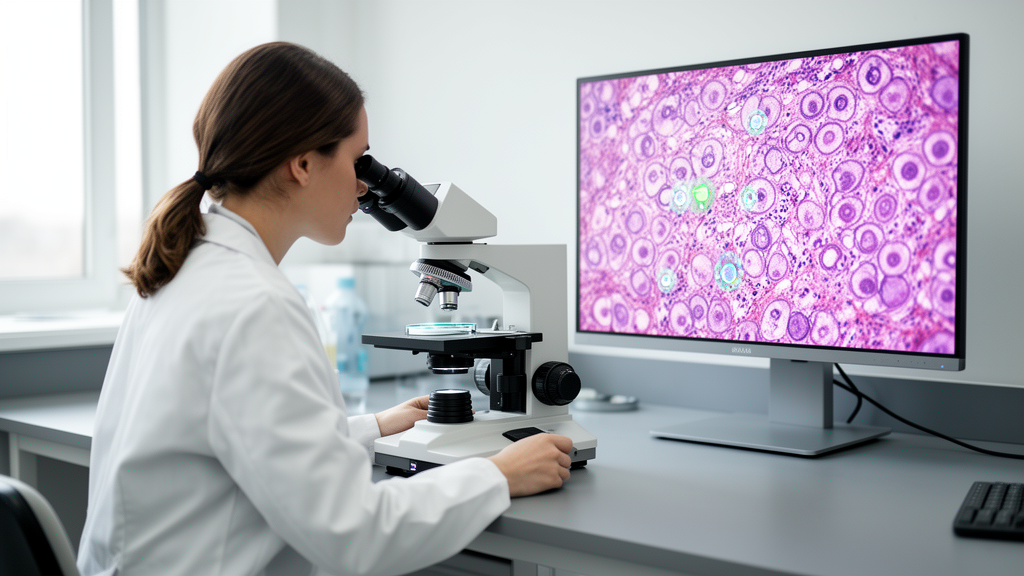
An artificial intelligence pipeline developed in Frankfurt can automatically grade testicular biopsies using the Bergmann-Kliesch Score, a histopathological measure that helps decide whether men with non-obstructive azoospermia should proceed to intracytoplasmic sperm injection. In a retrospective study of 74 patients treated at the University Medical Center Frankfurt, the automated scores agreed strongly with those assigned by board-certified uropathologists, and at the clinical decision cutoff of a score of at least 1, the system correctly classified every case in a held-out test set of 15 patients. The work, published in Basic and Clinical Andrology, presents what the researchers describe as the first fully automated, whole-slide-image-based, per-tubule implementation of this particular score in human diagnostic biopsies.
The Bergmann-Kliesch Score quantifies spermatogenesis by counting the fraction of seminiferous tubules that contain one or more elongated spermatids. The percentage of positive tubules, divided by ten, yields a value between 0 and 10. A score of 0 corresponds to germ cell aplasia or Sertoli cell-only syndrome, the most common cause of non-obstructive azoospermia, in which spermiogenesis is absent. Scores between 1 and 7 indicate reduced spermiogenesis of varying degree, described as mixed atrophy, while regular spermiogenesis is defined as 80 to 100 percent of evaluated tubules containing elongated spermatids, corresponding to scores between 8 and 10. At the University Medical Center Frankfurt, the recommendation to use cryopreserved tissue for ICSI is made when the score reaches at least 1, meaning at least 10 percent of seminiferous tubules contain elongated spermatids.
The clinical stakes are considerable. In men with non-obstructive azoospermia, testicular sperm extraction combined with ICSI is the only established treatment option for achieving biological parenthood. Yet a recent meta-analysis of 117 studies reported an overall sperm retrieval success rate of approximately 47 percent. TESE is an invasive procedure that carries the risk of testicular damage, hormonal sequelae and postoperative complications, and an incorrect histological score risks exposing the female partner to an unnecessary invasive procedure without a realistic chance of success. Manual scoring is also presumed to be susceptible to substantial inter- and intraobserver variability; the coarse qualitative interpretation of testicular histopathology among pathologists has been shown to achieve only moderate interobserver agreement, with a kappa of 0.43.
To build the pipeline, the team analyzed a retrospective monocentric cohort of 84 adult men with non-obstructive azoospermia who underwent TESE between January 2019 and October 2024. Ten patients were excluded because their samples contained exclusively epididymal tissue or testicular parenchyma without seminiferous tubules, leaving a final analysis cohort of 74. The pipeline uses two machine-learning models working in tandem on paired whole-slide images. A U-Net architecture with a ResNet-34 backbone, trained on 60 haematoxylin-eosin-stained slides from 58 patients with 5,633 manually annotated seminiferous tubules, performs tubular segmentation and reached a multi-class Dice coefficient of 0.897 on its validation set. A second U-Net model with the same backbone was trained on 15 OCT3/4 immunohistochemically stained slides containing 14,226 manually annotated elongated spermatids to detect those structures.
The choice of OCT3/4 staining is a distinctive feature of the approach. Although OCT3/4 immunohistochemistry is conventionally used to detect germ cell neoplasia in situ and is not a specific marker for late spermatid stages in its standard diagnostic application, the researchers observed that elongated spermatids stand out far more clearly in OCT3/4-stained sections than in haematoxylin-eosin at the same magnification, and they exploited this property for automated detection. The two serial sections, each 2 micrometers thick and scanned at 40x magnification, were aligned using a two-stage multimodal image registration combining rigid alignment based on Sobel-gradient representations with a B-spline transform to account for residual non-linear tissue deformations. Spermatid detections were then projected into the coordinates of the haematoxylin-eosin section, and the score was computed from the spatial intersection of spermatid detections with tubular polygons.
Performance was evaluated on two sets: a patient-level held-out test set of 15 patients with no overlap with any model training data, and the full cohort of 74, which was treated as a supportive, slide-level evaluation because some of those patients had contributed archival tissue to model development. On the held-out test set, using a threshold of at least two detected spermatids per tubule, the AI-derived scores showed a Pearson correlation of 0.957 with pathologist-assigned reference scores, a Spearman correlation of 0.856, a concordance correlation coefficient of 0.940, a mean absolute error of 0.93 and a root mean squared error of 1.28, with a mean bias of −0.18. Across the full evaluation cohort, agreement remained robust, with a Pearson correlation of 0.851, a Spearman correlation of 0.829, a mean absolute error of 1.52 and a root mean squared error of 2.20.
One methodological finding deserves particular attention. When the researchers directly translated the original qualitative criterion, requiring at least one detected spermatid per tubule, the pipeline achieved a high correlation with pathologist scores on the test set, with a Pearson correlation of 0.918, but produced a systematic positive bias of 0.69 driven by overestimation in cases with absent spermatogenesis. Under that configuration, six of the eight Sertoli cell-only syndrome cases in the test set received non-zero AI scores and were misclassified as spermatogenesis-positive at the clinical cutoff. Raising the threshold to at least two detected spermatids per tubule substantially reduced this bias without compromising the detection of spermatogenesis-positive cases. With the two-spermatid threshold, the pipeline correctly classified all 15 held-out cases, identifying all 7 spermatogenesis-positive cases and all 8 Sertoli cell-only syndrome cases, with sensitivity, specificity, positive predictive value and negative predictive value each reaching 1.00. The researchers note that this threshold was identified from an empirical post hoc sensitivity analysis rather than being pre-specified, so prospective validation on independent external cohorts will be required.
On the full evaluation cohort at the clinical cutoff, the pipeline achieved a sensitivity of 97.4 percent, a specificity of 62.9 percent, a positive predictive value of 74.5 percent, a negative predictive value of 95.7 percent and an accuracy of 81.1 percent. Discordant cases were almost exclusively false-positive AI classifications, with only a single false-negative case across the whole cohort. A pathologist-stratified analysis showed comparable concordance across the three reporting uropathologists, at 82.9 percent, 77.3 percent and 82.4 percent respectively, with overlapping confidence intervals and no consistent observer-specific failure pattern. The reference standard itself reflected routine clinical reporting rather than a prospectively generated consensus, which the authors acknowledge means that part of any disagreement may reflect variability in the reference standard rather than errors of the pipeline alone.
The researchers also report the practical details of deployment. The complete end-to-end processing time per whole-slide image pair was approximately 25 minutes on a single NVIDIA GeForce RTX 3090 graphics card, with multimodal image registration accounting for roughly 16 minutes of that total, while segmentation inference for both models combined required less than 1 minute. The comparatively low soft Dice coefficient of 0.284 for the spermatid detection model, the authors explain, reflects the extremely small size of elongated spermatids, which occupy only a minimal fraction of each image patch; because the score depends on whether a tubule contains spermatids rather than on perfect pixel-level outlines, tubule-level assignment matters more than pixel-wise overlap for the final result.
The authors are careful about the limits of the work. The study was retrospective and monocentric, with all slides processed, stained and scanned at a single institution, limiting generalizability to centers with different practices. The held-out test set comprised only 15 patients, so the perfect classification performance should be interpreted cautiously. Crucially, the study evaluated agreement with pathologist-assigned scores but did not assess whether AI-derived scores predict sperm retrieval rates, ICSI success, pregnancy or live birth outcomes, so the results do not yet prove that the automated score improves clinical decision-making or patient outcomes. The team positions the system as a decision-support tool rather than a replacement for expert assessment, with transparent tubule-level outputs that a pathologist can verify directly on the slide, and calls for external multicentric validation with standardized consensus reference scoring and prospective correlation with clinical outcome data before routine deployment.
Subject of Research: Development and validation of an artificial intelligence pipeline for automated Bergmann-Kliesch Score assessment of testicular biopsies in men with non-obstructive azoospermia
Article Title: Automated Bergmann-Kliesch Score assessment in testicular biopsies using artificial intelligence-based whole-slide image analysis: a retrospective monocentric development and validation study
Article References: Gassen, S., Flinner, N., Frøberg Mathisen, I., Bein, J., Beldermann, O., Haug, L., Köllermann, J., Chun, F., Bachmann, A., Lehr, K., Mayer, R. S., & Wild, P. J. (2026). Automated Bergmann-Kliesch Score assessment in testicular biopsies using artificial intelligence-based whole-slide image analysis: a retrospective monocentric development and validation study. Basic and Clinical Andrology, 36(1), Article 27. https://doi.org/10.1186/s12610-026-00329-x
Image Credits: AI Generated
DOI: 10.1186/s12610-026-00329-x
Keywords: artificial intelligence, testicular biopsy, Bergmann-Kliesch Score, non-obstructive azoospermia, TESE, ICSI, whole-slide imaging, histopathology, spermatogenesis, machine learning, male infertility, decision support
News Source: Ophelia Keating. (October 28, 2026). AI Reads Testicular Biopsies and Matches Pathologists at the ICSI Decision Cutoff. Scienmag.



