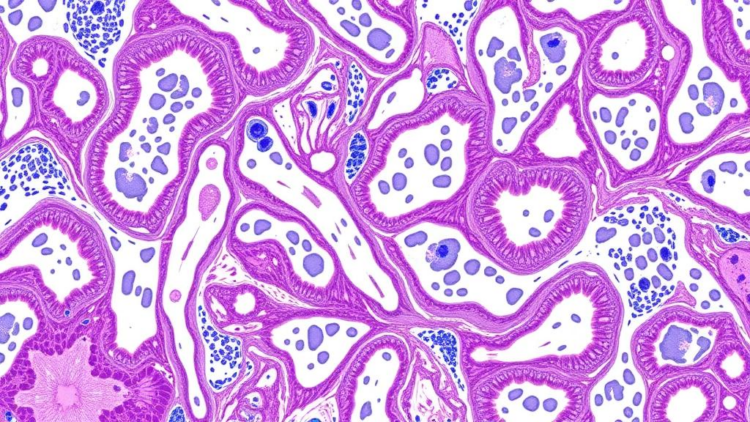
A routine tissue biopsy can now reveal far more than what a pathologist sees under the microscope. A team of researchers in China has developed an artificial intelligence system, called RIDGE, that predicts molecular biomarkers of cancer directly from ordinary hematoxylin and eosin stained pathology slides, the same glass slides prepared in every hospital laboratory in the world. The work, published in BMC Medical Imaging, describes a deep learning framework trained on thousands of whole slide images from The Cancer Genome Atlas and validated on an independent cohort from the Clinical Proteomic Tumor Analysis Consortium. The central claim is striking: the visual fingerprints of tumor morphology contain enough information to infer gene expression signatures and clinically actionable biomarkers, without any molecular testing at all.
The motivation behind the study lies in a practical bottleneck of modern oncology. Molecular profiling, which guides targeted therapies and immunotherapy decisions, currently depends on genomic or transcriptomic assays such as next generation sequencing. These tests are expensive, require specialized infrastructure, and can add days or weeks to the diagnostic timeline, a delay that matters enormously for patients with aggressive disease. If a machine could reliably estimate molecular features from the slide that is already being examined for diagnosis, the turnaround time for biomarker information could shrink dramatically and the cost per test could fall to nearly nothing beyond the computational expense. That is the promise the authors set out to test on a pan cancer scale rather than in a single tumor type.
The system, whose name stands for Rapid and Intelligent Detector for Genetic Estimation, is built on weakly supervised learning, a strategy that sidesteps one of the most stubborn obstacles in computational pathology. Whole slide images are gigantic, often exceeding one hundred thousand by one hundred thousand pixels, and labeling specific regions of interest by hand is prohibitively laborious. RIDGE instead learns from slide level labels only, using a multiple instance learning formulation in which the slide is treated as a bag of smaller tissue patches and only the overall slide carries a molecular label. The architecture employs fully convolutional networks to aggregate patch level information, allowing the model to identify which morphological patterns are associated with a given biomarker without ever being told where to look.
Several technical choices distinguish the framework. The authors incorporate clustering guided contrastive learning, a self supervised pretraining approach that teaches the network to group visually and biologically similar tissue patterns together before any biomarker prediction begins. Attention mechanisms, including a focused linear attention module, allow the model to weigh the contribution of thousands of patches efficiently, while depthwise convolutions and a mixture of experts design help the network specialize across the heterogeneous landscape of tumor types. Multi task learning enables a single model to predict multiple biomarkers and gene expression signatures simultaneously, sharing learned representations across related prediction problems. The result is a general purpose system intended to work across cancers rather than a bespoke model for each disease.
The training data were substantial. The team developed and validated RIDGE using 4,983 whole slide images from 4,680 patients spanning 12 solid tumor types in The Cancer Genome Atlas, including breast, lung, colon, rectal, stomach, liver, pancreatic, cervical, head and neck, and three kidney cancer cohorts. Performance was measured with the area under the receiver operating characteristic curve, the standard metric for binary classification tasks in medicine. Across all 12 cancer types, RIDGE achieved an overall AUC of 0.763, with a 95 percent confidence interval of 0.724 to 0.802. In a field where individual biomarker prediction models often hover in a similar range, a single framework reaching this level across such a diverse set of tumors and molecular targets is a meaningful benchmark.
Perhaps the most important result concerns generalization beyond the training data. Machine learning models in medicine frequently fail when moved to new datasets, a phenomenon driven by differences in staining protocols, scanners, and patient populations. To test reproducibility, the researchers applied RIDGE to an external validation cohort of 221 whole slide images from 105 colorectal cancer patients in the Clinical Proteomic Tumor Analysis Consortium, a completely independent resource, asking the model to predict microsatellite instability status. MSI is a critical biomarker because microsatellite unstable tumors respond well to immune checkpoint inhibitors. RIDGE achieved an AUC of 0.769, with a confidence interval of 0.686 to 0.841, closely matching its internal performance and suggesting the learned features reflect genuine biology rather than dataset specific artifacts.
Beyond raw accuracy, the authors emphasize interpretability, a persistent concern for clinicians asked to trust black box algorithms. The study reports that the model captures morphological visual characteristics that make gene expression signatures detectable directly from the slides, and supplementary analyses include explainability experiments examining how molecular features manifest in gastric cancer tissue. In effect, the network learns to associate particular cellular and tissue architectures, such as the appearance of tumor infiltrating immune cells, gland formation patterns, or nuclear features, with underlying molecular states. This capacity to quantify genotype phenotype relationships from images could itself become a research tool, allowing investigators to map molecular biology onto tissue morphology at a scale that manual review could never achieve.
The clinical implications, if the approach matures, are considerable. Because H&E stained slides are universally produced, an AI layer on top of standard pathology workflows could provide preliminary biomarker estimates within minutes of slide scanning, flagging patients who should receive priority for confirmatory molecular testing. In hospitals without access to sequencing facilities, such predictions could guide referral decisions and broaden equitable access to precision oncology. The authors argue that RIDGE could significantly expedite cancer screening and personalized therapy, and the pan cancer design means a single deployment could serve pathology departments handling many tumor types rather than requiring separate pipelines for each indication.
Caution is nonetheless warranted before such systems reach the clinic. An AUC of roughly 0.76, while respectable, indicates imperfect discrimination, meaning the model would need to function as a triage and prioritization tool rather than a replacement for definitive molecular assays. The study relied on publicly available, de identified data from TCGA and CPTAC, which, although multi institutional, may not capture the full heterogeneity of staining practices and patient demographics seen in routine global practice. Prospective clinical validation, regulatory review, and demonstration of impact on patient outcomes remain necessary steps. The published work was exempt from additional ethics approval because it used existing consented datasets, but real world deployment would face a new and more demanding evaluation landscape.
Even with those caveats, the study adds to a rapidly growing body of evidence that the humble pathology slide is an information rich object whose molecular content can be unlocked computationally. By demonstrating a single weakly supervised framework that predicts multiple biomarkers across a dozen cancer types and reproduces its performance on external data, the RIDGE team has moved the field closer to a future in which every diagnostic slide yields both a morphological diagnosis and a molecular profile. For patients, that could mean faster answers at lower cost; for researchers, a powerful new lens on the relationship between how a tumor looks and what it is, at the level of its genes.
Subject of Research: Deep learning prediction of pan-cancer molecular biomarkers from H&E-stained whole slide pathology images
Article Title: Deep learning-based large-scale pan-cancer multiple biomarkers prediction using RIDGE with pathological images
Article References: Xi, H., Feng, X., Lu, Y., Li, G., Zhang, Y., Li, J., Wang, Y., Xu, J., Zhang, Y., Sha, C., & He, M. (2026). Deep learning-based large-scale pan-cancer multiple biomarkers prediction using RIDGE with pathological images. BMC Medical Imaging. https://doi.org/10.1186/s12880-026-02695-4
Image Credits: AI Generated
DOI: 10.1186/s12880-026-02695-4
Keywords: computational pathology, deep learning, whole slide imaging, biomarker prediction, weakly supervised learning, multiple instance learning, microsatellite instability, TCGA, CPTAC, precision oncology, gene expression, pan-cancer
Cite Scienmag News
APA
MLA
Chicago
Nathaniel Bowman. (October 1, 2026). AI Reads Routine Pathology Slides to Predict Cancer Biomarkers Across 12 Tumor Types. Scienmag. https://scienmag.com/ai-reads-routine-pathology-slides-to-predict-cancer-biomarkers-across-12-tumor-types/
Nathaniel Bowman. “AI Reads Routine Pathology Slides to Predict Cancer Biomarkers Across 12 Tumor Types.” Scienmag, 1 October 2026, https://scienmag.com/ai-reads-routine-pathology-slides-to-predict-cancer-biomarkers-across-12-tumor-types/. Accessed 1 October 2026.
Nathaniel Bowman. “AI Reads Routine Pathology Slides to Predict Cancer Biomarkers Across 12 Tumor Types.” Scienmag. October 1, 2026. https://scienmag.com/ai-reads-routine-pathology-slides-to-predict-cancer-biomarkers-across-12-tumor-types/
Copy citation
Download RIS
Tags: AI models for personalized cancer therapyAI-based histopathology analysisAI-powered tumor morphology analysisbiomarker predictioncancer biomarker prediction from pathology slidescomputational pathologycost-effective cancer diagnosticsCPTACcross-tumor type biomarker predictiondeep learningdeep learning for cancer diagnosticsdigital pathology and machine learninggene expressionhematoxylin and eosin stained slide analysismicrosatellite instabilitymolecular profiling using digital pathologymultiple instance learningpan-cancerprecision oncologyrapid cancer molecular testing alternativesTCGAtumor gene expression inference with AIweakly supervised learningwhole-slide imaging