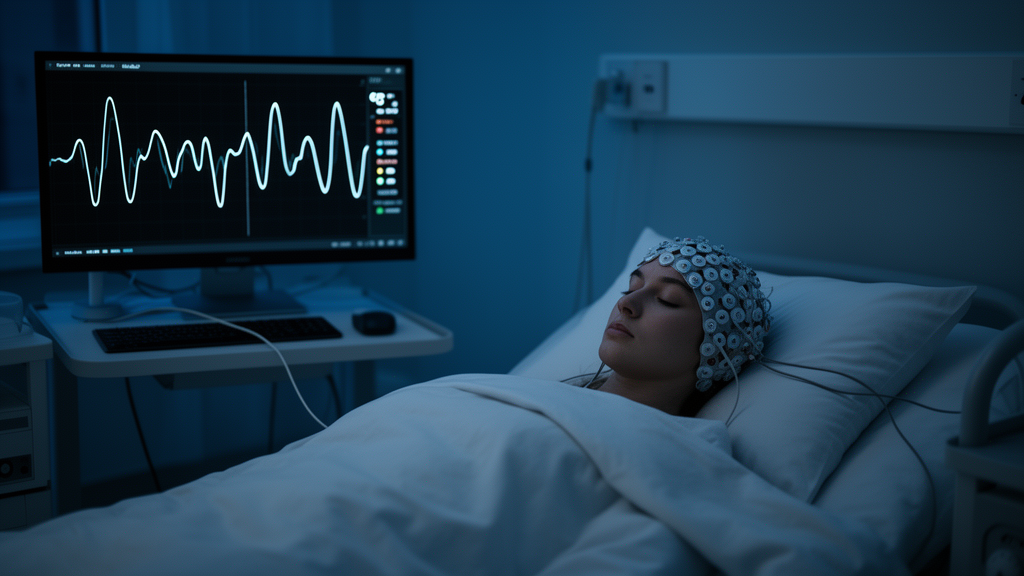
Automated sleep staging from a single EEG channel could one day lighten the equipment burden of overnight sleep studies, and a new study reports a framework designed to make that prediction more reliable. The work, published in Frontiers in Signal Processing, describes a physiology-informed spectral-temporal learning approach that classifies 30-second epochs of Fpz-Cz EEG recording into sleep stages, and it reports its accuracy together with a careful analysis of how much the model’s own confidence should be trusted.
The researchers, led by Chunming Shih and colleagues at Guang’anmen Hospital, China Academy of Chinese Medical Sciences, built their pipeline around the observation that sleep stages leave characteristic signatures in specific frequency bands. Each 30-second epoch is transformed into a log-power short-time Fourier transform representation, which is then modulated across five sleep-related bands. Depthwise-separable convolutions and efficient channel attention extract local time-frequency patterns from this representation, keeping the network lightweight.
A lightweight Transformer models a centered seven-epoch window, using the surrounding epochs to predict the stage of the middle one. Training combines a class-balanced focal loss, supervision on neighboring epochs, and a transition prior estimated from the training labels, so the model learns both the appearance of each stage and the plausible order in which stages follow one another.
On a fixed subject-disjoint evaluation partition of the Sleep-EDF dataset, the framework achieved 0.8469 accuracy, 0.7905 macro F1 and 0.7906 Cohen’s kappa. It produced higher discrimination metric point estimates than a protocol-matched light CNN, although a temporal convolutional network, or TCN, achieved slightly higher accuracy and kappa. The authors are careful to describe these as point estimates on a fixed test partition rather than definitive rankings.
The framework yielded the lowest expected calibration error among the three evaluated models, at 0.0320. Well-calibrated confidence is essential if automated scores are to be used in a referral workflow, where low-confidence epochs are passed to a human scorer.
That referral idea was tested directly. Removing the 20 percent lowest-confidence epochs yielded 0.9167 accuracy among the remaining automated epochs at 80 percent coverage. As a control, repeated random referral at the same coverage left accuracy near the full-test-set estimate, whereas confidence-guided referral retained higher accuracy among the automated epochs. In other words, the model’s confidence scores carried real information about which predictions were likely to be correct.
The team also ran retraining-based ablations under the same protocol, separately removing spectral modulation, the transition-prior loss, and neighboring-epoch supervision, to probe which components of the design contribute to performance. Across random seeds 42, 123 and 2024, accuracy and macro F1 averaged 0.8530 plus or minus 0.0060 and 0.8006 plus or minus 0.0098 respectively, indicating that the results were stable across training runs. Test-time spectral, context and noise stress analyses examined how sensitive the trained model was to perturbations, without any retraining.
The authors position these results as supporting further evaluation of the framework as an offline or delayed pre-scoring aid, not as a clinical tool. They explicitly note that the small fixed test cohort and the absence of external validation preclude broader reliability or clinical generalization claims, and that the findings should be interpreted as methodological evidence rather than clinical validation.
The next step, according to the study’s own framing, is broader external validation before any claims about real-world reliability can be made.
Subject of Research: Automated single-channel EEG sleep staging using a physiology-informed spectral-temporal deep learning framework with confidence-aware evaluation
Article Title: Physiology-informed spectral-temporal learning with confidence-aware evaluation for single-channel EEG sleep staging
Article References: Shih, C., Lv, B., Zhai, L., & Xu, F. (2026). Physiology-informed spectral-temporal learning with confidence-aware evaluation for single-channel EEG sleep staging. Frontiers in Signal Processing, 6, Article 1956948. https://doi.org/10.3389/frsip.2026.1956948
Image Credits: AI Generated
DOI: 10.3389/frsip.2026.1956948
Keywords: sleep staging, EEG, deep learning, Transformer, spectral analysis, calibration, Sleep-EDF, confidence-aware referral, machine learning, biomedical signal processing, Physiology-informed, spectral-temporal
News Source: Blake Davidson. (October 27, 2026). AI Reads a Single EEG Channel to Stage Sleep, With Confidence Checks Built In. Scienmag.