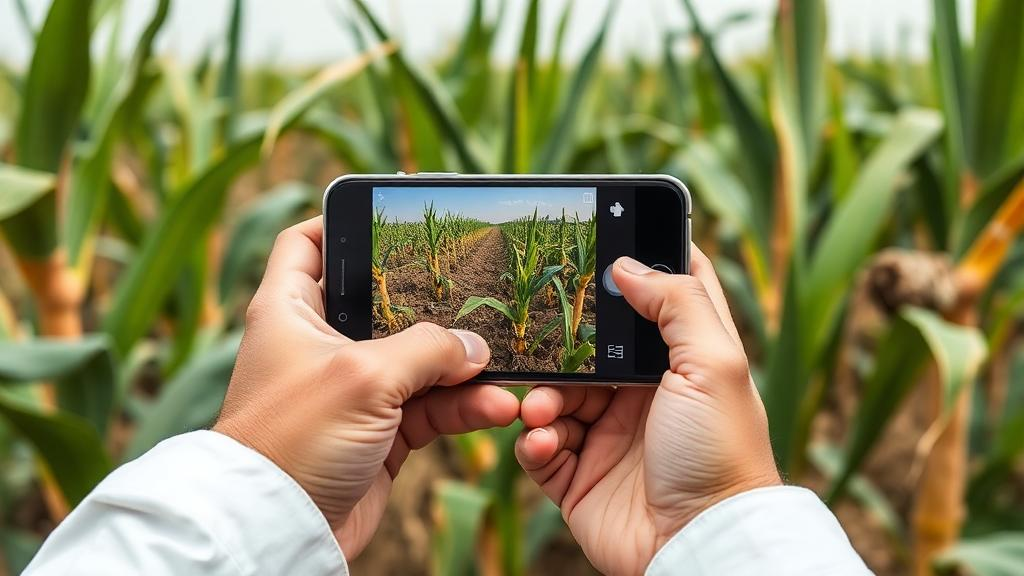
A disease that hides in the tender heart of sugarcane plants has finally met its match in an algorithm small enough to live inside a pocket. Pokkah boeng, a fungal infection caused by species within the Fusarium fujikuroi species complex, is one of the most deceptive threats facing global sugar production. Its earliest signs, a faint yellowing at the base of young leaves or a subtle narrowing of the blade, are easy to miss even for trained eyes, yet the disease can strip 5 to 20 percent of yield and cut sugar content by up to 3 percent. Now, a research team led by Cuimin Sun and Xiaojie Qin has built a lightweight deep learning framework that can grade the severity of these early symptoms directly on an ordinary Android smartphone, achieving 96.53 percent accuracy without ever sending a single image to the cloud.
The study, published in Smart Agricultural Technology, addresses a stubborn gap in agricultural artificial intelligence. Most computer vision work on sugarcane diseases has focused on classifying which disease a plant has, treating pokkah boeng as just one category among many. Far less attention has been paid to the harder question of how sick a plant is, particularly when the visible symptoms are still faint. Existing severity assessment methods in other crops typically rely on prominent lesion features or the proportion of leaf area covered by lesions, strategies that simply do not work for a disease whose early signature is discoloration and mild deformation rather than obvious spots. Meanwhile, many high-accuracy plant disease models are far too large and computationally demanding to run on the resource-constrained devices that farmers actually carry into the field.
The team’s first contribution was a new severity grading standard built around what can actually be seen in a photograph. Working with experienced sugarcane disease experts, the researchers defined three visual symptom anchors: leaf colour alteration, covering chlorosis and yellowing; leaf deformation, covering wrinkling, curling, and twisting of the blade or margin; and visible abnormalities in the growing-point region, such as pronounced twisting or necrosis of the heart leaf. These anchors were combined into a four-grade scale. Healthy plants show none of the signs, mild cases display colour changes alone, moderate cases add clear deformation, and severe cases involve the growing point itself. The authors stress that these anchors are descriptive tools for structuring labels rather than independent variables the model must predict, and that atypical symptom combinations observed in the field did not form stable patterns and were excluded.
To train and test the system, the researchers constructed a dedicated dataset of 3,235 images, the Sugarcane Pokkah Boeng Disease Dataset, collected monthly from May to August 2025 at a pathological nursery in Guangxi Subtropical Agricultural Science New City, the heart of China’s sugarcane belt. Images were captured with a Huawei smartphone at high resolution across five cultivars, spanning close-ups and wider views of the heart leaf region. Two researchers independently annotated every image, achieving a Cohen’s kappa of 0.86 before a senior expert adjudicated disagreements. Crucially, the data were split at the plant level rather than the image level, preventing multi-angle photographs of the same plant from leaking between training and test sets. The model was first pre-trained on the public PlantVillage dataset of 54,305 plant disease images, then fine-tuned on the sugarcane data, a transfer learning strategy that produced faster and more stable convergence than training from scratch.
The architecture itself is where the engineering gets interesting. The backbone is MobileNetV2, a network designed for mobile efficiency through depthwise separable convolutions and inverted residual blocks. On top of this, the team added two custom modules. The first, a Multi-Scale Dynamic Feature Fusion module, taps features from two different depths of the network, an early stage rich in colour, texture, and local morphology, and a deep stage carrying global semantic information. A single learnable scalar weight, generated from the deep features by a fully connected layer with just 321 trainable parameters, dynamically balances the contribution of each level for every input image. The second module, called Fast Channel-Spatial Interaction, runs parallel channel recalibration and local spatial modelling branches over the fused features and combines them by addition, sharpening the representations that matter most for telling adjacent severity grades apart.
The results were convincing. The proposed model reached 96.53 percent accuracy on the held-out test set, with a quadratic weighted kappa of 96.00 percent, comfortably ahead of ResNet18, AlexNet, VGG16, EfficientNetB0, GhostNet, SqueezeNet, ShuffleNetV2, and the unmodified MobileNetV2 baseline. Every severity class scored an F1-score above 0.93, and the model recorded a severity grade mean absolute error of just 0.0571, a 3.09 percent underestimation rate for genuinely sick plants, and a zero percent false alarm rate for healthy ones. Because misjudging a severely diseased plant as healthy is far more costly than the reverse, the team also ran a cost-sensitive analysis under three different cost matrices, and their model posted the lowest error cost in all three, including a scenario where underestimation was penalised twice as heavily as overestimation.
Skeptics of single-run benchmarks will appreciate the statistical rigor. The team repeated training across ten random seeds, finding the model achieved 96.29 percent accuracy plus or minus 0.73 percent with a Macro-F1 of 95.43 percent plus or minus 0.77 percent, consistently above the strongest baselines with low run-to-run variation. Paired 95 percent confidence intervals for the accuracy differences over MobileNetV2, ResNet18, and GhostNet all remained above zero, and McNemar tests on same-test-set predictions yielded p-values below 0.05 for all three comparisons. Grad-CAM visualisations added a qualitative layer, showing that the new model concentrates its attention tightly on leaf structures and symptom regions, while the baseline MobileNetV2’s attention scatters into irrelevant background. An analysis of the learned fusion weight revealed it adapts non-monotonically with severity, leaning more on shallow features for mild cases and deep features for moderate ones, a Kruskal-Wallis test confirmed the differences were highly significant.
The deployment results may prove the most consequential part of the story. Exported to ONNX format, the model contains only 2.2693 million parameters and occupies 8.63 megabytes. On a POCO X3 GT smartphone running ONNX Runtime, it classified images in about 30.8 milliseconds with a peak memory footprint of 128 megabytes, while still delivering the highest on-device accuracy of all tested models. After INT8 post-training quantisation, the model shrank to 2.57 megabytes and inference dropped to roughly 10.8 milliseconds per image, with accuracy unchanged at 96.53 percent and not a single test prediction altered. The model also held up well under JPEG compression, brightness shifts, and reduced resolution, though strong motion blur did degrade performance somewhat. The team packaged everything into an Android application prototype that takes a photo, displays the severity grade, and offers general field-management guidance, completing a pipeline from camera to actionable advice entirely on the device.
The authors are candid about the limits. The dataset comes from a single nursery in Guangxi, so regional climate and cultivar variation across other production areas remain untested, and pre-training on PlantVillage leaves a domain gap between controlled backgrounds and messy field conditions. The system relies solely on RGB images, uses a single-task design, and was validated on just one Android phone. Future work, they write, will expand collection to Guangdong, Yunnan, and Hainan, explore multispectral and hyperspectral fusion, and extend the model toward multi-task frameworks that jointly grade severity, detect growth point status, and predict yield loss. Even so, the study marks a meaningful step toward precision agriculture that fits in a pocket: a farmer standing in a humid Guangxi cane field can now point a phone at a suspicious leaf and, in a hundredth of a second, know whether the disease hiding there is mild or already reaching for the plant’s growing point.
Subject of Research: On-device deep learning severity grading of early sugarcane pokkah boeng disease symptoms
Article Title: Severity grading of early visible symptoms of sugarcane pokkah boeng disease based on multi-scale dynamic feature fusion and channel-spatial interaction: an on-device framework
Article References: Severity grading of early visible symptoms of sugarcane pokkah boeng disease based on multi-scale dynamic feature fusion and channel-spatial interaction: an on-device framework. (n.d.). Original publication
Image Credits: AI Generated
DOI: Not provided
Keywords: sugarcane, pokkah boeng, deep learning, MobileNetV2, severity grading, plant disease detection, INT8 quantisation, mobile deployment, feature fusion, attention mechanism, precision agriculture, Fusarium fujikuroi
News Source: Alan Morgan. (October 10, 2026). AI on a Phone: New Lightweight Model Grades Sugarcane Disease Severity in the Field. Scienmag.