


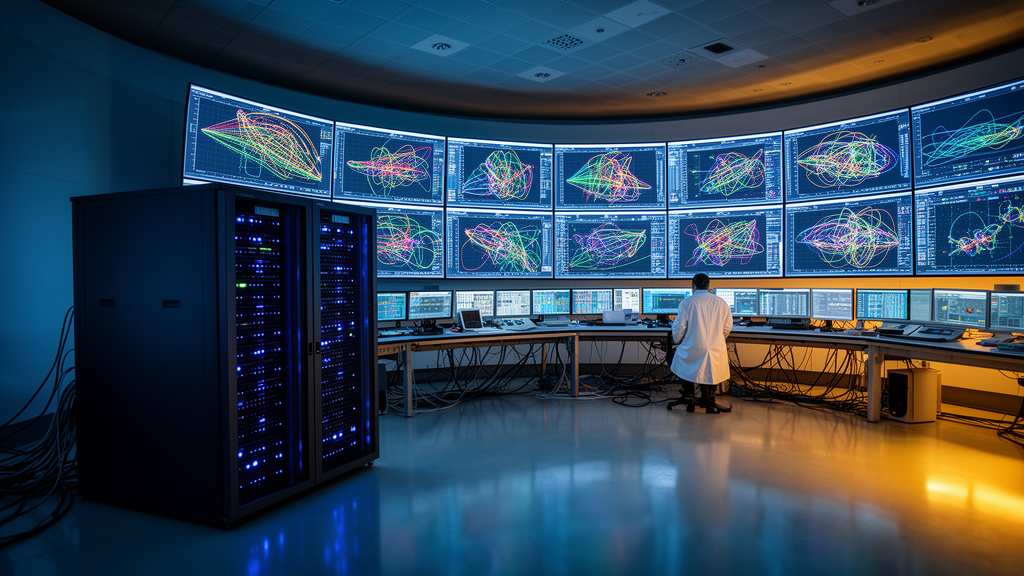
Particle accelerators are among the most sophisticated scientific instruments ever constructed, generating, guiding, and delivering beams of charged particles—electrons, protons, and ions—across energy scales spanning many orders of magnitude. These machines serve applications ranging from fundamental physics discoveries to cancer treatment, materials characterization, and industrial processing. For decades, their operation, optimization, and design have depended on deep expertise in beam physics, electromagnetic engineering, vacuum technology, and control systems, accumulated through incremental refinement. Now, artificial intelligence and machine learning are reshaping accelerator science, and a new editorial collection in EPJ Research Infrastructures, published on 7 July 2026, documents just how far this transformation has progressed—and where it is still struggling to keep up.
The collection, assembled by guest editors Adnan Ghribi, Carsten Welsch, and Thomas Shea, brings together contributions from across the accelerator community. Its scope extends beyond a simple survey of recent results: the papers articulate emerging priorities and fault lines likely to shape accelerator AI research and development in the coming years. The contributions range from foundational data and software infrastructures to systems approaching operational use, drawing on experience from both university-scale machines and large international facilities. What emerges is a field in transition, moving from exploratory proof-of-concept demonstrations toward the less visible but more demanding challenge of sustained deployment.
The pace of that transition varies sharply depending on the method in question. Surrogate models have already become practical tools, reducing the cost of parameter scans and beam dynamics studies by orders of magnitude. These models, trained on simulation data, can evaluate beam dynamics significantly faster than traditional physics codes, enabling rapid parameter exploration and real-time prediction across circular colliders, linear accelerators, compact ion sources, and plasma-based systems. However, advanced models intended for energy frontier colliders still require a significant amount of work before reaching maturity. By contrast, anomaly detection approaches are only beginning to enter operational contexts, often revealing tensions between detection performance and the lack of robust interpretability mechanisms. Algorithms designed to detect precursors of anomalies can identify incipient faults before they cause beam loss, but translating that capability into routine practice remains a work in progress.
Reinforcement learning sits at the other end of the maturity spectrum. It remains the most constrained of the AI approaches surveyed, largely limited to sandboxed studies where safety, latency, and control authority can be tightly bounded. The appeal is clear: reinforcement learning can optimize multi-dimensional parameter spaces that exceed what classical analytical methods can handle. But handing control authority to an algorithm in a facility where failure carries immediate operational consequences demands safeguards that current deployments have not yet fully resolved. Meanwhile, digital twins—systems coupling physics-based models with learned components—support real-time decision making, and software agents are making their way into control rooms, assisting operators through natural language interfaces that translate complex machine states into actionable recommendations.
The timing of the collection reflects challenges that many facilities are experiencing directly. Questions of reproducibility across facilities, data and model sharing under operational constraints, and long-term workforce capacity are no longer abstract concerns but practical obstacles that shape what can be deployed and maintained. Governance frameworks, the editors argue, must evolve from general principles to mechanisms that can support trustworthy and safe AI use in environments where a failure has immediate operational consequences. Crucially, these challenges cannot be addressed by individual facilities acting independently—not only for reasons of scale, but because methods, data representations, and operational constraints differ in ways that limit direct transfer between sites. Effective progress therefore depends on coordination across institutions, disciplines, and national boundaries, with explicit attention to where harmonization is possible and where it is not.
Two initiatives have emerged to structure this coordination. In Europe, the ARTIFACT network—ARTificial Intelligence For Accelerators, user Communities and associated Technologies—connects research infrastructures, institutes, and universities around shared technical and organizational questions. In the United States, MOAT, the Multi-Office particle Accelerator Team, plays a similar role. The editors also emphasize that sustained impact requires extending beyond particle accelerator physics itself, building durable links with adjacent communities, notably healthcare, life sciences, particle and nuclear physics, and core computer science AI research, where issues of interpretability and trustworthiness are being actively shaped. Societal applications form part of the collection itself, demonstrating how AI methods developed for accelerator physics can benefit life sciences, healthcare, and other applications that leverage accelerated particle beams.
The strategic context in Europe has shifted markedly. The 2026 update of the European Strategy for Particle Physics, formally adopted by the CERN Council on 22 May 2026, identifies the electron–positron Future Circular Collider (FCC-ee) as the preferred next flagship project at CERN and places AI explicitly among the enabling technologies required to realize it. The strategy calls on the European particle physics community to intensify its activities in AI and to develop a coordinated roadmap across CERN, national laboratories, institutes, and universities, taking into account synergies with international partners and other communities. In parallel, the European Commission launched RAISE—the Resource for AI Science in Europe—in November 2025, a distributed virtual institute supported by €107 million under Horizon Europe that pools computing infrastructure, data, and scientific talent across five domains, including physics and astronomy. Together, these developments signal that AI for accelerator science has moved from an exploratory effort to a recognized strategic priority, with dedicated institutional backing at both the intergovernmental and European Commission levels.
Beneath the strategic framing, the collection identifies concrete technical themes. Data and infrastructure contributions establish foundations for reproducible AI development, including FAIR data practices, metadata standards, and federated data access mechanisms that enable collaboration while respecting facility-specific constraints. Smart diagnostics and anomaly detection contributions address the challenge of extracting actionable information from high-dimensional sensor data, including beam position monitors, emittance measurements, and multi-modal diagnostic streams. Digital twins and operational AI papers present integrated systems supporting commissioning, optimization, and real-time decision support across diverse facility types, while control system integration contributions tackle the software engineering challenges of deploying AI models in operational environments, including abstraction layers, safety constraints, and interfaces between AI systems and existing control infrastructure.
Several cross-cutting observations stand out. Despite the diversity of accelerator types and institutional contexts, there is growing convergence around shared software frameworks, data formats, and methodological best practices—convergence the editors describe as essential for meaningful transfer learning and cross-facility collaboration. Physics-informed methods, which embed physical constraints, symmetries, and domain knowledge into hybrid models, can outperform purely data-driven approaches, improving sample efficiency and extrapolation. But the advantage is context-dependent: the gains are most pronounced when the underlying assumptions hold and the system dynamics are well-characterized. In operational or poorly instrumented settings, purely data-driven methods sometimes match or even exceed hybrid approaches in short-term predictive accuracy, illustrating that physics-informed strategies are powerful but not universally superior.
Perhaps the most sobering theme is what the editors call the deployment gap. Across several contributions, strong offline performance does not translate directly into operational use, because models encounter constraints largely absent from benchmark studies. In practice, inference latency, sensitivity to unmodeled machine drifts, and the need to interface with existing control and protection systems often dominate performance considerations. Bridging this gap requires sustained engineering effort extending beyond model design into validation, integration, and long-term maintainability under operational conditions. Compounding the problem is a workforce bottleneck: deploying AI effectively in accelerator environments demands individuals who can navigate the intersection of accelerator physics, machine learning, and complex software systems—a combination the editors describe as exceptionally rare, and unevenly distributed across facilities. Addressing it requires interdisciplinary curricula alongside mentorship, cross-facility collaboration, and knowledge transfer mechanisms that account for local constraints.
Looking ahead, the editors see domain-specific foundation models, trained on pooled operational data across multiple facilities via federated learning, as a potential route to knowledge transfer at an unprecedented scale—though only if differences in data formats, access policies, and operational constraints are adequately addressed. Rather than training fully dedicated models for each site, the community could share general-purpose accelerator models that can be fine-tuned locally; however, disparities in instrumentation, calibration procedures, and facility-specific safety requirements mean that fine-tuning will not be uniformly straightforward, and some adaptation or retraining may still be necessary. The integration of large language models into accelerator operations remains experimental, with their use as documentation interfaces, reasoning aids for fault diagnosis, and control-room assistants constrained by both system complexity and safety requirements. Early deployments have revealed that reliability, interpretability, and alignment with operational protocols vary widely between facilities, making verification, validation, incremental adoption, and explicit oversight mechanisms essential if these systems are to augment, rather than compromise, operational decision-making. As AI capabilities mature, the editors conclude, questions of data sovereignty and protection, model ownership, attribution, and regulatory compliance will become increasingly pressing as AI transitions from research tool to operational infrastructure.
Subject of Research: Artificial intelligence and machine learning methods for the operation, optimization, and design of particle accelerators
Article Title: Editorial: Artificial Intelligence for Particle Accelerators
Article References: Ghribi, A., Welsch, C., & Shea, T. (2026). Editorial: Artificial Intelligence for Particle Accelerators. EPJ Research Infrastructures, 10(1), Article 16. https://doi.org/10.1007/s41781-026-00170-x
Image Credits: AI Generated
DOI: 10.1007/s41781-026-00170-x
Keywords: particle accelerators, artificial intelligence, machine learning, surrogate models, anomaly detection, reinforcement learning, digital twins, EPJ Research Infrastructures, FCC-ee, European Strategy for Particle Physics, federated learning, large language models
News Source: Blake Davidson. (October 30, 2026). AI Moves to the Heart of Particle Accelerator Science. Scienmag.



