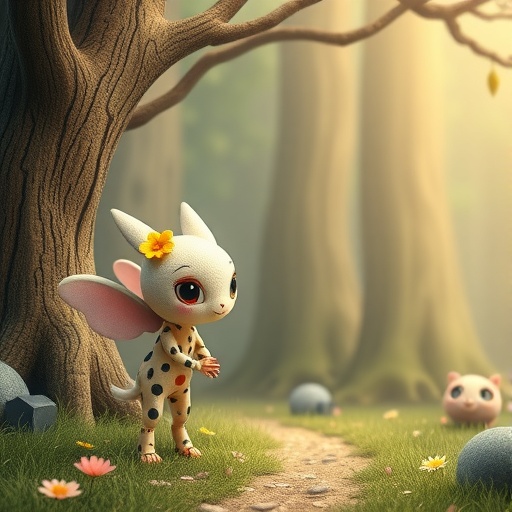
Artificial intelligence is giving children stories filled with talking animals, magical journeys and personalized illustrations—but a new University of Washington study suggests that these seemingly harmless tales may reveal a striking and unexpected gender bias. When six leading AI models were asked to complete short stories about animals, female characters appeared only 2% of the time. Male characters accounted for 41%, while the remaining 57% were presented as gender-neutral or without any explicit gender.
The findings, presented June 25 at the 2026 ACM Conference on Fairness, Accountability, and Transparency in Montréal, build on earlier research into how children’s literature portrays animals. Melanie Walsh, an assistant professor in the University of Washington’s Information School, previously worked with journalists from The Pudding to examine 300 popular children’s books. That analysis found that most frequently appearing animals were described as male, with a few exceptions: cats, ducks and birds tended to be represented as female slightly more often. Frogs and wolves, by contrast, had more than a 90% chance of being referred to as “he.”
The researchers then tested whether people reproduced similar assumptions when completing stories themselves. In one experiment, participants were given prompts such as, “And then the bear said, ‘I must go to the river.’ Upon arriving…” Human writers were more likely to assign masculine identities to every animal tested. That result prompted Walsh and her colleagues to ask whether language models trained on human-created text would reproduce the same pattern—or generate a different form of bias.
For the new study, researchers submitted variations of the same unfinished-story prompt to Claude Sonnet 4.5, Gemini 2.5, GPT-4o, GPT-5.1, Mistral Medium and Olmo 3. Together, the models produced 23,800 responses. The team tested seven animals—bears, birds, cats, dogs, mice, pigs and rabbits—in four settings: a farm, kitchen, river and store. They also varied each model’s temperature, a technical parameter that influences randomness. Higher temperatures generally make outputs more diverse, while lower temperatures encourage more predictable responses.
Neither temperature nor setting substantially changed the overall gender distribution. The animal itself, however, had a measurable effect. Cats were assigned female identities 7% of the time, the highest proportion recorded for any animal. Birds were neutral in 96% of responses. Across the dataset, the models frequently avoided gendered pronouns altogether, referring repeatedly to “the bird” or “the bear,” or used “it,” “its” and “itself” instead of “he” or “she.”
That apparent neutrality did not represent a balanced alternative. Female characters were nearly absent, and the researchers found that gender-neutral language was rarely expressed through singular “they” or “them.” According to lead author Imani Finkley, a UW doctoral student, those pronouns appeared only twice for a single animal character. In the earlier human study, approximately 3% of responses used “they/them.” The AI systems’ version of neutrality therefore removed not only masculine and feminine labels, but also most recognizable non-masculine identities.
The differences between models were substantial. Gemini and GPT-5.1 showed the strongest masculine bias, assigning male identities in 63% and 65% of responses, respectively. Claude generated the largest share of female characters, although females still appeared in only 4% of its stories. Olmo 3, an open-source model developed by the Allen Institute for Artificial Intelligence and UW-affiliated researchers, produced the fewest masculine characters, at 12%, and the highest proportion of neutral characters, at 85%.
The study illustrates a technical problem in how modern language models handle ambiguity. Large language models predict likely sequences of words from patterns learned during training. When a prompt does not specify an animal’s gender, a model may draw on common associations in its training data, select a stereotypical pronoun or avoid making a choice altogether. The UW team believes that developers may have encouraged models to use neutral language as a safety strategy designed to reduce social bias. Yet the result can be another kind of distortion: instead of representing genders more evenly, the systems may erase female characters while preserving masculine defaults whenever they do assign a gender.
The researchers also noticed recurring storytelling patterns, including wise old owls gathering animals around fires and other familiar narrative tropes. These repeated structures suggest that the issue extends beyond pronouns. AI-generated children’s stories may reflect biases in character roles, authority, age, personality and relationships, even when the stories appear imaginative and playful. The current research examined only English-language outputs and focused on seven animals, so the team plans to investigate other languages and broader forms of social representation. As AI storybook tools become increasingly accessible to parents, teachers and children, the findings offer a warning: personalization may change a story’s surface details, but it does not guarantee that the underlying patterns are fair, diverse or free from inherited human assumptions.
Subject of Research: Gender representation and bias in AI-generated animal stories
Article Title: Neutrality Bites: Gender Representation in AI-Generated Animal Stories
Web References: https://dl.acm.org/doi/10.1145/3805689.381228; https://ischool.uw.edu/people/faculty/profile/melwalsh; https://pudding.cool/2025/07/kids-books/; https://ischool.uw.edu/people/phd/profile/ifinkley; https://allenai.org/blog/olmo3
References: DOI: 10.1145/3805689.381228
Image Credits: University of Washington
Keywords
Artificial intelligence, generative AI, AI bias, gender bias, language models, children’s stories, machine learning, natural language processing, algorithmic fairness, University of Washington
Tags: analysis of male and female animal charactersbiases in AI-generated storytellingeffects of artificial intelligence on children’s perceptionsfairness and accountability in AI story generationgender bias in children’s AI-generated storiesgender disparities in AI-created contentgender stereotypes in AI story completiongender-neutral vs. gender-specific animal charactersimpact of AI models on children’s literatureinfluence of AI on gender portrayal in children’s mediainfluence of AI on gender roles in children’s narrativesrepresentation of female characters in animal stories