


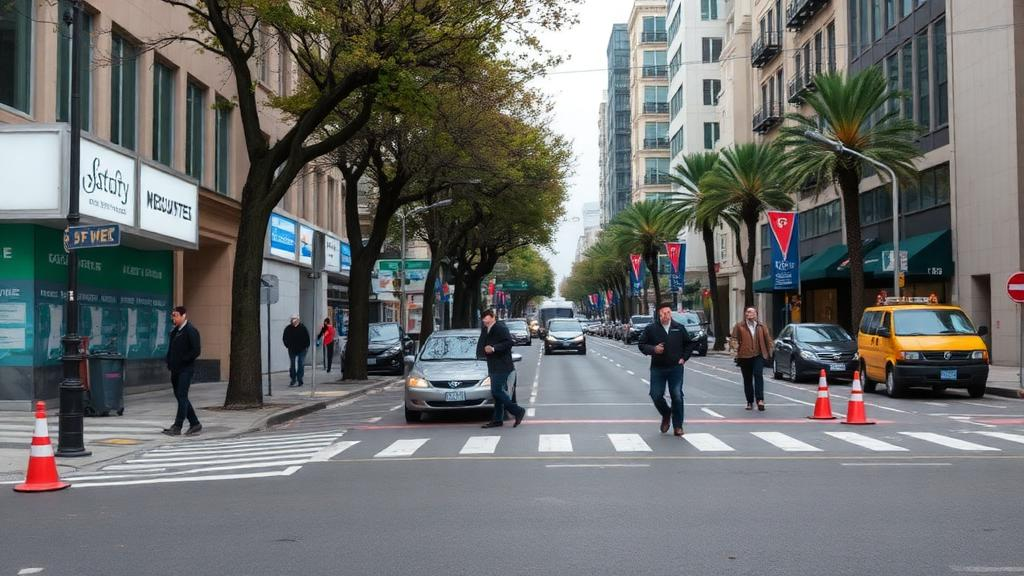
Multimodal large language models can assess how safe a city street looks from a photograph alone, but their judgements shift dramatically depending on the demographic persona the model is asked to adopt, according to a peer-reviewed study published in EPJ Data Science on 3 September 2026.
Researchers Ciro Beneduce, Bruno Lepri and Massimiliano Luca investigated whether these models, which process both images and text, could evaluate perceived urban safety from street-view imagery while accounting for the fact that perception differs between observers. Conventional surveys capture such perceptions well but are costly and difficult to scale, making automated approaches attractive for inclusive urban planning.
The team used Place Pulse 2.0, a dataset of street-view images, to evaluate four open and proprietary multimodal models across 56 cities. Each model was tested under a Neutral prompt and under socio-demographic personas defined by gender, age, and race or ethnicity. The researchers also analysed the keywords the models generated to justify each classification.
All four models showed comparable zero-shot capability, with city-macro F1 scores of 65 to 69 percent, and preserved meaningful variation between cities. Yet the models shared systematic biases: they favoured the Safe class, underpredicted unsafety, and compressed the differences between cities, muting the very variation that makes perceived safety data useful for planners.
The explanations the models offered converged on a shared visual lexicon. Maintenance, greenery, order and residential character supported Safe judgements, whereas deterioration, isolation, poor lighting and limited pedestrian activity supported Unsafe judgements. This suggests the models rely on interpretable visual cues rather than opaque patterns, even though their overall calibration is skewed toward safety.
Persona prompting produced substantial and structured shifts while the image itself was held fixed. Female personas yielded more Unsafe classifications than Male personas across all four models. Age effects depended on the model, although Middle-aged personas generally remained closest to the Neutral baseline.
Race or ethnicity personas showed some of the largest effects. Black/African American and Native American personas frequently produced the biggest departures from Neutral classifications, while the persona closest to the Neutral response varied from model to model. The authors conclude that these models can provide scalable signals of perceived urban safety, but not from a demographically neutral standpoint.
The study is an evaluation of model behaviour on an existing dataset, not a demonstration that these systems can replace human surveys. The published version is an early-release, peer-reviewed accepted article that remains subject to further edits before the final Version of Record. The findings nonetheless carry a clear implication for anyone deploying such models in planning or policy contexts: the demographic framing embedded in a prompt is not a neutral default, and outputs attributed to an imagined observer may encode priors about gender, age and race that differ systematically from a baseline judgement of the same street.
Subject of Research: How multimodal large language models assess perceived urban safety from street-view imagery and how demographic personas alter their judgements
Article Title: Multimodal large language models predict urban safety perception but encode non-neutral demographic priors
Article References: Beneduce, C., Lepri, B., & Luca, M. (2026). Multimodal large language models predict urban safety perception but encode non-neutral demographic priors. EPJ Data Science. https://doi.org/10.1140/epjds/s13688-026-00695-6
Image Credits: AI Generated
DOI: 10.1140/epjds/s13688-026-00695-6
Keywords: multimodal large language models, urban safety perception, street-view imagery, Place Pulse 2.0, persona prompting, algorithmic bias, urban planning, EPJ Data Science, zero-shot classification, demographic priors, Multimodal, large
News Source: Blake Davidson. (October 29, 2026). AI models judge urban safety from street photos, but personas skew the verdict. Scienmag.



