Researchers at the University of Southern California have developed an artificial intelligence framework that predicts the presence and severity of obstructive sleep apnea using just 10-minute segments of recorded physiological data. Published in the journal Nature Communications, the study demonstrates that the computational approach, termed Long-Range Interdependencies Aware analysis or LRIA, can make diagnostic evaluation significantly faster and more efficient by identifying subtle patterns across physiological channels that standard models frequently miss. Led by investigators in the USC Ming Hsieh Department of Electrical and Computer Engineering, including senior author Paul Bogdan, the work engaged an international collaboration of engineers, clinicians, and sleep researchers seeking to improve upon existing analytical techniques.
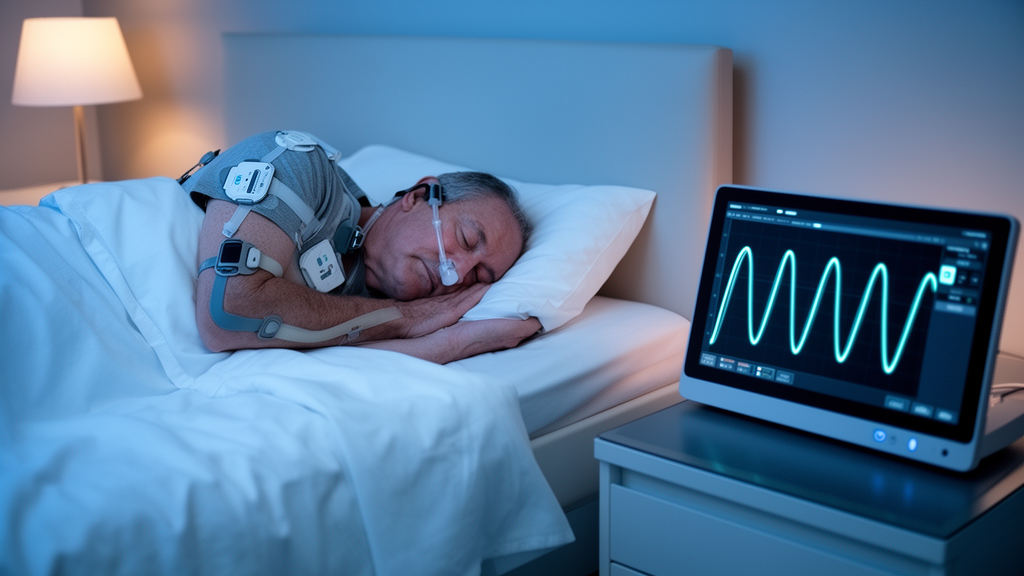
Obstructive sleep apnea is a common chronic condition characterized by recurrent episodes where breathing becomes restricted or stops entirely during sleep. These intermittent breathing cessations lower blood oxygen concentrations and are linked to an increased risk of severe health issues, including cardiovascular diseases and metabolic disorders. Presently, the established diagnostic standard relies on overnight polysomnography, an in-depth clinical sleep study conducted in specialized facilities to record respiratory effort, blood oxygenation, cardiac activity, and additional biometric channels. Although polysomnography yields detailed diagnostic insights, the overnight testing process remains labor-intensive, expensive, and logistically burdensome for patients and healthcare systems alike.
While many conventional machine learning and deep-learning tools inspect localized segments or isolated snapshots in time within sleep recordings, the USC-led team engineered LRIA to capture long-range temporal dependencies. The framework is specifically structured to uncover subtle, extended interactions that unfold across multiple organ systems over broader observation windows. To achieve this, the architecture utilizes fractional dynamic modeling to convert raw physiological time-series data into compact coupling matrices. These mathematical representations quantify the continuous, mutual interactions between distinct signals, including airflow, blood oxygen levels, heart rate, and respiratory effort. The extracted coupling features are subsequently supplied to a deep-learning classification pipeline designed to categorize sleep apnea severity into four clinical tiers: normal, mild, moderate, or severe.
A critical observation from the team’s mathematical analysis was that these physiological coupling representations stabilized within approximately 10 minutes of recorded data. This mathematical stabilization indicates that brief observation windows capture sufficient physiological signatures to reliably reflect the underlying pathology of sleep-disordered breathing. In comparison with prior computational approaches, the LRIA framework operated with condensed representations of the source recordings rather than requiring extensive, full-night data streams. When evaluated against established deep-learning architectures and recently introduced sleep-analysis models, the new framework consistently achieved superior diagnostic precision, outperforming state-of-the-art comparison models by 8% to 18% across the test configurations.
To rigorously assess diagnostic performance and generalizability, the research team validated the framework across five distinct human cohorts comprising more than 35,000 individuals. These cohorts represented diverse demographic profiles, clinical environments, and signal recording protocols, ensuring that the model was tested against varied real-world data collection conditions. The evaluation included data from the Sleep Heart Health Study, the Multi-Ethnic Study of Atherosclerosis, the Osteoporotic Fractures in Men Sleep Study, a clinical dataset from Massachusetts General Hospital, and an additional cohort from western Romania. Across all evaluated cohorts, the framework demonstrated consistent accuracy, yielding area-under-the-receiver-operating-characteristic (AUROC) scores that systematically exceeded 0.91 for binary sleep apnea detection. Specifically, LRIA attained an AUROC of 0.947 in the Sleep Heart Health Study, 0.942 in the Multi-Ethnic Study of Atherosclerosis, 0.920 in the Osteoporotic Fractures in Men cohort, and 0.918 in the Massachusetts General Hospital dataset.
Looking toward future clinical integration, the researchers propose that the LRIA methodology could serve as the analytical foundation for automated clinical screening systems and diagnostic decision-support tools. Because the framework processes physiological measurements that are already routinely gathered during both formal laboratory polysomnography and ambulatory home sleep assessments, the mathematical architecture could eventually be implemented within less cumbersome diagnostic hardware. By extracting dependable diagnostic information from shorter segments of physiological data, such computational tools could streamline clinical workflows, facilitate wider population screening, and support more individualized assessments for individuals suffering from sleep-disordered breathing. To encourage broader research collaboration and reproducibility, the study team has made the underlying research code publicly accessible.
Despite these promising results, the study authors emphasize clear boundaries regarding the clinical application and interpretation of their findings. The technology is not designed to replace clinical judgment or supersede conventional diagnostic evaluations. Because the investigation relied exclusively on retrospective analyses of previously gathered sleep databases, subsequent prospective clinical trials are necessary to verify how the framework performs in active patient care environments. Furthermore, the researchers did not carry out sex-stratified analyses, as the primary aim of the investigation was to establish and benchmark the core mathematical methodology rather than explore differential disease mechanisms between demographic subgroups. Nevertheless, the findings illustrate the practical value of uniting fractional dynamic modeling with deep learning to reveal physiological interdependencies that elude traditional signal processing techniques.
Subject of Research: Artificial intelligence framework for rapid obstructive sleep apnea detection and severity prediction
Article Title: USC researchers develop ai framework to rapidly predict sleep apnea severity
Article References: USC researchers develop ai framework to rapidly predict sleep apnea severity. Original publication (Bibliographic details unavailable.)
Image Credits: AI Generated
DOI: Not provided
Keywords: obstructive sleep apnea, artificial intelligence, fractional dynamic modeling, physiological signal analysis, polysomnography, Nature Communications, Paul Bogdan, University of Southern California, deep learning, coupling matrices, Sleep Heart Health Study, Multi-Ethnic Study of Atherosclerosis, Osteoporotic Fractures in Men Sleep Study, Massachusetts General Hospital, sleep apnea screening, AUROC performance, respiratory signals, cardiovascular dynamics
News Source: Blake Davidson. (November 24, 2026). AI Model Rapidly Predicts Sleep Apnea Severity Using Brief Physiological Recordings. Scienmag.