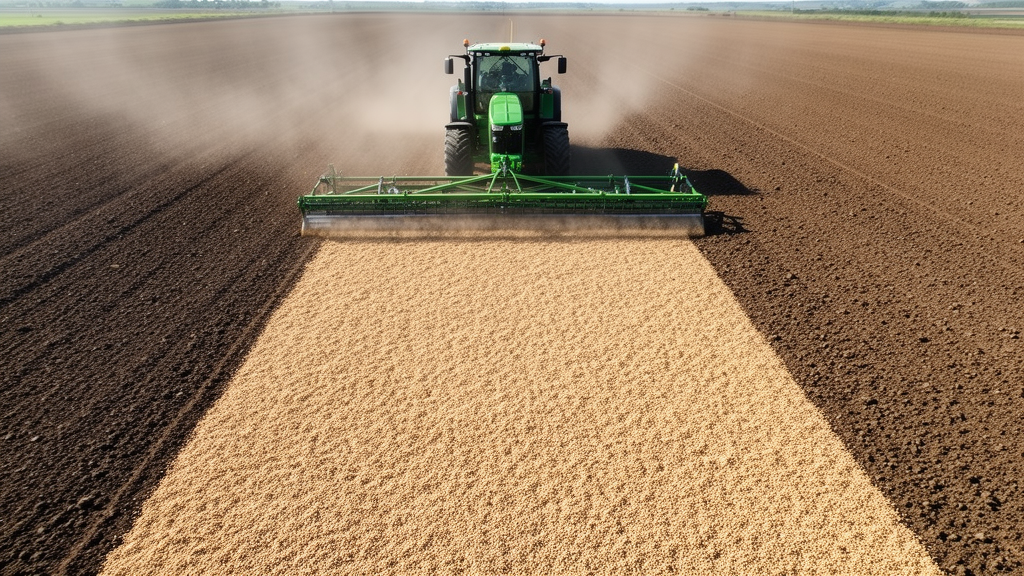
Researchers at the University of Regina and collaborators have developed a computer vision framework that estimates the width of fertilizer distribution directly from video sequences, eliminating the need for physical collection trays or post-application ground analysis. Published in Smart Agricultural Technology, the study introduces a hybrid architecture combining a ResNet-18 convolutional neural network with a Transformer encoder to process temporal image data. This approach allows for the rapid assessment of spreading performance during operation, addressing a significant gap in precision agriculture where real-time monitoring of nutrient application has been hindered by the labor-intensive nature of traditional calibration methods.
The central challenge addressed by the study is the difficulty of measuring swath width in real time. Swath width determines the overlap between adjacent passes of a fertilizer spreader and directly influences the spatial uniformity of application. Uneven distribution can reduce nutrient-use efficiency, increase production costs, and contribute to environmental degradation through runoff and leaching. Existing methods, such as tray-based collection specified in ISO 5690 and ASAE S341.2 standards, provide accurate ground-truth measurements but are offline, time-consuming, and material-consuming. Physics-based simulations using the Discrete Element Method (DEM) offer detailed insights into particle dynamics but are computationally expensive and generally unsuitable for direct real-time field implementation.
To overcome the lack of large-scale, labeled datasets of actual fertilizer spreading images, the team adopted a simulation-to-real (Sim2Real) strategy. They generated synthetic video sequences using a physics-informed particle-motion model programmed in Python. This simplified model simulated the projective motion of fertilizer particles subject to gravity and aerodynamic drag, avoiding the high computational cost of full DEM simulations while maintaining the core mechanics of spreading. The synthetic data spanned a wide range of operating conditions, including variations in disk diameter, disk speed, disk height, wind speed, and wind direction, creating a diverse training set for the machine learning model.
The proposed framework processes sequential image data to predict swath width. The model architecture uses a ResNet-18 backbone to extract spatial features from individual video frames, producing a 512-dimensional feature vector for each frame. These features are then concatenated to form a temporal sequence, which is processed by a Transformer encoder with two layers and eight attention heads. This design allows the model to capture both the spatial characteristics of the fertilizer distribution within individual frames and the temporal evolution of particle dispersion across the sequence. The final output is a single continuous value representing the predicted swath width in meters.
The training dataset comprised 297 simulation scenarios, split into 162 baseline operating conditions and 135 scenarios with varying wind conditions. The model was trained using the Adam optimizer with a mean squared error loss function over 30 epochs. The researchers evaluated the model’s performance through a multi-stage validation process, starting with held-out synthetic test data, followed by comparison with independent EDEM simulations, and finally laboratory experiments using both synthetic and real camera-captured images. This hierarchical approach was designed to assess prediction accuracy, model robustness, and the capability for simulation-to-real transfer.
On the held-out synthetic test dataset, the wide-field-of-view (FOV) model achieved a mean absolute error (MAE) of 0.529 meters and a coefficient of determination (R²) of 0.996. The wide-FOV configuration, which captured the full distribution pattern from disk to ground, outperformed the narrow-FOV configuration, which suffered from incomplete visibility of particle trajectories at high disk speeds. The results indicated that complete spatial coverage is critical for accurate prediction, as the model relies on observing the full extent of the spreading pattern to learn the relationship between distribution dynamics and final swath width.
Validation against independent EDEM simulations provided evidence of the model’s generalizability beyond the simplified physics-informed training environment. EDEM simulations, which explicitly model particle-particle and particle-equipment interactions, yielded an MAE of 0.535 meters and an R² of 0.954. Although prediction accuracy was slightly lower than on the synthetic dataset, the strong agreement suggested that the model learned meaningful physical relationships governing fertilizer spreading rather than overfitting to the specific assumptions of the training data. The slight underestimation of swath width in EDEM comparisons was attributed to the simplified treatment of particle motion on the disk in the training model, which did not fully account for interactions that can increase ejection velocity.
Laboratory experiments were conducted using a Scotts Elite Spreader to evaluate the framework under controlled conditions. The spreader had a disk diameter of 0.15 meters and operated at three different disk speeds. Swath width was measured using a collector-bin system consisting of 13 containers arranged perpendicular to the travel path. The model was tested on both synthetic images generated from the laboratory conditions and real image sequences captured by a ZED 2 stereo camera mounted above the spreader. For the real-image validation, the model achieved an MAE of 0.11 meters and a mean absolute percentage error (MAPE) of 7.26% compared to the collector-bin measurements.
The successful transfer from synthetic training data to real image sequences demonstrated the effectiveness of the Sim2Real strategy. A pre-processing pipeline, including lens undistortion, gamma correction, and orthorectification, was applied to real images to reduce geometric and photometric differences with the synthetic training data. This processing effectively suppressed background interference and enhanced fertilizer particle visibility, allowing the model to maintain predictive performance without additional fine-tuning on labeled real-world data. The ability to estimate swath width directly from image sequences without physical collectors or particle tracking highlights the potential for integrating such systems into intelligent fertilizer application platforms.
Computational efficiency was assessed to determine the feasibility of real-time deployment. The complete processing time for one 25-frame image sequence was 1.318 seconds, corresponding to a full-pipeline frame rate of 18.96 frames per second on an NVIDIA GeForce RTX 3050 GPU. The majority of the inference time was associated with CNN feature extraction rather than Transformer processing. While this speed supports rapid estimation, the authors note that further optimization is required for closed-loop control systems, potentially through hardware acceleration or model compression.
The study acknowledges several limitations. Laboratory validation was conducted using a small-scale spreader and a limited number of experimental conditions, whereas the training data was generated for commercial-sized centrifugal spreaders. Validation using commercial-scale spreaders operating under field conditions is necessary before practical deployment. Real-world field environments introduce additional complexities, such as soil texture, vegetation variability, shadows, dust, and changing light conditions, which may reduce particle-background contrast and introduce segmentation errors. The current framework predicts swath width only and does not estimate the complete distribution profile or agronomically relevant metrics like the coefficient of variation.
Despite these limitations, the study establishes a scalable foundation for vision-based monitoring of fertilizer spreading. The ability to estimate swath width in real time provides actionable information to support the reduction of spread-pattern overlap and over-application, potentially improving fertilizer-use efficiency. Future research should focus on field-scale validation under diverse environmental conditions, extending the framework to estimate distribution uniformity, and optimizing computational latency for embedded hardware. This work demonstrates that machine learning models trained on synthetic data can effectively generalize to real-world agricultural applications, offering a practical alternative to traditional, labor-intensive calibration methods.
The physics-informed simulation used to generate training data modeled a spreader with two counter-rotating disks, each equipped with four evenly spaced blades. Fertilizer particles were released from the blade tips at a frequency of 250 Hz, with initial velocities calculated as the vector sum of tangential blade velocity and the spreader’s forward speed. During flight, particles were subjected to gravitational and aerodynamic drag forces, with a spherical drag coefficient of 0.45 and air density of 1.255 kg/m³. Because particle-particle and particle-blade collisions were not explicitly modeled in this simplified Python-based simulation, a calibration factor of 1.2 was applied to improve agreement between the simulated swath widths and those generated by the more complex EDEM simulations. This approach allowed for the efficient generation of controlled training data spanning a wide range of operating conditions without the high computational costs associated with full discrete element modeling.
Camera field of view emerged as a critical factor in prediction accuracy. The wide-FOV configuration, which captured a 60 by 60 meter observational area, provided complete visibility of particle trajectories and landing positions. In contrast, the narrow-FOV configuration, covering a 23 by 23 meter area, resulted in incomplete visibility of the final distribution pattern under high disk speeds, where portions of the particle trajectories extended beyond the camera view. This lack of complete spatial coverage led to increasing prediction errors at larger swath widths in the narrow-FOV model. The wide-FOV model achieved a lower mean absolute error of 0.529 meters and a maximum absolute error of 1.51 meters compared to the narrow-FOV model’s 0.67 meters and 2.28 meters, respectively. These findings suggest that ensuring full visibility of the spreading pattern is essential for reliable real-time estimation.
The pre-processing pipeline applied to real camera-captured images was designed to bridge the gap between synthetic training data and real-world imagery. This pipeline included lens undistortion using specific intrinsic matrices and distortion coefficients, gamma correction, and contrast-limited adaptive histogram equalization. Additional steps involved top-hat morphology with an elliptical kernel, adaptive Gaussian thresholding, and homography-based orthorectification to project the ground plane. These processes effectively suppressed background interference, such as spreader wheels and collection cups, while enhancing fertilizer particle visibility. The robustness of this pipeline was demonstrated even when background complexity increased, such as when a person’s leg and shoe were included in the frame. This visual consistency between processed real images and synthetic training images was crucial for the model’s ability to maintain predictive performance without requiring additional fine-tuning on labeled real-world datasets.
Subject of Research: Rapid swath-width estimation using a hybrid CNN-Transformer architecture for precision fertilizer application
Article Title: Rapid swath-width estimation using a hybrid CNN-Transformer architecture for precision fertilizer application
Article References: Lak, A., Stilling, D. S. D., Mehrandezh, M., & Mohammadi, A. (2026). Rapid swath-width estimation using a hybrid CNN-Transformer architecture for precision fertilizer application. Smart Agricultural Technology, 15, Article 102695. https://doi.org/10.1016/j.atech.2026.102695
Image Credits: AI Generated
DOI: 10.1016/j.atech.2026.102695
Keywords: Rapid, swath-width, estimation, hybrid, CNN-Transformer, architecture, precision, fertilizer, application, scientific research
News Source: Alan Morgan. (November 8, 2026). AI Model Predicts Fertilizer Spread Width from Video. Scienmag.