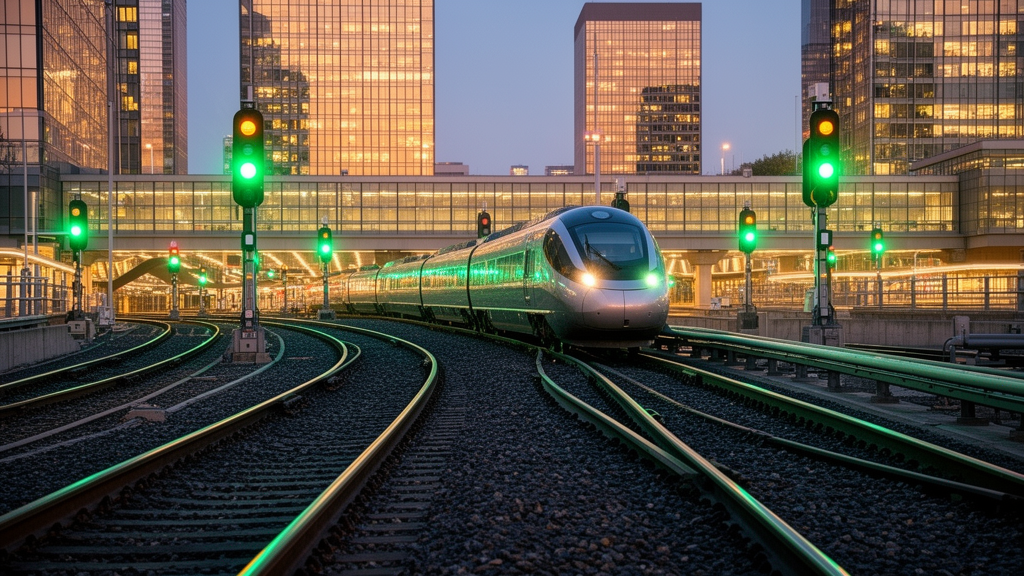
Researchers have developed a new signal control model designed to address inefficiencies in high-density rail transit systems, where complex interactions between intelligent signaling and train operations can compromise both safety and operational stability. The study, published in Discover Applied Sciences, introduces an advanced framework based on a Markov Decision Process (MDP) enhanced with reinforcement learning to optimize rail operations. This approach aims to provide a robust solution to the challenges of modern rail traffic management by allowing the system to continuously learn and adapt to dynamic conditions.
The core of the model is a mathematical characterization of the rail environment, which defines a state space comprising track signals and train queues, an action space for control decisions, and a reward function focused on reducing delays. By utilizing a Deep Q-Network (DQN) algorithm with prioritized experience replay, the intelligent control system is enabled to continuously learn and adjust signal strategies. This adaptive nature ensures that the model can maintain optimal performance under varying traffic conditions, marking a substantial advancement in the field of intelligent transportation systems.
Experimental results demonstrate that the proposed model offers significant improvements over conventional approaches, such as stepwise prediction and multi-agent reinforcement learning (MARL). The study reports an 18–22% reduction in passenger wait times and 12–15% shorter journey durations when using the MDP-based model. These metrics indicate that the integration of reinforcement learning into signal control can effectively streamline operations, thereby enhancing the overall efficiency of high-density rail networks without compromising safety standards.
In addition to improving passenger experience, the model achieves notable gains in resource efficiency and system performance. The researchers observed an 8–10% lower fuel consumption, suggesting that optimized signaling can contribute to more sustainable rail operations. Furthermore, the model achieved 25–30% higher system rewards, a metric that reflects the overall effectiveness of the control strategy in managing the complex dynamics of the rail environment. These findings confirm the model’s effectiveness in managing high-density rail operations while maintaining established safety protocols.
The study highlights the potential of combining Markov Decision Processes with deep reinforcement learning to tackle the specific challenges of high-density rail transit. By focusing on delay reduction through a well-defined reward function, the model provides a targeted approach to improving operational stability.
While the results are promising, the study is presented as an early access version, meaning it is subject to further edits before the final Version of Record is published. The research contributes to the growing body of literature on intelligent transportation systems by offering a specific, mathematically grounded solution to signal control.
Subject of Research: Optimization of rail transit signaling using Markov Decision Processes and reinforcement learning
Article Title: A Markov decision process model for coupled intelligent signaling and train operation systems in high density rail transit
Article References: Xing, M., Ge, X., & Ge, R. (2026). A Markov decision process model for coupled intelligent signaling and train operation systems in high density rail transit. Discover Applied Sciences. https://doi.org/10.1007/s42452-026-09752-1
Image Credits: AI Generated
DOI: 10.1007/s42452-026-09752-1
Keywords: rail transit, signal control, reinforcement learning, Markov Decision Process, Deep Q-Network, intelligent transportation, operational efficiency, high-density rail, Markov, decision, process, model
News Source: Denise Maddox. (November 10, 2026). AI Model Optimizes High-Density Rail Transit Signals. Scienmag.