


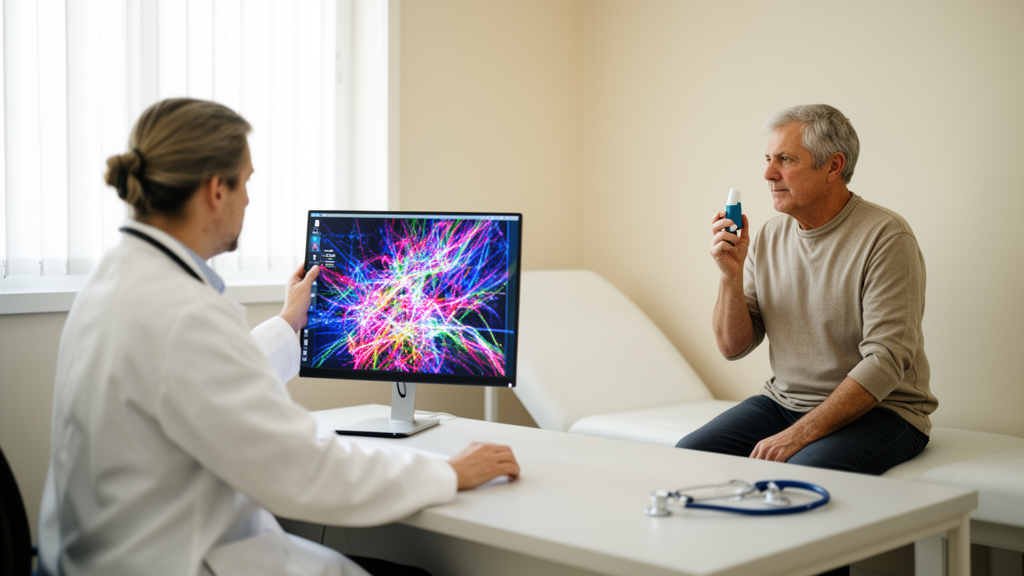
Severe asthma patients often wait months for a biologic drug to prove itself, only to discover the therapy was never going to work for them. A research team spanning the United Arab Emirates, Saudi Arabia, Poland, and Canada has now built an artificial intelligence system designed to predict, before treatment begins, which patients are likely to respond and which are not. The retrospective study, published in Frontiers in Digital Health, analyzed anonymized data from 801 patients with severe asthma and used a Random Forest machine learning model to forecast clinical improvement under biologic therapy.
The researchers, led by Bassam Mahboub of Dubai Health and Sameer Alawnah of the American University of Sharjah, structured their work around four tasks. First, they trained a baseline model on the complete patient profile, including demographics, lung function, medication history, and comorbidities. Second, they applied Recursive Feature Elimination to strip away variables with little predictive power. Third, they retrained the model on the reduced feature set. Finally, they used counterfactual simulation to test how each patient’s predicted outcome would change if a different biologic agent had been chosen.
The baseline model, trained on all available features, achieved an overall accuracy of 78.57 percent on an independent test set of 56 patients. Its sensitivity was high at 90.91 percent, meaning it rarely missed patients who did improve. But its specificity was only 33.33 percent, indicating it frequently misclassified non-responders as likely responders. The model’s positive predictive value stood at 83.33 percent, while the negative predictive value was just 50.00 percent. The area under the receiver operating characteristic curve reached 0.83.
Feature selection changed that picture. Recursive Feature Elimination, using Gini impurity-based importance from the Random Forest, retained 14 top-ranked variables. The most influential predictors of treatment response were the Asthma Control Test score, blood eosinophil count, and type 2 inflammatory comorbidities, particularly nasal polyposis and sinusitis. Spirometry results, exacerbation counts, oral corticosteroid usage, age, and body mass index also ranked as important. Comorbidities such as obstructive sleep apnea, gastroesophageal reflux disease, cancer, urticaria, and thyroid disorders were not significant predictors, and neither was gender.
Retraining the model on the selected features raised overall accuracy to 82.14 percent and, more importantly, doubled specificity from 33.33 percent to 66.67 percent. Sensitivity remained strong at 86.36 percent. The F1-score for the Not Improved class rose from 40.00 percent to 61.54 percent, and the average recall, reflecting both sensitivity and specificity, climbed from 62.12 percent to 76.52 percent. The area under the curve dipped slightly from 0.83 to 0.82. The authors note that with only 12 non-improved cases in the test set, specificity and negative predictive value estimates are sensitive to sampling variability and should be interpreted cautiously.
The clinical significance of improved specificity lies in avoiding wasted treatment. Biologic therapies for severe asthma, including omalizumab, mepolizumab, benralizumab, dupilumab, and tezepelumab, typically require a four-to-six-month empirical trial before their effectiveness can be judged. Identifying likely non-responders before initiation could spare patients months of uncontrolled symptoms and unnecessary drug exposure. The study’s data came from the International Severe Asthma Registry, and the outcome definition required patients to meet at least two of three criteria: a clinically meaningful rise in Asthma Control Test score of at least three points, a 50 percent or greater decrease in yearly exacerbation rate, or a notable reduction in annual oral corticosteroid use.
The fourth task pushed the model beyond simple prediction into treatment recommendation. For each patient in the test group, the researchers systematically replaced the assigned biologic with every other available agent while holding all other clinical and demographic characteristics constant. The model then estimated the probability of clinical improvement under each hypothetical scenario. In one illustrative case, a patient who had started on omalizumab was classified as Not Improved by both the treating clinician and the model. The counterfactual simulation suggested a 62 percent probability of improvement had the patient instead received benralizumab, an anti-IL5 receptor agent.
The authors are explicit that these counterfactual results are predictive rather than causal. Because biologic selection in routine practice is driven by clinician judgment using biomarkers, disease severity, and prior treatment history, treatment assignment in the observational data was not random. The counterfactual predictions may therefore be influenced by confounding by indication, meaning the original biologic choice already reflects clinical reasoning based on similar information. Without prospective switching trials or long-term follow-up, the alternative outcomes cannot be conclusively verified. The simulations should be treated as hypothesis-generating decision-support outputs rather than definitive estimates of treatment effect.
Several further limitations temper the findings. The analysis is retrospective and relies on routinely collected registry data with variable completeness and possible unmeasured confounders. Although the cohort is multinational, it was assembled from a finite number of contributing centers, so demographic and geographic representation may not fully reflect the broader severe-asthma population, and some selection bias is possible. The class imbalance, with 625 patients classified as Improved and 176 as Not Improved, and the composite definition of overall improvement may influence performance estimates. No formal country- or site-stratified performance analyses were conducted, no confidence intervals were reported, and no paired statistical comparisons between the baseline and optimized models were performed. Final performance was evaluated on a single independent train/test split rather than repeated resampling.
The study nonetheless offers a proof of concept for moving severe asthma management away from trial-and-error biologic selection toward a data-driven, precision-medicine approach. The authors plan future work on prospective and external validation in fully independent cohorts, integration into electronic health record systems for real-time decision support, and pragmatic biologic switching trials informed by model recommendations. Until such validation is complete, the model’s counterfactual recommendations remain theoretical projections rather than established clinical guidance, but they illustrate how machine learning trained on real-world multinational data could help clinicians identify non-responder phenotypes earlier and reduce prolonged exposure to ineffective therapies.
Subject of Research: Artificial intelligence decision support for predicting biologic treatment response in severe asthma
Article Title: Utilizing AI for decision support in severe asthma biological treatment
Article References: Mahboub, B., Alawnah, S., Dhou, S., Kuna, P., Bergeron, C., Al-Lehebi, R., Alnahadi, N., Alhousani, N., Sagahyroon, A., Alzabi, A., & Salameh, L. (2026). Utilizing AI for decision support in severe asthma biological treatment. Frontiers in Digital Health, 8, 1939100. https://doi.org/10.3389/fdgth.2026.1939100
Image Credits: AI Generated
DOI: 10.3389/fdgth.2026.1939100
Keywords: severe asthma, biologic therapy, artificial intelligence, Random Forest, treatment response, precision medicine, eosinophils, nasal polyposis, counterfactual simulation, decision support system, omalizumab, benralizumab
News Source: Blake Davidson. (October 30, 2026). AI model flags which severe asthma patients will not benefit from biologics. Scienmag.



