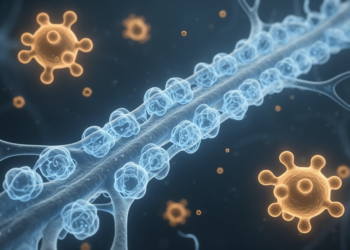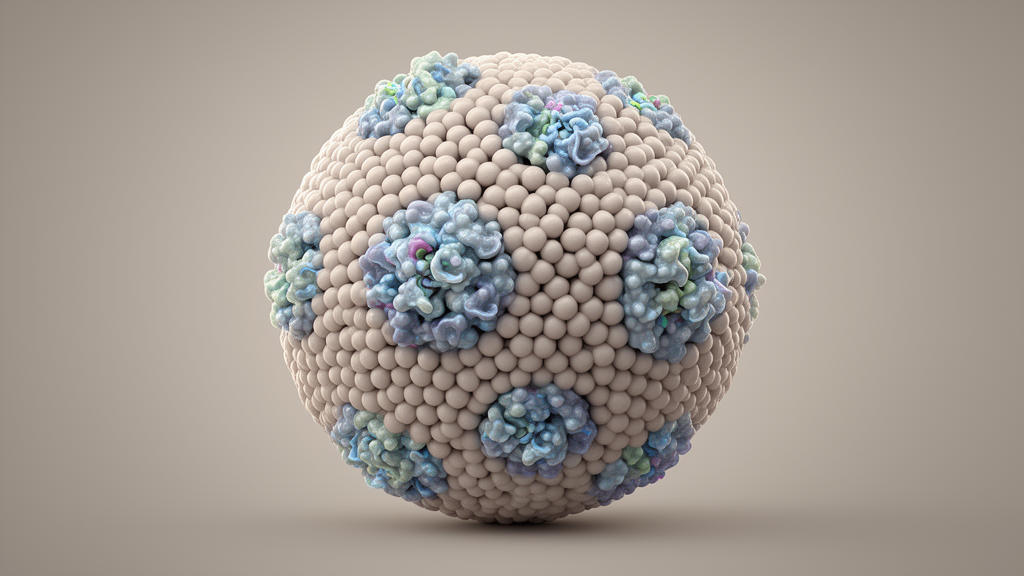
Researchers at the Institute of Biophysics of the Chinese Academy of Sciences have developed an artificial-intelligence-assisted computational method named isSPA-vesicle to advance the three-dimensional structural determination of proteins embedded within lipid membranes. Led by Professor ZHANG Xinzheng, the research group detailed their experimental framework in a study published in the Proceedings of the National Academy of Sciences. The technique was designed to reconstruct membrane protein structures preserved in lipid vesicles, providing high-resolution structural insights under conditions that closely reflect physiological bilayers.
Vesicles serve as critical experimental models because they provide membrane curvature and maintain the capacity to establish ion gradients across bilayers, effectively mimicking native physiological conditions. Despite recent progress in preparing native membrane samples, achieving high-resolution structural determination of vesicle-embedded targets has remained difficult. Conventional structural biology pipelines, specifically single-particle analysis (SPA) and subtomogram averaging (STA), have frequently faced severe bottlenecks due to limited operational efficiency and restricted reconstruction resolution.
To overcome these structural analysis limitations, the research team focused on the geometric properties of vesicles suspended in solution. Because solvated vesicles frequently display anisotropic shapes that approximate spheres or ellipsoids, the scientists trained an artificial intelligence model to calculate ellipsoidal surface fits. From these fitted surfaces, the machine-learning model estimates fundamental membrane geometric parameters and calculates precise local normal vectors across the vesicle membrane surfaces.
This acquired geometric information serves as the basis for a post hoc filtering stage integrated into the isSPA framework. Rather than retaining all detected signals indiscriminately, the method evaluates individual particle orientations against the calculated local membrane normal vectors. Candidate particles are selected based on the angular differences between their structural orientations and the corresponding local membrane vectors. Concurrently, free background particles that are not physically embedded in or associated with the vesicles are systematically identified and excluded from downstream analysis.
The experimental results demonstrated that isSPA-vesicle accurately determines particle positions and spatial orientations, even in complex scenarios where membrane densities overlap in imaging projections. When compared directly with conventional single-particle analysis workflows that rely on Topaz or traditional template matching (TM) for automated particle picking, the AI-guided workflow identified a substantially higher number of valid particles.
The researchers verified the versatility of isSPA-vesicle across a wide spectrum of biological targets, reconstructing membrane proteins ranging in size from 130 kilodaltons (kDa) to 2 megadaltons (MDa). Their experimental scope encompassed specimens derived from two distinct classes of enveloped viruses as well as three separate types of synthetic liposomes. Among the evaluated targets, the team determined the detailed atomic structures of two representative viral glycoproteins: influenza A virus hemagglutinin, resolved to a high resolution of 2.7 Å, and the prefusion spike protein of human coronavirus OC43, resolved to 3.1 Å.
Beyond viral membrane assemblies, the researchers tested the technique against an AcrB validation dataset to benchmark reconstruction quality against existing processing strategies. On the AcrB dataset, isSPA-vesicle achieved a reconstruction resolution of 3.1 Å, surpassing the structural resolutions obtained by the other three evaluated methods. In comparison to the original isSPA computational framework, this vesicle-focused adaptation efficiently removes membrane-unbound particles from particle pools and substantially lowers the minimum molecular weight threshold of proteins that can be reliably resolved.
Together, these experimental outcomes highlight the capabilities of isSPA-vesicle as a streamlined, efficient tool for solving the high-resolution structures of membrane proteins directly within physiological lipid bilayers. By resolving geometric orientation ambiguities and eliminating unassociated particle noise, the method facilitates structural characterization across both enveloped viral pathogens and synthetic proteoliposome systems.
Subject of Research: AI-assisted high-resolution structure determination of membrane proteins in vesicles
Article Title: IsSPA-vesicle: an AI-assisted method advances high-resolution structure determination of membrane proteins in vesicles
Article References: IsSPA-vesicle: an AI-assisted method advances high-resolution structure determination of membrane proteins in vesicles. Original publication (Bibliographic details unavailable.)
Image Credits: AI Generated
DOI: Not provided
Keywords: isSPA-vesicle, membrane proteins, single-particle analysis, vesicles, lipid bilayers, subtomogram averaging, influenza A virus hemagglutinin, human coronavirus OC43, prefusion spike protein, AcrB, proteoliposomes, synthetic liposomes, particle picking, membrane curvature, Institute of Biophysics, Chinese Academy of Sciences, enveloped viruses
News Source: Denise Maddox. (November 23, 2026). AI Method Resolves High-Resolution Membrane Protein Structures in Lipid Vesicles. Scienmag.