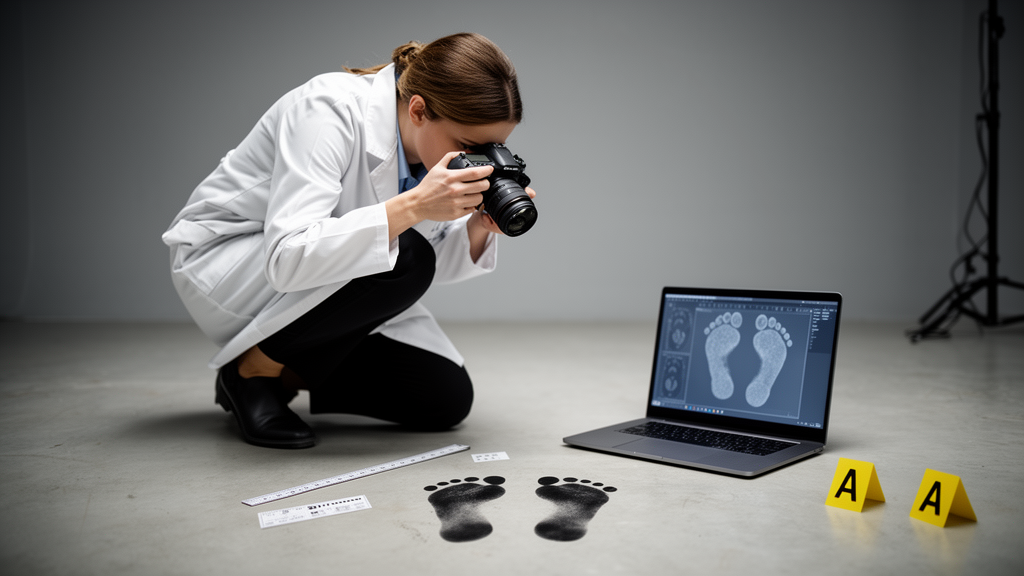
Barefoot footprints have quietly served criminal investigations for more than a century, offering investigators a biological trace that can survive at crime scenes even when shoes, gloves, and other concealments are used. But extracting identification value from a footprint has always depended on trained examiners who painstakingly measure contours, toe positions, arch shapes, and heel outlines. Now a research team in China has built a deep learning system that automates this delicate visual task, teaching an artificial intelligence to recognize the fine-grained anatomical regions of a bare footprint with a precision that outpaces a series of mainstream object detection algorithms.
The new framework, called CDCNet, was developed by Yujie Shen and colleagues at the People’s Public Security University of China, the Institute of Forensic Science of China, and Shanxi University. Writing in Frontiers in Bioengineering and Biotechnology, the team reports that their model reaches a mean Average Precision of 83.2 percent on a purpose-built dataset of high-resolution ink footprints, an improvement of 5.2 percentage points over the YOLOv10m baseline it is built upon. The work is framed not as a replacement for forensic examiners but as a step toward intelligent, automated forensic identification.
The difficulty of footprint analysis lies in its scale. A single footprint image contains structures that vary enormously in size and morphological subtlety: a big toe may be long or short relative to its neighbors, an arch may be high, narrow, or flat, and a heel may be round, oval, or rectangular. These distinctions carry biometric significance, yet they are subtle enough that generic object detectors often blur or misclassify them. Traditional approaches relied on manually designed features such as contour extraction and geometric ratios, which could capture local shape but missed the structural relationships linking toes, arch, and heel within the whole footprint.
Deep learning promised to change that, but early convolutional networks faced their own limits. Standard convolutions aggregate information within a regular receptive field, which is poorly suited to the elongated and curved boundaries that define footprint regions. Multi-scale features—those captured at different resolutions of the image—also tend to be fused clumsily, so fine details like toe edges can be washed out while the network processes the broader geometry of the foot. The Chinese team’s answer was to redesign the detection pipeline in three complementary directions: context, orientation, and semantics.
The first pillar is a context-guided spatial feature reconstruction pyramid network, or CGSFRPN. At its core sits a pyramid context extraction module that gathers feature maps from three processing depths of the network—corresponding to one-eighth, one-sixteenth, and one-thirty-second of the input resolution—and pools them down to a shared scale, producing a unified multi-scale summary of the footprint. This pooled pyramid then passes through stacked rectangular self-calibration modules, which use horizontal and vertical pooling to build rectangular attention regions, calibrate them with large strip-shaped convolution kernels, and re-weight the original features. The effect is a network that understands not just what it sees locally but how each patch relates to the footprint’s overall axis and layout.
The second pillar tackles direction. Toe boundaries, arch contours, and heel outlines are elongated or curved along specific orientations, and a conventional square convolution kernel responds weakly to such directional structure. The team’s Direction-Aware Pinwheel Convolution, DAPConv, deploys four branches of asymmetric 1-by-3 and 3-by-1 kernels with carefully chosen asymmetric padding, so that each branch specializes in one spatial direction. The four directional outputs are concatenated and compressed with a small convolution, feeding orientation-sensitive boundary information directly into the backbone of the detector. This allows CDCNet to distinguish regions that look globally similar but differ in the curvature or tilt of their edges—exactly the kind of variation that separates a flat arch from a narrow one.
The third pillar, called ConvFormer, replaces several standard feature extraction blocks in the YOLOv10 architecture with a design rooted in the MetaFormer concept. ConvFormer combines depthwise separable convolutions, which process spatial and channel information efficiently, with a channel-wise multilayer perceptron and a custom StarReLU activation. The result is efficient local-to-global semantic modeling: fine structures in the forefoot retain their detail, while broader contextual relationships across the midfoot and rearfoot are reinforced. Ablation experiments showed each pillar contributes, and that the fully assembled model improves both strict and lenient detection metrics while actually lowering computational cost from 58.9 to 54.6 gigafloating-point operations per second relative to the baseline.
The experiments rested on a carefully constructed dataset of 2,587 high-resolution ink-print footprints collected from 573 individuals. Ink was applied to the plantar surface with a sponge applicator and impressions were made on absorbent Xuan paper on a hard, flat indoor surface; blurred or incomplete samples were excluded or recollected, and the paper impressions were digitized with a high-resolution scanner. Experienced annotators labeled eight fine-grained categories: thumb-toe length and second-toe length in the forefoot, high, narrow, and flat arch in the midfoot, and round, oval, and rectangular heel in the rearfoot. Crucially, the data were split into training, validation, and test sets at the subject level, so no individual’s footprints appeared in more than one subset—a safeguard against identity leakage that makes the reported generalization more credible.
Head-to-head comparisons under identical training conditions put CDCNet ahead of Faster R-CNN, YOLOv8, YOLOv10, YOLOv12, RT-DETR, and Mamba-YOLO. The classic two-stage Faster R-CNN managed only 48.13 percent mean Average Precision, while the strongest rivals, YOLOv12 and Mamba-YOLO, reached 80.4 and 81.2 percent respectively. Visual inspections highlighted the difference: competing detectors missed long thumbs and oval heels, mislabeled narrow arches as flat, and produced overlapping, unstable boxes when the confidence threshold was lowered to 0.3. CDCNet, by contrast, kept its detections clean and correctly placed at both thresholds, with no missed regions or category confusion in the reported examples.
The authors acknowledge that their results come from a proprietary dataset, and future work will aim to strengthen generalization across acquisition scenarios, deploy the model on edge devices in complex field conditions, and broaden applications in related domains. Even so, the study marks a notable convergence of computer vision and forensic trace examination: a system that treats a footprint not as a single image to classify, but as an anatomical composition of interacting regions. If such tools mature, the humble footprint—dusty, partial, or inked on paper—could become an even sharper instrument for narrowing investigations and identifying suspects.
Subject of Research: Deep learning-based fine-grained barefoot footprint region recognition for forensic identification
Article Title: Contextual and structural representation learning for fine-grained barefoot footprint region recognition
Article References: Shen, Y., Xie, W., Zhao, Y., Jiang, X., & Wang, J. (2026). Contextual and structural representation learning for fine-grained barefoot footprint region recognition. Frontiers in Bioengineering and Biotechnology, 14, Article 1912110. https://doi.org/10.3389/fbioe.2026.1912110
Image Credits: AI Generated
DOI: 10.3389/fbioe.2026.1912110
Keywords: barefoot footprint recognition, forensic science, CDCNet, YOLOv10, object detection, computer vision, CGSFRPN, DAPConv, ConvFormer, biometrics, multi-scale feature fusion, deep learning
News Source: Blake Davidson. (October 16, 2026). AI Learns to Read Barefoot Footprints Like a Forensic Scientist. Scienmag.