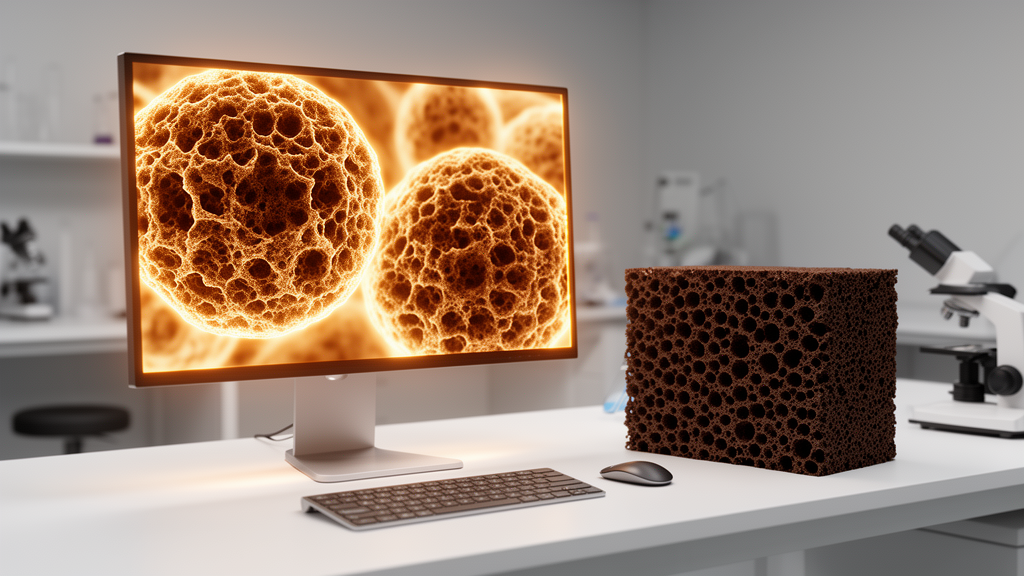
Engineers have built a machine learning framework that can look at a microscope image of a lignin-based polyurethane foam and predict its mechanical properties to within 2.3 percent on average, then run the calculation in reverse to specify the exact lignin-based formulation needed to hit a target set of properties. The work, published in Advanced Modeling and Simulation in Engineering Sciences, tackles a problem that has long frustrated materials designers: the inverse problem, where many different material combinations can produce the same desired outcome, making the search for the right recipe ill-posed and non-unique.
The team, led by Chady Ghnatios with collaborators including Ilige Hage, Jose Enrico Q. Quinsaat, Daniel J. van de Pas, Richard Vendamme, Walter Eevers, Karolien Vanbroekhoven and Elias Feghali, focused on rigid polyurethane foams containing lignin-derived polyols. Polyurethane foam is prized for thermal insulation, acoustic damping and lightweight structural performance, but traditional formulations rely on polyols and polyisocyanates from non-renewable feedstocks. Replacing petrochemical polyols with bio-based alternatives is a growing priority, and lignin, an aromatic biopolymer that makes up as much as 35 percent of lignocellulosic biomass and ranks second only to cellulose in natural abundance, has emerged as a promising candidate. Its phenolic and aliphatic hydroxyl groups react readily with polyisocyanates, and its rigid aromatic backbone imparts stiffness, UV stability and intrinsic flame retardancy.
Previous work by Quinsaat and colleagues demonstrated that lignin hydrogenolysis oil, a depolymerized lignin produced through a lignin-first approach, can substitute up to 50 percent of petrochemical polyols while improving foam stiffness and compressive strength. That material can be produced at pilot scale using a biorefinery concept, which matters because the experimental development of lignin-based foams is slow and resource-intensive. In the pilot-scale process referenced in the new study, reductive catalytic fractionation in a 50-liter reactor generated only around 250 grams of the precious lignin oil, making every formulation decision expensive and raising the stakes for accurate computational design.
The experimental dataset behind the new framework consists of 15 unique foam formulations synthesized with polymeric methylene diphenyl diisocyanate, sorbitol-based and sucrose-based polyols, and five lignin-based polyol components: Kraft lignin Indulin AT, lignin hydrogenolysis oil and its ether-soluble and ether-insoluble fractions, and dihydroconiferyl alcohol, a lignin-related model monomer. The isocyanate index was held at 1.3 across all experiments. Varying the lignin-based polyol content between 0 and 50 percent by weight of the total polyol component produced a dataset spanning 107 foam manufacturing experiments, with mechanical testing under compression according to ASTM D1621-10 and scanning electron microscopy at magnifications of 40x and 100x in both compressed and uncompressed states.
Because the dataset is small, the researchers leaned heavily on data augmentation. Each high-resolution 40x image was cut into quarters and expanded with a sliding window into nine images, then further multiplied by mirroring and 180-degree flips, ultimately multiplying the image count by 36 to reach 3,852 images. Only the 40x images were augmented, since cutting 100x images could compromise individual foam cells. Augmented images were not simply assigned the properties of their parent sample; instead, each was attributed a property sampled from the normal distribution identified from the manual sampling and testing of the foams, with normality checked using quantile-quantile plots. Images were undersampled to 120 by 160 by 3 pixels, normalized to remove lighting effects, and processed as RGB rather than grayscale, since grayscale training was systematically outperformed.
The core algorithmic innovation is the Rank Reduction Autoencoder, or RRAE, which combines a neural network autoencoder with kernel principal component analysis, a non-linear model order reduction technique. Conventional autoencoders compress data into a low-dimensional bottleneck whose size must be chosen in advance. The RRAE instead maps data into a much larger latent space, where correlations become linear in line with Koopman theory, and then applies a truncated singular value decomposition in the bottleneck. The truncation rank k is discovered adaptively during training by keeping singular values above a threshold relative to the largest, so the intrinsic dimensionality of the data is learned rather than specified. The variational counterpart, the VRRAE, adds a random layer and Kullback-Leibler divergence regularization to capture variability when deterministic inputs produce dispersed outputs.
The full architecture arranges these components in a Directed Acyclic Graph that enforces causality between material composition, latent microstructural features and mechanical properties. Four surrogate networks connect the pieces: one maps latent features to material inputs, one maps inputs to the latent space, one maps latent features to mechanical properties, and one maps desired properties back to the latent space for inverse design. Training ran on a CPU, an Apple ARM M4 Pro chip with 128 gigabytes of memory, taking about 12 hours for the autoencoders and roughly two hours for the surrogates, with inference completed in seconds. For image reconstruction, the RRAE achieved an average absolute pixel error of 0.06 on the training set and 0.062 on the test set, with average digital image correlation distances of 4.46 and 4.63 pixels respectively, and the comparable train and test values indicated the model avoided overfitting despite the limited data.
Performance on the prediction and inception tasks was the headline result. Predictions of mechanical properties from foam images landed within 2.3 percent on average of actual values on both training and testing sets, and the inception of the compounds used to fabricate the foams reached an accuracy of 0.893 on the training set and 0.891 on the test set. Predicting mechanical properties directly from the composition inputs, without any imaging, performed less well, though the authors note this route has the practical advantage of not requiring the foam to be manufactured and sliced for microscopy. Classification of compounds from measured mechanical properties was also less accurate than from images, with certain lignin-derived compounds misclassified because their foams share similar properties. Generating images from mechanical properties proved possible but produced blurry, less informative pictures, a failure the authors attribute to their augmentation strategy creating images from the same foam with large correlation differences.
Ablation analyses underscored why the architecture matters. Linear PCA applied to flattened images failed to reconstruct the foams, stagnating even after 200 modes with a mean relative error of about 19 percent. Ablated networks with the same encoder and decoder structure but no SVD bottleneck, or with a dense-layer bottleneck of the same size, performed markedly worse on test data, with average correlation distances rising to 8.23 and 11.95 pixels respectively. A conventional convolutional variational autoencoder reached correlation distances above 11 pixels, and a dense network attempting the inverse problem without access to the image-derived reduced basis classified all test foams into a single category, demonstrating that the latent structure learned from images is what carries the inverse-design capability.
The authors frame the framework as a one-shot solution to inverse problems in material processing, in which desired properties lead directly to a designed microstructural content without iterative manufacturing or genetic optimization loops. They also caution about limitations: the framework may struggle to extract an optimal reduced projection basis when measurement uncertainty and material variability are exceptionally high within restricted datasets, and future work will explore stochastic reduced bases using the Nonparametric Probabilistic Method to bolster robustness against experimental noise. As datasets grow to include a wider variety of compounds, the team expects the stochastic capabilities to extend into the inception phase, potentially accelerating the rational design of bio-based polyurethane foams that balance mechanical performance with sustainability goals.
Subject of Research: A hybrid machine learning and model order reduction framework for predicting and inversely designing lignin-based polyurethane rigid foams from microstructure imaging.
Article Title: Foam property prediction and inception via a hybrid machine learning and model order reduction framework
Article References: Ghnatios, C., Hage, I., Quinsaat, J. E. Q., van de Pas, D. J., Vendamme, R., Eevers, W., Vanbroekhoven, K., & Feghali, E. (2026). Foam property prediction and inception via a hybrid machine learning and model order reduction framework. Advanced Modeling and Simulation in Engineering Sciences, 13(1), Article 18. https://doi.org/10.1186/s40323-026-00338-5
Image Credits: AI Generated
DOI: 10.1186/s40323-026-00338-5
Keywords: polyurethane foam, lignin, machine learning, model order reduction, kernel PCA, autoencoder, inverse problem, microstructure imaging, mechanical properties, bio-based materials, variational autoencoder, materials design
News Source: Denise Maddox. (October 28, 2026). AI Learns to Design Lignin Foams From Pictures and Predicts Their Strength. Scienmag.