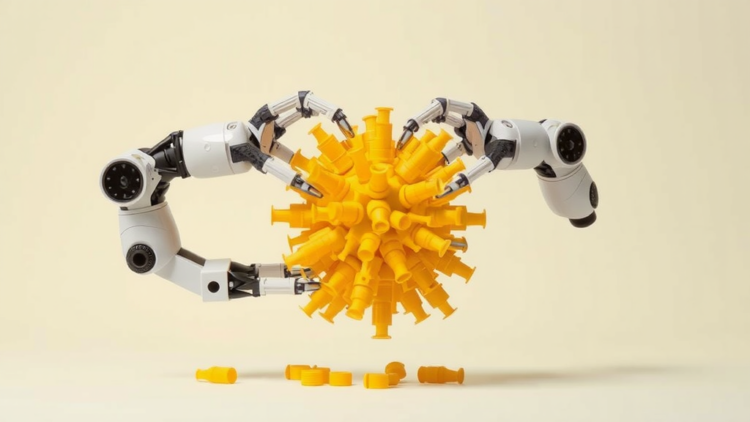
One of the most stubborn problems in industrial robotics is deceptively simple to describe: slide a peg into a hole. When the peg is a single rigid cylinder and the tolerances are generous, a well-tuned machine can manage it. But when a robot must simultaneously insert multiple pegs into multiple holes — a task known as multi-peg-in-hole assembly — the physics becomes brutally unforgiving. Every contact point couples with every other, tiny angular errors compound across the part, and the robot must essentially feel its way through a maze of jamming and wedging forces. A new systematic review published in Artificial Intelligence Review by Wei Zhang, Qingni Yuan, Pengju Qu, Wei Jia and Yan Zhang of Guizhou University takes the most comprehensive look yet at how artificial intelligence is being applied to this challenge, and its findings reveal both remarkable progress and a striking gap between what the field publishes and what it can actually demonstrate.
The review, published open access on 13 September 2026, focuses specifically on dual-arm robotic multi-peg-in-hole assembly, abbreviated DA-MPiH. This is the variant of the problem where two robot arms must cooperate to manipulate a part — often a large, flexible, or awkwardly shaped component — and align it with multiple mating features at once. The authors frame the task as fundamentally contact-rich: it involves multi-point contact coupling, bimanual closed-chain constraints, error propagation, and sensing uncertainty. In plain terms, when two arms grip a single workpiece, they form a kinematically closed loop in which the forces each arm applies are not independent. If one arm drifts by a fraction of a millimeter, the other must absorb the resulting internal stress, or the entire assembly will bind. This is precisely the regime where classical position control fails and where intelligence — in perception, reasoning, and control — must take over.
To build their evidence base, the team conducted a genuinely systematic search. They queried four major databases — the Web of Science Core Collection, Scopus, IEEE Xplore and arXiv — for literature published between 2008 and July 2026, supplementing the search with backward citation tracking. After deduplication and screening following the PRISMA protocol, the standard methodology for systematic reviews in medicine and now increasingly in engineering, 191 studies made the final cut. Each study was coded by robot configuration, peg-hole scale, validation setting, and relevance to the dual-arm multi-peg task. That coding scheme matters, because it allowed the authors to ask a question that most narrative reviews in robotics never answer rigorously: how many of these papers actually test their methods on the full dual-arm, multi-peg problem, rather than on a simplified proxy?
The answer is the review’s most sobering finding. While learning-based perception and control demonstrably improve a robot’s adaptation under uncertain contact conditions, the overwhelming majority of the 191 studies address single-arm or single-peg tasks. Direct experimental evidence that integrates dual-arm coordination with multi-peg constraints remains limited. This is not merely an academic quibble. Techniques that work brilliantly for a single rigid peg — reinforcement learning policies trained in simulation, force-guided search strategies, learned contact-state estimators — do not automatically transfer when a second arm enters the picture and the part acquires multiple simultaneous contact interfaces. The closed-chain constraint between the two arms introduces internal forces that have no counterpart in single-arm assembly, and the review argues that these internal forces are systematically under-addressed in the current literature.
The review organizes the AI-enabled toolbox into several interlocking layers. The first is system composition: what sensors, actuators and computational architectures dual-arm assembly cells actually deploy. The second is cooperative and contact-state modeling, the mathematical machinery for reasoning about which surfaces of the peg are touching which surfaces of the hole at any instant. Contact-state reasoning is the intellectual heart of the problem, because a robot that knows its contact state can predict whether pushing harder will advance the assembly or jam it irreversibly. The third layer covers target recognition and search — the pre-contact strategies by which the robot localizes holes with cameras and plans exploratory trajectories, often combining deep-learning vision models with spiral or force-guided search patterns to compensate for residual localization error.
The fourth layer, compliant control, is where the review draws its sharpest technical distinctions. Passive compliance relies on mechanical elasticity, such as remote center of compliance devices, that physically absorb alignment errors without any computation. Active compliance uses force and torque feedback to modulate the robot’s motion in real time, letting it respond to contact forces within milliseconds. Learning-based compliance, the newest and fastest-growing category, uses reinforcement learning, imitation learning and related techniques to acquire insertion strategies that would be prohibitively difficult to hand-engineer. The authors find that learning-based approaches genuinely improve adaptation under uncertainty — a policy trained with domain randomization can tolerate part tolerances and fixture variations that would defeat a fixed controller — but they also caution that these gains come with costs that the field rarely reports honestly.
That reporting problem is the review’s second major critique. Performance metrics and training costs are documented so inconsistently across studies that strict cross-study comparison is effectively impossible. One paper may report success rates on a specific peg-hole clearance ratio with a specific sensor suite; another may report only qualitative demonstrations. Training a reinforcement learning policy can require millions of simulated episodes or thousands of physical trials, yet few papers quantify the computational budget, the sim-to-real gap, or the failure modes encountered during transfer. Without standardized reporting, a laboratory manager hoping to deploy dual-arm assembly on a production line has no rigorous way to judge which published method would survive contact with their own parts, tolerances and cycle-time requirements. The review explicitly calls for standardized DA-MPiH benchmarks to fix this.
The authors also identify challenges in sensor fusion, interpretability and safe learning that cut across the entire field. Multimodal sensing — combining vision, force-torque data, tactile arrays and joint encoders — promises the richest contact-state estimates, but fusing these streams reliably under the noise and latency of real hardware remains unsolved. Interpretability matters because an assembly policy that fails unpredictably on a factory floor is worse than a weaker but transparent controller. And safe skill transfer — moving a policy learned in simulation, or on one robot, onto another without dangerous force spikes — is a prerequisite for any industrial adoption, since a two-meter robot arm applying uncontrolled forces to a machined aluminum housing can destroy thousands of dollars of parts in a fraction of a second.
Looking forward, the review lays out a research agenda with four priorities: multimodal contact estimation, internal-force-aware compliant control, safe skill transfer, and standardized benchmarks. The internal-force priority deserves particular emphasis, because it is the feature that most cleanly separates dual-arm assembly from everything that came before it. A controller that treats the two arms as independent single-arm agents will generate fighting forces through the workpiece; a controller that explicitly models and regulates the internal stress within the closed chain can exploit bimanual manipulation for what it is actually good at — handling large, heavy or compliant parts that no single arm could manage. Whether reinforcement learning architectures can internalize this constraint, or whether it must be built in through constrained optimization and hybrid force-position control, is one of the field’s most interesting open questions.
The significance of this work extends well beyond robotics conferences. Multi-peg-in-hole assembly stands in for an entire class of contact-rich manipulation tasks — connector mating in electronics, fastener insertion in aerospace, joinery in construction — that still resist automation and still consume enormous amounts of skilled human labor. The Guizhou University team’s systematic accounting of 191 studies makes clear that the AI community has built powerful components: vision systems that localize holes, policies that wiggle pegs home, controllers that yield gracefully to unexpected contact. What it has not yet built, in most cases, is the integrated, dual-arm, multi-peg system that industry actually needs, validated on real hardware with reproducible metrics. The review’s message to the field is essentially a challenge: stop publishing single-peg proxies, start reporting training costs, and build the benchmarks that will let the next generation of bimanual assembly robots be compared, improved and, ultimately, deployed.
Subject of Research: Artificial intelligence methods for dual-arm robotic multi-peg-in-hole assembly
Article Title: Artificial intelligence for dual-arm robotic multi-peg-in-hole assembly: a review
Article References: Zhang, W., Yuan, Q., Qu, P., Jia, W., & Zhang, Y. (2026). Artificial intelligence for dual-arm robotic multi-peg-in-hole assembly: a review. Artificial Intelligence Review. https://doi.org/10.1007/s10462-026-11705-4
Image Credits: AI Generated
DOI: 10.1007/s10462-026-11705-4
Keywords: dual-arm robotics, multi-peg-in-hole assembly, artificial intelligence, reinforcement learning, compliant control, contact-state modeling, bimanual manipulation, robotic assembly, systematic review, sensor fusion, sim-to-real transfer, industrial automation
Cite Scienmag News
APA MLA Chicago
Denise Maddox. (September 25, 2026). AI Is Teaching Two-Armed Robots the Delicate Art of Multi-Peg Assembly. Scienmag. https://scienmag.com/ai-is-teaching-two-armed-robots-the-delicate-art-of-multi-peg-assembly/
Denise Maddox. “AI Is Teaching Two-Armed Robots the Delicate Art of Multi-Peg Assembly.” Scienmag, 25 September 2026, https://scienmag.com/ai-is-teaching-two-armed-robots-the-delicate-art-of-multi-peg-assembly/. Accessed 25 September 2026.
Denise Maddox. “AI Is Teaching Two-Armed Robots the Delicate Art of Multi-Peg Assembly.” Scienmag. September 25, 2026. https://scienmag.com/ai-is-teaching-two-armed-robots-the-delicate-art-of-multi-peg-assembly/
Copy citation Download RIS
Tags: advancements in multi-robot coordinationAI applications in manufacturingAI-driven robotic manipulationArtificial Intelligenceartificial intelligence in industrial roboticsbimanual manipulationcompliant controlcontact-state modelingdual-arm robot cooperationdual-arm roboticshandling flexible and complex parts with robotsindustrial automationmachine learning for robotic assemblymulti-contact force management in robotsmulti-peg-in-hole assemblymulti-peg-in-hole robotic assemblyprecision peg insertion challengesreinforcement learningrobotic assemblyrobotic assembly error mitigationsensor fusionsim-to-real transfersystematic reviewsystematic review of AI in robotics