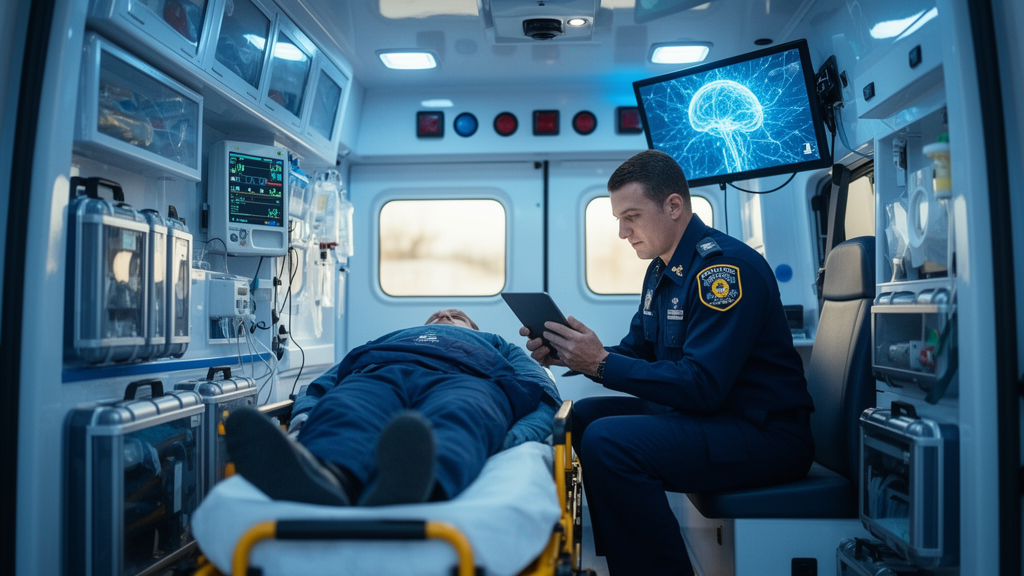
Artificial intelligence could reshape emergency medical services, from the first seconds of an emergency call to the handover of a patient at the hospital door, but almost none of it has moved beyond pilot projects and local solutions yet. That is the central message of a narrative review published on 4 May 2026 in BMC Artificial Intelligence, in which Carl Machado and Sebastian Hessel map where AI is already being tested in prehospital care, what measurable results have been reported, and what stands in the way of routine deployment. The review is written for paramedics and clinicians and evaluates AI applications against the three quality dimensions of Donabedian’s model: structural, process and outcome quality.
The authors chose a narrative rather than systematic review design because the field is marked by substantial methodological diversity, varying technological maturity and strong interconnections between technical, medical, organisational and legal dimensions. Their literature search covered PubMed, MEDLINE, Scopus and Web of Science, supplemented by Google Scholar for grey literature, with a geographical emphasis on the German emergency medical service system. Applications were organised according to a four-phase operational model: emergency call interrogation, dispatch and resource allocation, operational-tactical applications, and clinical applications. Hypothetical scenarios and illustrative case studies were developed to demonstrate operational pathways, and the authors are explicit that these scenarios are illustrative constructs without empirical validation.
The most striking reported numbers concern cardiac arrest recognition. In scenarios of out-of-hospital cardiac arrest, where irreversible organ damage may occur within minutes, rapid identification is lifesaving. Using AI-based speech recognition and machine learning, hints of cardiac arrest can be detected in emergency calls much faster than previously possible. Bloomberg and colleagues demonstrated that the AI4EMS technology could identify cardiac arrest within 44 seconds. In a subsequent study with more than 110,000 calls, 43 percent more cardiac arrests were detected, and the AI recognised these patterns 25 percent faster than human dispatchers. Commercial AI solutions that transcribe calls, filter background noise, identify critical keywords and forward them to dispatchers are already available and can be integrated into dispatch centre management systems, which is described as especially beneficial for calls involving foreign languages or dialects.
In dispatch and resource allocation, the review points to the BMBF-funded AI Rescue project in Germany, which evaluates and predicts operational, tactical and strategic decisions using mobile sensors and intelligent algorithms. In the Dutch EMS region Brabant Zuid-Oost, AI algorithms steered high-priority responses based on historical dispatch data. AI-assisted dispatch decisions improved the on-time performance for highly urgent ambulance requests by 0.77 percentage points, achieved by consistently re-dispatching ambulances that were on their way to a less urgent request. The authors note that, according to simulation results, an equivalent increase would otherwise require the addition of more than seven extra eight-hour shifts per week. In India, a network provider employs AI to optimise resource allocation based on incident site, vehicle locations, traffic conditions and medical equipment availability.
On the clinical side, the review highlights AI-based interpretation of prehospital twelve-lead electrocardiograms. A deep learning model combining convolutional and recurrent architectures, CNN-LSTM, was developed for telemedical ECG assessment and evaluated on 362 prehospital ECGs. Compared with online physicians, interpretation time fell markedly: the AI responded in 37.2 plus or minus 11.3 seconds, while telemedics took 113.2 plus or minus 369.4 seconds. Accuracy was 99.2 percent, precision 88.9 percent, specificity 99.4 percent and sensitivity 94.1 percent. The system identified ten STEMI patients with a median contact-to-door time of 18.5 minutes. The study’s authors describe all-day real-time AI-assisted remote detection of STEMI on prehospital twelve-lead ECGs in the field as feasible with high diagnostic accuracy, an approach that may help minimise preventable delays in contact-to-treatment times for patients requiring primary percutaneous coronary intervention.
Ultrasound is the second clinical focus. Point-of-care ultrasound has become an integral component of modern prehospital diagnostics, applied through protocols such as FAST and extended FAST in trauma care, focused echocardiography in cardiovascular emergencies, and thoracic and abdominal assessment. AI-based systems can automatically optimise imaging parameters such as gain, depth and contrast, improving image quality independently of operator experience, and can support detection of pathological findings through machine learning trained on large numbers of patients. Automated measurement of diameters, volumes and functional parameters may improve reproducibility while reducing cognitive workload. The review frames such systems as safety nets for less experienced physicians and paramedics, while definitive diagnostic interpretation and therapeutic decisions remain the responsibility of experienced clinicians at the receiving hospital. Robotic ultrasound platforms capable of performing routine scans with minimal manual input are also emerging, though they are currently evaluated primarily in hospital settings with limited resources.
Operational-tactical applications bridge the ambulance and the hospital. One solution enables real-time transmission of patient, hospital and capacity data to rescue personnel via IoT and 5G technologies, with AI domains covering first aid guidance, prediction of critically ill patients and recommendation of an optimal destination hospital based on resource availability. A pilot platform within Malaysian emergency medical services enables mobile acquisition of patient data in ambulances and seamless forwarding to clinical settings, with a reported automated detection accuracy of 90 percent; real-time analysis and categorisation of medical data support clinical triage through deep integration with hospital systems. The review also situates AI within a security context: prehospital care is described as especially vulnerable to disruption, cyber interference and misinformation in hybrid threat environments, so AI deployment can either strengthen or weaken system resilience depending on safeguards.
Against these promising figures, the authors catalogue substantial constraints. Implementation remains mostly limited to pilot projects and local solutions. Deficits in training, regulation, financing, interoperability and governance persist, alongside unresolved ethical and safety concerns including algorithmic bias, model drift and cybersecurity vulnerabilities. To date, telemedicine and AI content is only partially addressed in training and continuing education, and the authors call for action-oriented, case-based learning so personnel can competently interpret and validate AI inputs. On the regulatory side, data protection is pivotal: server locations outside Germany are frequently problematic, patient-oriented applications outside Europe are prohibited under the EU Data Privacy Act, and the continuous processing of personal data expands obligations to inform patients. Transmission of imaging and other patient-related data requires active consent, with presumed consent for incapacitated patients subject to best-practice standards. AI technologies employed as medical devices must meet stringent conformity assessment criteria.
The conclusion is deliberately cautious. AI technologies have the potential to enhance all quality dimensions of prehospital emergency medicine by integrating heterogeneous data streams, reducing cognitive load and supporting time-critical decision-making, but only if AI-supported structures and processes translate into more accurate triage, timelier interventions and better resource allocation can their implementation be considered warranted. The authors argue that structural enhancements such as digital documentation or fleet mapping do not inherently require AI, and that AI becomes relevant where system complexity and information density exceed human capacity to maintain reliable decision-making. They call for evidence-based, stepwise implementation involving emergency medical services professionals, robust evaluation, bias auditing with inclusive training datasets, continuous performance monitoring, explainable AI architectures, comprehensive cybersecurity frameworks with documented manual fallback protocols, and participatory governance. AI, they conclude, should be understood as a supportive tool embedded within resilient systems, not as a substitute for clinical expertise.
Subject of Research: Applications of artificial intelligence in prehospital emergency medical services
Article Title: Artificial intelligence in the prehospital setting – potentials, challenges, and practice-relevant fields of application in emergency medical services
Article References: Machado, C., & Hessel, S. (2026). Artificial intelligence in the prehospital setting – potentials, challenges, and practice-relevant fields of application in emergency medical services. BMC Artificial Intelligence, 2(1), Article 12. https://doi.org/10.1186/s44398-026-00027-8
Image Credits: AI Generated
DOI: 10.1186/s44398-026-00027-8
Keywords: artificial intelligence, emergency medical services, prehospital care, cardiac arrest detection, ECG interpretation, point-of-care ultrasound, dispatch systems, algorithmic bias, medical regulation, cognitive load, telemedicine, patient safety
News Source: Blake Davidson. (October 29, 2026). AI in ambulances shows promise but remains stuck at pilot stage. Scienmag.