Hair loss is undesirable for many men — and women — because one’s hairstyle is often closely tied to their self-confidence. And while some people embrace it, others wish they could regrow their lost strands. Now, researchers reporting in ACS’ Nano Letters have used artificial intelligence (AI) to predict compounds that could neutralize baldness-causing reactive oxygen species in the scalp. Using the best candidate, they constructed a proof-of-concept microneedle patch and effectively regenerated hair on mice.
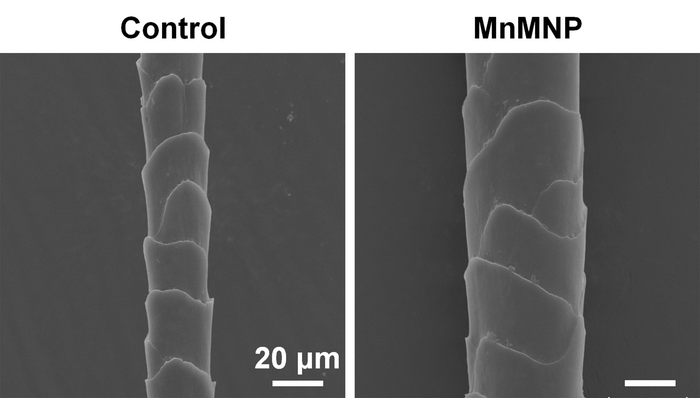
Credit: Adapted from Nano Letters 2022, DOI: 10.1021/acs.nanolett.2c03119
Hair loss is undesirable for many men — and women — because one’s hairstyle is often closely tied to their self-confidence. And while some people embrace it, others wish they could regrow their lost strands. Now, researchers reporting in ACS’ Nano Letters have used artificial intelligence (AI) to predict compounds that could neutralize baldness-causing reactive oxygen species in the scalp. Using the best candidate, they constructed a proof-of-concept microneedle patch and effectively regenerated hair on mice.
Most people with substantial hair loss have the condition androgenic alopecia, also called male- or female-pattern baldness. In this condition, hair follicles can be damaged by androgens, inflammation or an overabundance of reactive oxygen species, such as oxygen free radicals. When the levels of oxygen free radicals are too high, they can overwhelm the body’s antioxidant enzymes that typically keep them in check. Superoxide dismutase (SOD) is one of these enzymes, and researchers have recently created SOD mimics called “nanozymes.” But so far, those that have been reported aren’t very good at removing oxygen free radicals. So, Lina Wang, Zhiling Zhu and colleagues wanted to see whether machine learning, a form of AI, could help them design a better nanozyme for treating hair loss.
The researchers chose transition-metal thiophosphate compounds as potential nanozyme candidates. They tested machine-learning models with 91 different transition-metal, phosphate and sulfate combinations, and the techniques predicted that MnPS3 would have the most powerful SOD-like ability. Next, MnPS3 nanosheets were synthesized through chemical vapor transport of manganese, red phosphorus and sulfur powders. In initial tests with human skin fibroblast cells, the nanosheets significantly reduced the levels of reactive oxygen species without causing harm.
Based on these results, the team prepared MnPS3 microneedle patches and treated androgenic alopecia-affected mouse models with them. Within 13 days, the animals regenerated thicker hair strands that more densely covered their previously bald backsides than mice treated with testosterone or minoxidil. The researchers say that their study both produced a nanozyme treatment for regenerating hair, and indicated the potential for computer-based methods for use in the design of future nanozyme therapeutics.
The authors acknowledge funding from the National Natural Science Foundation of China and the Natural Science Foundation of Shandong Province China.
The American Chemical Society (ACS) is a nonprofit organization chartered by the U.S. Congress. ACS’ mission is to advance the broader chemistry enterprise and its practitioners for the benefit of Earth and all its people. The Society is a global leader in promoting excellence in science education and providing access to chemistry-related information and research through its multiple research solutions, peer-reviewed journals, scientific conferences, eBooks and weekly news periodical Chemical & Engineering News. ACS journals are among the most cited, most trusted and most read within the scientific literature; however, ACS itself does not conduct chemical research. As a leader in scientific information solutions, its CAS division partners with global innovators to accelerate breakthroughs by curating, connecting and analyzing the world’s scientific knowledge. ACS’ main offices are in Washington, D.C., and Columbus, Ohio.
To automatically receive news releases from the American Chemical Society, contact [email protected].
Follow us: Twitter | Facebook | LinkedIn | Instagram
Journal
Nano Letters
DOI
10.1021/acs.nanolett.2c03119
Article Title
“Machine Learning Guided Discovery of Superoxide Dismutase Nanozymes for Androgenetic Alopecia”
Article Publication Date
20-Oct-2022