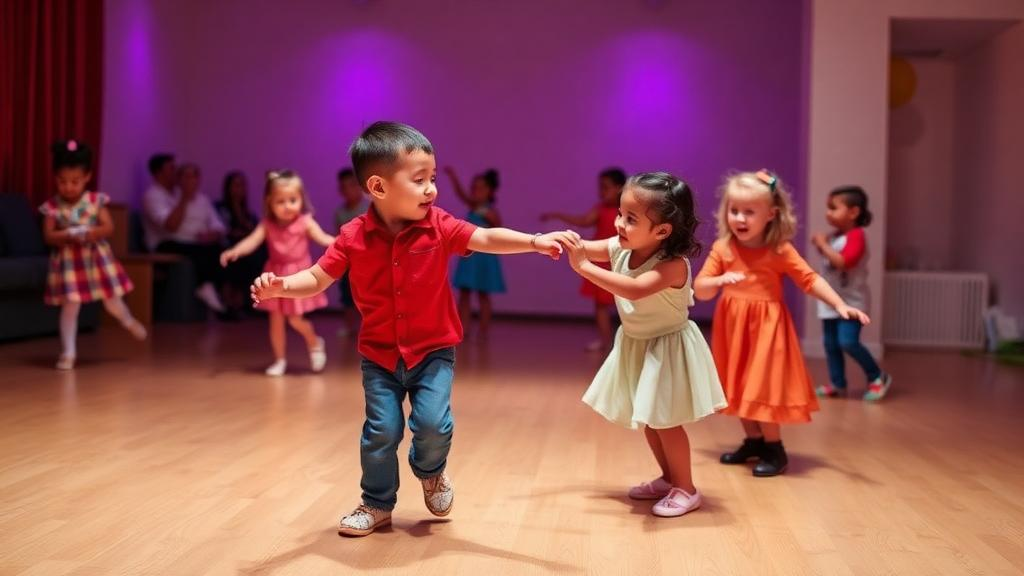
Preschool dance classes rarely make headlines in artificial intelligence research, but a new study published in Discover Artificial Intelligence argues that they should. Lan Ma of Nanyang Institute of Technology has built and tested a federated, multimodal AI framework designed to support inclusive dance interventions for children aged four to six, including those with special educational needs. The system, called HomeSchool-AI, links what happens in the classroom with what happens at home, while ensuring that no raw video, behavior log, or family report ever leaves a local device. In a 16-week cluster-randomized trial involving 1,038 children across 12 kindergartens, the full home-school system produced the largest gains in motor skills and social inclusion compared with classroom-only analytics and traditional teaching.
The problem the study tackles is deceptively simple to state and notoriously hard to solve. Teachers need timely, specific feedback about movement quality, participation, and peer interaction. Caregivers need practical home tasks rather than abstract scores. Meanwhile, child data governance rules make it nearly impossible to pool sensitive recordings into a single central repository. Most existing digital tools optimize only one of these axes: classroom analytics platforms stop at in-class scoring, while family-facing apps may boost participation but rarely connect their suggestions to teacher observations or movement evidence. The result is a discontinuity that weakens interventions over time, particularly for vulnerable subgroups who benefit most from consistent follow-through.
The technical core of the framework is federated learning, a training paradigm in which model updates rather than raw data are transmitted and aggregated. Each kindergarten class and each household acts as a client holding its own local samples: pose-sequence data, teacher observation records, parent text logs, interaction traces, outcome targets, and subgroup labels. Crucially, the child rather than the device or clip is treated as the indivisible partitioning unit. A pseudonymous master identifier links school-side and home-side records for the same child, and duplicate events are resolved using child ID, modality, timestamp windows, and data source. When the system is tested on an unseen school, the entire kindergarten is excluded before model selection, preventing child-level leakage across clients.
Inside the pipeline, four specialized encoders process the different evidence streams. Movement is captured by a nine-block spatial-temporal graph convolutional network operating on 64-frame pose sequences with 17 joints, augmented with first- and second-order temporal derivatives so the model can sense velocity and acceleration, not just static positions. Teacher records pass through a three-layer multilayer perceptron, parent texts through a BERT-base backbone fitted with parameter-efficient adapters, and weekly behavioral traces through a bidirectional gated recurrent unit. All four representations are projected into a shared 256-dimensional space for fusion. Only adapter and projection parameters of the language model are updated during federated training, keeping communication costs manageable.
One of the study’s most careful contributions concerns missing data. In home-school settings, missingness is structured rather than random: family logs thin out during busy weeks, teacher forms arrive late, and interaction traces depend on which devices are in use. Simply concatenating a missing-modality mask is insufficient, because zero-filled absent channels can still produce spurious activations. The framework therefore combines cross-modal imputation with hard-constrained gating: absent modalities receive a large negative bias before the softmax, effectively forcing their attention weights to zero. A balance regularization term keeps the surviving modalities from dominating, and random modality dropout at rates of 10, 30, and 50 percent during training builds robustness against realistic gaps.
Trustworthiness is engineered into the objective itself rather than bolted on afterward. The local loss combines motor and social prediction terms with an engagement objective, a differentiable fairness surrogate that penalizes divergence between the residual means of typically developing and special-educational-needs subgroups, an evidence-alignment loss that forces generated recommendation text to match saliency-derived visual evidence in a shared embedding space, and the fusion balance and imputation terms. Differential privacy is applied during federated aggregation: per-sample gradients are clipped and perturbed with Gaussian noise, and a moments accountant tracks the cumulative privacy budget. Instead of reporting privacy budgets in isolation, the study jointly reports utility degradation and subgroup disparity shifts under each budget, identifying a privacy parameter of epsilon equal to 4 as a balanced operating point with moderate utility cost and substantially reduced membership-inference attack risk.
The decision layer is deliberately conservative. A constrained recommendation module translates predictions and saliency evidence into role-specific guidance: teacher-level outputs emphasize class grouping and lesson sequencing, while caregiver-level outputs take the form of short home-practice cards with duration and caution details. Hard safety constraints cover age suitability and special-needs accommodations. When predictive uncertainty exceeds a preset threshold, the system abstains and returns observation-oriented suggestions instead of directive instructions. Every output shown to practitioners is tied to an upstream evidence path, including joint-level saliency maps, key movement segments, and modality-reliability weights. The study is explicit that the AI is a bounded decision-support pipeline, not autonomous pedagogy; final intervention decisions remain with teachers and caregivers.
The evaluation design is as much a contribution as the model. A 16-week, three-arm cluster-randomized protocol assigned 72 classes to traditional teaching, classroom-only analytics, or the full home-school intervention, with assessments at baseline, week 6, week 12, and week 16. An eight-experiment matrix covered intervention effects, longitudinal retention, mediation through parental engagement, subgroup fairness, ablation of individual components, robustness under perturbation, privacy-utility trade-offs, and cross-school transfer. The dataset spans 612 hours of usable pose-video material after quality filtering, with parent logs averaging 57 tokens in length. Repeated outcomes were analyzed with a three-level mixed model controlling for age, sex, baseline ability, and attendance, with false-discovery-rate correction and multiple-imputation handling of missing data.
The results tell a coherent story across all eight experiments. HomeSchool-AI yielded the largest post-test gains and maintained higher follow-up performance than both comparator arms, with the advantage over classroom-only analytics especially pronounced for social-inclusion outcomes. Mediation analysis showed that parental engagement functions as a measurable pathway linking intervention exposure to outcome change, not merely a correlated variable. Fairness diagnostics revealed smaller improvement gaps between typically developing children and those with special educational needs in the full system, alongside better calibration for both subgroups. Ablations confirmed that removing fairness or evidence-alignment constraints degraded subgroup parity or explanation quality, while robustness tests showed graceful degradation under pose noise, frame loss, and missing home logs. Cross-school leave-one-out transfer showed lower between-school variance for the proposed model, supporting external robustness.
The author is candid about limitations. Measurement equivalence across schools cannot be assumed, annotation heterogeneity may persist, and fairness in inclusive education is multidimensional in ways a single residual-gap metric cannot capture. Privacy budgets are reported at the system level, and translating them into individual stakeholder communication remains nontrivial. Yet the study’s broader significance is hard to overstate: it demonstrates that efficacy, fairness, privacy, and interpretability can be evaluated together under one statistical plan, in a real educational setting with vulnerable participants, rather than treated as optional appendices to a benchmark score. For a field often criticized for deploying black-box tools in classrooms, this integrated design-and-evaluation package offers a practical pathway for privacy-preserving, human-centered AI in early-childhood education, one in which the machine’s role is to lighten the observational burden while humans retain the final word.
Subject of Research: A federated multimodal AI framework for privacy-preserving, explainable support of inclusive preschool dance interventions
Article Title: Federated multimodal home school collaborative dance intervention for inclusive preschool education with privacy preserving and explainable AI framework
Article References: Federated multimodal home school collaborative dance intervention for inclusive preschool education with privacy preserving and explainable AI framework. (n.d.). https://doi.org/10.1007/s44163-026-02395-6
Image Credits: AI Generated
DOI: 10.1007/s44163-026-02395-6
Keywords: federated learning, multimodal learning, inclusive preschool education, dance movement assessment, differential privacy, fairness in AI, explainable recommendation, early childhood education, special educational needs, home-school collaboration, pose estimation, cluster-randomized trial
News Source: Courtney Benton. (October 14, 2026). AI Helps Preschoolers Learn to Dance While Keeping Their Data Private. Scienmag.