• HOME
  • NEWS
  • EXPLORE
    • CAREER
      • Companies
      • Jobs
    • EVENTS
    • iGEM
      • News
      • Team
    • PHOTOS
    • VIDEO
    • WIKI
  • BLOG
  • COMMUNITY
    • FACEBOOK
    • INSTAGRAM
    • TWITTER
Thursday, May 21, 2026
BIOENGINEER.ORG
No Result
View All Result
  • Login
  • HOME
  • NEWS
  • EXPLORE
    • CAREER
      • Companies
      • Jobs
        • Lecturer
        • PhD Studentship
        • Postdoc
        • Research Assistant
    • EVENTS
    • iGEM
      • News
      • Team
    • PHOTOS
    • VIDEO
    • WIKI
  • BLOG
  • COMMUNITY
    • FACEBOOK
    • INSTAGRAM
    • TWITTER
  • HOME
  • NEWS
  • EXPLORE
    • CAREER
      • Companies
      • Jobs
        • Lecturer
        • PhD Studentship
        • Postdoc
        • Research Assistant
    • EVENTS
    • iGEM
      • News
      • Team
    • PHOTOS
    • VIDEO
    • WIKI
  • BLOG
  • COMMUNITY
    • FACEBOOK
    • INSTAGRAM
    • TWITTER
No Result
View All Result
Bioengineer.org
No Result
View All Result
Home NEWS Science News Biology

AI helping to quantify enzyme activity

Bioengineer by Bioengineer
October 19, 2021
in Biology
Reading Time: 2 mins read
0
Schematic presentation of the prediction process for Michaelis constants
Share on FacebookShare on TwitterShare on LinkedinShare on RedditShare on Telegram

Without enzymes, an organism would not be able to survive. It is these biocatalysts that facilitate a whole range of chemical reactions, producing the building blocks of the cells. Enzymes are also used widely in biotechnology and in our households, where they are used in detergents, for example.
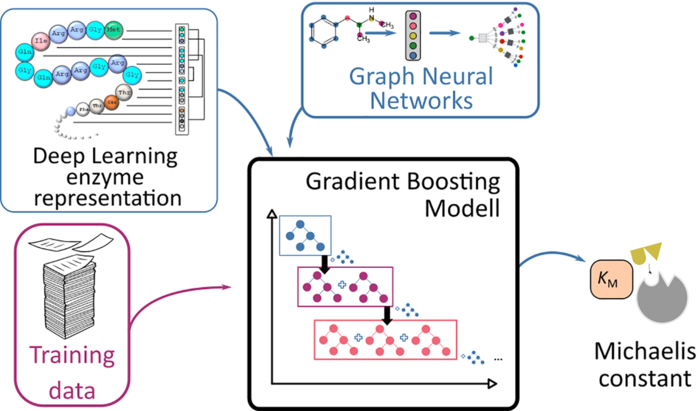
Schematic presentation of the prediction process for Michaelis constants

Credit: HHU / Swastik Mishra

Without enzymes, an organism would not be able to survive. It is these biocatalysts that facilitate a whole range of chemical reactions, producing the building blocks of the cells. Enzymes are also used widely in biotechnology and in our households, where they are used in detergents, for example.

To describe metabolic processes facilitated by enzymes, scientists refer to what is known as the Michaelis-Menten equation. The equation describes the rate of an enzymatic reaction depending on the concentration of the substrate – which is transformed into the end products during the reaction. A central factor in this equation is the ‘Michaelis constant’, which characterises the enzyme’s affinity for its substrate.

It takes a great deal of time and effort to measure this constant in a lab. As a result, experimental estimates of these constants exist for only a minority of enzymes. A team of researchers from the HHU Institute of Computational Cell Biology and Chalmers University of Technology in Stockholm has now chosen a different approach to predict the Michaelis constants from the structures of the substrates and enzymes using AI.

They applied their approach, based on deep learning methods, to 47 model organisms ranging from bacteria to plants and humans. Because this approach requires training data, the researchers used known data from almost 10,000 enzyme-substrate combinations. They tested the results using Michaelis constants that had not been used for the learning process.

Prof. Lercher had this to say about the quality of the results: “Using the independent test data, we were able to demonstrate that the process can predict Michaelis constants with an accuracy similar to the differences between experimental values from different laboratories. It is now possible for computers to estimate a new Michaelis constant in just a few seconds without the need for an experiment.”

The sudden availability of Michaelis constants for all enzymes of model organisms opens up new paths for metabolic computer modelling, as highlighted by the journal PLOS Biology in an accompanying article.

Original publication

Alexander Kroll, Martin K. M. Engqvist, David Heckmann, Martin Lercher, Deep learning allows genome-scale prediction of Michaelis constants from structural features, PLOS Biology (2021).

DOI: 10.1371/journal.pbio.3001402


Journal

PLoS Biology

DOI

10.1371/journal.pbio.3001402

Article Title

Deep learning allows genome-scale prediction of Michaelis constants from structural features

Article Publication Date

19-Oct-2021

Share12Tweet8Share2ShareShareShare2

Related Posts

How Atlantic Herring Rewired Their Reproductive Strategy to Thrive in Changing Oceans — Biology

How Atlantic Herring Rewired Their Reproductive Strategy to Thrive in Changing Oceans

May 20, 2026
Study Finds Young Fraser River Chinook Salmon Swimming in Chemical Mixture — Biology

Study Finds Young Fraser River Chinook Salmon Swimming in Chemical Mixture

May 20, 2026

Thousands of UK Beekeepers Contribute Honey to Advance Environmental Science

May 20, 2026

New Fossil Finds in Northwest Canada Transform Understanding of Early Animal Evolution

May 20, 2026

POPULAR NEWS

  • blank

    New Study Reveals Plants Can Detect the Sound of Rain

    733 shares
    Share 292 Tweet 183
  • ESMO 2025: mRNA COVID Vaccines Enhance Efficacy of Cancer Immunotherapy

    302 shares
    Share 121 Tweet 76
  • Research Indicates Potential Connection Between Prenatal Medication Exposure and Elevated Autism Risk

    846 shares
    Share 338 Tweet 212
  • Breastmilk Balances E. coli and Beneficial Bacteria in Infant Gut Microbiomes

    58 shares
    Share 23 Tweet 15

About

We bring you the latest biotechnology news from best research centers and universities around the world. Check our website.

Follow us

Recent News

SMA Crack Self-Healing Boosts Concrete Beam Repair

How Regional Traits Shape Europe’s Human Mobility

Essential Initialization in Biological Neural Networks

Subscribe to Blog via Email

Enter your email address to subscribe to this blog and receive notifications of new posts by email.

Join 82 other subscribers
  • Contact Us

Bioengineer.org © Copyright 2023 All Rights Reserved.

Welcome Back!

Login to your account below

Forgotten Password?

Retrieve your password

Please enter your username or email address to reset your password.

Log In
No Result
View All Result
  • Homepages
    • Home Page 1
    • Home Page 2
  • News
  • National
  • Business
  • Health
  • Lifestyle
  • Science

Bioengineer.org © Copyright 2023 All Rights Reserved.