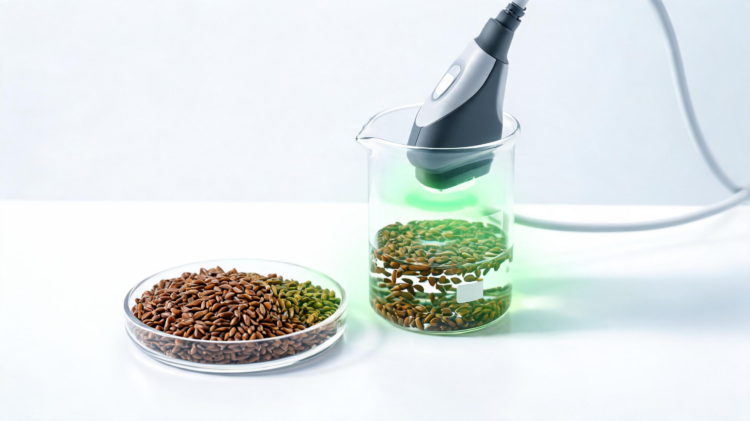
A small medicinal plant seed has become the testing ground for a research strategy that combines ultrasound, a biodegradable solvent and artificial intelligence. In a study published in Discover Green Chemistry, researchers developed an extraction method for the seeds of Cassia absus L., commonly known as Chaksu, using a natural deep eutectic solvent made from choline chloride and glycerol. The approach was designed to recover compounds associated with antioxidant and iron-chelating activity while reducing reliance on conventional organic solvents. Rather than optimizing the process for a single chemical measurement, the team used statistical modelling, an artificial neural network and the multi-criteria decision method TOPSIS to find a compromise among several competing outcomes. The result was a short extraction process that used 60 percent ultrasound amplitude for six minutes and a solvent-to-feed ratio of 20 millilitres per gram.
Cassia absus belongs to the Fabaceae family and grows in tropical and subtropical regions of Asia. Its seeds have a history of medicinal use and contain reported bioactive constituents including chaksine and isochaksine. That traditional and phytochemical background made the plant a candidate for a more systematic investigation of its extractable compounds. The researchers were not testing a finished medicine or demonstrating a treatment for disease; they were developing and optimizing a laboratory extraction process. The distinction matters because measurements such as antioxidant activity in a test tube do not establish clinical benefit. They do, however, help characterize extracts and identify whether a plant material may warrant further chemical, toxicological and pharmaceutical study.
The process began with seeds purchased from a local market in Lahore, Pakistan. The seeds were washed, dried, ground and passed through an 80-mesh sieve to produce a relatively uniform powder. The material was defatted by soaking it in n-hexane for three days, then dried at 40 degrees Celsius. For the greener extraction stage, the researchers prepared the deep eutectic solvent by combining choline chloride and glycerol in a 1:3 molar ratio. The mixture was heated at 80 degrees Celsius for two hours under vacuum until it formed a clear, colourless liquid. For extraction, the solvent was mixed with water in equal proportions. This water-containing system was then brought into contact with one gram of the prepared seed powder.
Ultrasound supplied the physical force intended to open the plant matrix. When a probe emits high-intensity sound into a liquid, microscopic bubbles can form, grow and collapse in a phenomenon known as acoustic cavitation. These rapid events can disturb cell walls, improve wetting and solvent penetration, and increase movement of dissolved molecules from the solid material into the surrounding liquid. The technique can therefore accelerate mass transfer compared with passive soaking. But more energy or more time is not automatically better. Excessive sonication can increase heating, alter fragile compounds or reduce the energy delivered efficiently through the liquid. The researchers monitored temperature and avoided excessive heat build-up while varying ultrasound amplitude, extraction time and solvent-to-feed ratio across a Box–Behnken experimental design.
The study evaluated four responses: total phenolic content, total flavonoid content, DPPH radical-scavenging activity and iron-chelating activity. Total phenolic content was expressed as milligrams of gallic acid equivalents per gram, while flavonoid content was reported using a rutin-equivalent calibration. DPPH testing measures how effectively an extract reduces a stable laboratory radical, producing an estimate of radical-scavenging capacity. The iron-chelation assay examined the ability of the extract to interfere with the reaction between ferrous ions and ferrozine, with lower colour formation corresponding to greater apparent chelation. These are widely used screening measurements, but they represent chemical behaviour under defined assay conditions rather than proof that the extract will neutralize radicals or regulate iron in a human body.
Seventeen experimental runs, including five centre points, were used to map how the three process variables affected the four responses. The results showed that no single run maximized every measurement. One run produced the highest total phenolic content at 44.18 milligrams of gallic acid equivalents per gram, another produced the highest flavonoid content at 29.26 milligrams of rutin equivalents per gram, a third reached 89.53 percent DPPH radical-scavenging activity, and a fourth recorded 90.31 percent iron-chelating activity. This divergence reflects the chemical complexity of extraction. Phenolics, flavonoids and other active constituents differ in polarity, solubility and stability, so conditions that release one group efficiently may not recover another group or preserve its activity. Maximizing one result could consequently produce an extract that performs poorly across the broader set of desired properties.
Response surface methodology was used first to fit second-order polynomial models describing linear, quadratic and interaction effects. The models were statistically significant for all four responses, with p-values below 0.0001 for phenolic and flavonoid content, 0.0011 for DPPH activity and 0.0024 for iron-chelating activity. Model R-squared values ranged from 0.9299 to 0.9933, indicating that the equations accounted for much of the variation within the tested design space. The solvent-to-feed ratio emerged as the strongest influence on phenolic and flavonoid recovery. Increasing solvent availability likely improved penetration and maintained a concentration gradient that favoured diffusion, but the negative quadratic terms showed that the benefit eventually levelled off or declined. Too much solvent could dilute the extract or reduce ultrasonic energy density.
The antioxidant response was more complicated. Extraction time had a significant negative effect on DPPH activity, suggesting that prolonged sonication may have degraded or structurally modified sensitive radical-scavenging compounds. Ultrasound amplitude and solvent-to-feed ratio also interacted, meaning their effects could not be interpreted independently. Iron-chelating activity was governed mainly by quadratic effects rather than simple increases or decreases in individual variables. The researchers then trained a feedforward artificial neural network using 70 percent of the experimental data for training, with 15 percent each reserved for validation and testing. The selected network used two hidden layers containing 20 and 10 neurons, with logsig and tansig activation functions. Its overall correlation values ranged from 0.97256 for iron-chelating activity to 0.99469 for total phenolic content, although the small dataset means these strong figures apply only within the investigated range and require confirmation with additional experiments.
TOPSIS provided the final decision framework by treating every experimental run as an alternative and all four responses as beneficial criteria. The data were normalized, given equal weights and compared with an ideal solution representing the best combined performance. Run 12 achieved the highest closeness coefficient, 0.7153, at 60 percent amplitude, six minutes and 20 millilitres per gram. Its measured results were 33.51 milligrams of gallic acid equivalents per gram of total phenolics, 27.99 milligrams of rutin equivalents per gram of flavonoids, 74.70 percent DPPH activity and 82.33 percent iron-chelating activity. It did not lead every individual category, but it offered the strongest overall balance. Compared with the lowest-ranked run, it had approximately 2.7 times more total phenolics, 27 percent higher flavonoid content and 59 percent higher DPPH activity, despite slightly lower iron-chelating activity.
The modelling comparison gave the neural network a modest advantage over response surface methodology. At the selected condition, the artificial neural network showed prediction errors of 1.15 percent for flavonoid content and 2.18 percent for DPPH activity, while TOPSIS was closest for total phenolic content with a 1.03 percent error. All models predicted iron-chelating activity with errors below 1 percent. Across the dataset, the neural network generally produced lower average absolute deviations and mean absolute percentage errors, particularly for the nonlinear antioxidant and chelation responses. The researchers also assessed the method with the ComplexMoGAPI green analytical metric, which gave an overall score of 81. The favourable score reflected the use of a choline chloride–glycerol and water system, room-temperature extraction, short sonication and avoidance of more hazardous conventional solvents. However, the reported E-factor was 60, and extraction yield remained below 70 percent, showing that waste and solvent efficiency still need improvement.
The findings position the method as a promising laboratory framework rather than an industrially validated product. Natural deep eutectic solvents can be tuned by changing their components and proportions, and their low volatility and biodegradability are attractive for natural-product processing. Yet solvent recovery, viscosity, long-term stability, compound identification and scale-up must be addressed before commercial adoption. The researchers recommend compound-level characterization, stability testing, toxicity evaluation and pilot-scale validation. Future work could also examine whether the solvent can be reused, whether lower solvent volumes can maintain performance and which specific molecules account for the measured activities. For now, the study demonstrates how acoustic cavitation and data-driven optimization can turn a traditional plant resource into a more systematically studied extraction target, while also showing that a greener label does not eliminate the need to measure waste, validate predictions and test biological claims carefully.
An important consideration is that the reported response values are operational measurements tied to the extraction and assay protocols. Total phenolic and flavonoid results depend on the calibration standards used, while DPPH and iron-chelation values summarize reactions in controlled chemical systems. They can therefore be useful for comparing extraction conditions without identifying which individual seed constituents produced the response. Chemical profiling would be needed to connect the optimized process with specific molecules such as the reported Cassia absus alkaloids or other extract components.
The optimization also illustrates why process conditions should be treated as a defined operating window rather than a universal recipe. The selected settings were derived from a Box–Behnken design covering particular amplitude, time and solvent-to-feed ranges, with a 50:50 NaDES–water extraction mixture and pretreated seed powder. Performance outside those conditions cannot be inferred from the model alone. Changes in particle characteristics, solvent composition, equipment geometry or temperature control could alter cavitation and mass transfer. Independent confirmation using new batches of seeds, expanded chemical characterization and scale-relevant equipment would help establish how reproducible the balance identified by TOPSIS is.
Subject of Research: AI-guided ultrasound extraction of Cassia absus seed phytochemicals using a natural deep eutectic solvent
Article Title: Artificial neural network and TOPSIS guided ultrasound extraction of Cassia absus L. seed phytochemicals using a natural deep eutectic solvent
Article References: Khalid, N. U. A., Iftikhar, H., Ahmed, D., & Mushtaq, M. (2026). Artificial neural network and TOPSIS guided ultrasound extraction of Cassia absus L. seed phytochemicals using a natural deep eutectic solvent. Discover Green Chemistry, 1(1), Article 26. https://doi.org/10.1007/s44509-026-00031-1
Image Credits: AI Generated
DOI: 10.1007/s44509-026-00031-1
Keywords: Cassia absus, green extraction, natural deep eutectic solvents, ultrasound extraction, artificial neural networks, TOPSIS, antioxidants, phytochemicals, Artificial, neural, network, guided
Cite Scienmag News
APA
MLA
Chicago
Scienmag. (August 28, 2026). AI Finds Greener Way to Extract Cassia Seed Compounds with Ultrasound. https://scienmag.com/ai-finds-greener-way-to-extract-cassia-seed-compounds-with-ultrasound/
Scienmag. “AI Finds Greener Way to Extract Cassia Seed Compounds with Ultrasound.” Scienmag, 28 August 2026, https://scienmag.com/ai-finds-greener-way-to-extract-cassia-seed-compounds-with-ultrasound/. Accessed 28 August 2026.
Scienmag. “AI Finds Greener Way to Extract Cassia Seed Compounds with Ultrasound.” Scienmag. August 28, 2026. https://scienmag.com/ai-finds-greener-way-to-extract-cassia-seed-compounds-with-ultrasound/
Copy citation
Download RIS
Tags: AI-driven process optimization in herbal medicine researchantioxidantsArtificialartificial intelligence in natural product extractionartificial neural networksbioactive compound recovery from Fabaceae family plantsbiodegradable solvent extraction of medicinal plant seedsCassia absusdeep eutectic solvents for herbal compound recoveryenvironmentally friendly extraction of antioxidant compoundsgreen chemistry methods for plant compound isolationgreen extractionguidedmulti-criteria decision analysis in phytochemical extractionnatural deep eutectic solventsnetworkneuraloptimization of ultrasound extraction parametersphytochemicalsrapid extraction methods for traditional medicinal seedssustainable extraction techniques for Cassia absus seedsTOPSISultrasound extractionultrasound-assisted extraction