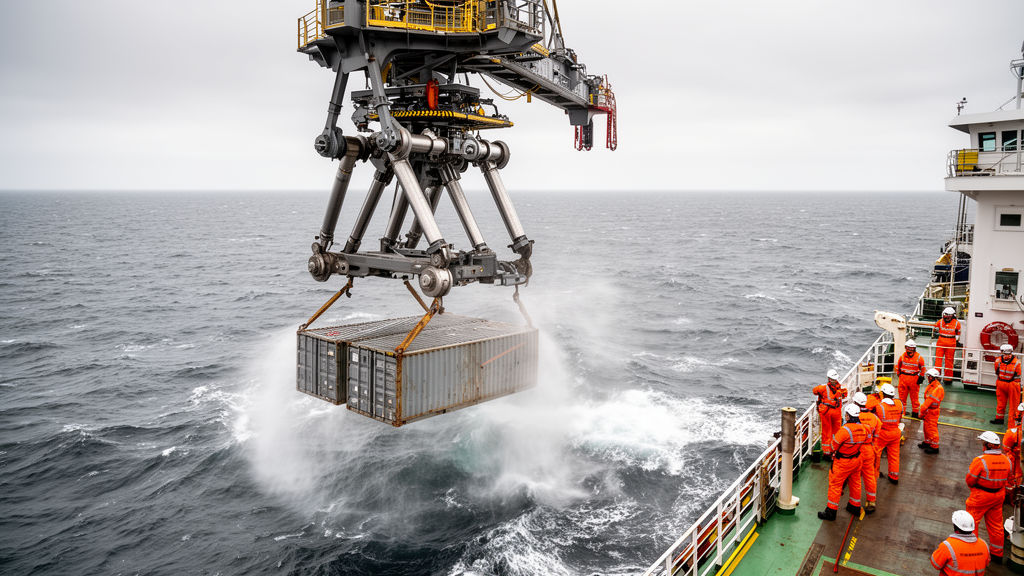
As offshore wind farms push farther from shore and deep-sea operations grow more ambitious, the gangways that bridge service vessels to fixed platforms have become lifelines for personnel and cargo. Yet the ocean rarely cooperates: six-degree-of-freedom ship motions can turn a simple transfer into a hazardous collision course. Wave compensation systems, typically built on the six-legged Stewart parallel mechanism, are the industry’s answer, and a new study published in Mechanical Sciences shows how artificial intelligence and evolutionary computation can squeeze dramatically better performance out of these heavy-duty machines before a single control algorithm is ever switched on.
A team led by Tianzhong Huang of the Shanghai Marine Equipment Research Institute, together with colleagues from Jiangsu University of Science Technology and Zhejiang College of Security Technology, tackled a 20-tonne-class wave compensation platform whose geometry had never been systematically optimized. Their approach, detailed in a paper published on 28 July 2026, integrates an artificial neural network surrogate model with an enhanced version of the NSGA-III multi-objective genetic algorithm, followed by TOPSIS decision analysis to select a single winning configuration. The result is a design that improves dexterity by 18.12 percent, cuts peak driving force by 11.78 percent, and enhances the kinematic condition number by 6.85 percent, all while slightly reducing actuator stroke.
The engineering stakes are considerable. In a Stewart platform, six hydraulic or electromechanical legs connect a base to a moving platform, and the radii of the two joint circles, the angular distribution of the joints, and the initial platform height jointly determine how the machine behaves across its entire workspace. Get these dimensions wrong, the authors note, and the consequences range from wasted deck space and redundant actuator strokes to legs that endure dangerous force spikes during extreme wave poses. Worse still, if the mechanism drifts toward a singular configuration, the platform can oscillate violently, risking mechanical failure at precisely the moment reliability matters most.
Previous research on wave compensation has concentrated heavily on control algorithms, from linear active disturbance rejection and neural-network-based PID schemes to model predictive control and linear-quadratic-Gaussian methods. But as the researchers point out, most of these strategies assume fixed mechanism dimensions, using software to compensate for physical design deficiencies. Any control scheme, however sophisticated, remains constrained by inherent physical bottlenecks such as actuator output limits and joint interference. The new work flips the emphasis, arguing that a rational physical configuration must come first, with control layered on top of an already well-conditioned structure.
The optimization problem itself is genuinely multi-dimensional and riddled with trade-offs. The team defined a five-dimensional decision vector comprising the upper and lower platform joint radii, the two joint distribution angles, and the initial height, then formulated four competing objectives: minimizing maximum actuator stroke, minimizing peak driving force, maximizing global dexterity, and minimizing the kinematic condition number, which measures how uniformly the platform responds across all six degrees of freedom. These indices are mutually exclusive in practice, and earlier attempts to blend them with weighted single-objective methods suffered from subjective weight choices and premature convergence in the face of the Stewart platform’s notoriously nonlinear, multimodal design landscape.
Computational cost posed another barrier. Evaluating peak driving forces requires traversing extreme poses and solving force Jacobian equations derived from the principle of virtual work, while dexterity and isotropy demand singular value decomposition of the Jacobian matrix at every pose. To break this bottleneck, the researchers generated 2500 datasets with a MATLAB-based physical simulation program, using random sampling within engineering-constrained boundaries, and trained a four-layer neural network with a 5-20-15-4 architecture and sigmoid activations. Trained via the Levenberg-Marquardt algorithm on an 80:20 train-test split, the surrogate achieved average R-squared values above 0.98 across all four objectives. Even when 0.5 percent Gaussian noise was injected to mimic manufacturing errors, joint clearances, and sensor noise, testing accuracy stayed between 0.987 and 0.999, an order-of-magnitude leap in optimization efficiency without sacrificing fidelity.
The optimization engine is where the study makes its most distinctive contributions. Standard NSGA-II loses its screening power as objectives multiply, so the team adopted NSGA-III, which steers evolution using 455 uniformly distributed reference points on a hyperplane in the four-dimensional objective space. Two enhancements proved decisive: a dynamic objective-space normalization strategy that eliminates the extreme scale bias between stroke metrics on the order of meters and force metrics on the order of hundreds of kilonewtons, and a constraint-violation penalty that explicitly forbids solutions violating cylinder stroke limits or exceeding the allowable cone angle of the Hooke’s joints. Head-to-head comparisons showed the improved NSGA-III reduced the spacing metric by 37.4 percent and boosted hypervolume by 26.2 percent relative to NSGA-II, producing a denser, more evenly distributed Pareto front of genuinely feasible designs.
Sensitivity analysis revealed that the upper platform radius and the initial height are the dominant levers of performance. Raising the upper radius from 2140 to 3110 millimeters, for instance, dropped peak driving force from 117.47 to 87.44 kilonewtons while correlating strongly with improved dexterity and a condition number falling from roughly 22 to 14.28. From the 455 non-dominated solutions, the team distilled three archetypal design families, a compact scheme for cramped decks, a robust scheme for heavy loads, and a dexterous scheme for kinematic performance, then applied TOPSIS with engineering-informed weights, giving peak driving force the highest weight at 0.30, to rank 91 shortlisted candidates. The top-ranked configuration expanded the base radius to 3881 millimeters and the upper radius to 3060 millimeters at a height of 5291 millimeters, with joint angles of 19.82 and 19.04 degrees that preserve safe installation clearances.
Critically, the team did not stop at simulation. They built a scaled proof-of-concept prototype with DC linear actuators, mirroring the optimized joint angles, and commanded it through roll and pitch extremes of plus and minus 15 degrees fifty consecutive times. The relative error between commanded and executed angles stayed strictly within 1 percent across every cycle, and the six legs operated smoothly with no collisions or interference between kinematic pairs. The authors are candid about limitations: the dynamic evaluation rests on rigid-body assumptions, so structural elasticity under extreme loads on the full 20-tonne system remains unmodeled, and the optimization deliberately excludes control co-design. Future work will pair multibody dynamics models with control-structure co-design to test real-time tracking under stochastic wave spectra.
For an offshore industry racing to install and maintain turbines in ever rougher seas, the study offers something rarer than a better gangway: a reusable design methodology. By fusing neural-network surrogates, reference-point-based evolutionary search, and principled multi-criteria decision-making, it demonstrates that the physics of a machine can be optimized before its software ever runs, providing a benchmark that could ripple through shipborne robotics, deployable antennas, and any heavy parallel mechanism where geometry decides survival.
Subject of Research: Multi-objective optimization of a heavy-duty wave compensation parallel platform using an ANN surrogate model and an improved NSGA-III algorithm
Article Title: Optimal design and validation of a heavy-duty wave compensation parallel platform utilizing the NSGA-III algorithm
Article References: Huang, T., Luo, R., Mao, L., Wang, J., Zhou, F., & Zhang, G. (2026). Optimal design and validation of a heavy-duty wave compensation parallel platform utilizing the NSGA-III algorithm. Mechanical Sciences, 17(2), 783-798. https://doi.org/10.5194/ms-17-783-2026
Image Credits: AI Generated
Keywords: wave compensation, Stewart platform, parallel mechanism, NSGA-III, artificial neural network, multi-objective optimization, TOPSIS, offshore gangway, dexterity, condition number, surrogate model, marine engineering
News Source: Denise Maddox. (October 9, 2026). AI-Driven Algorithm Reshapes Heavy-Duty Wave Compensation Platforms for Safer Offshore Work. Scienmag.