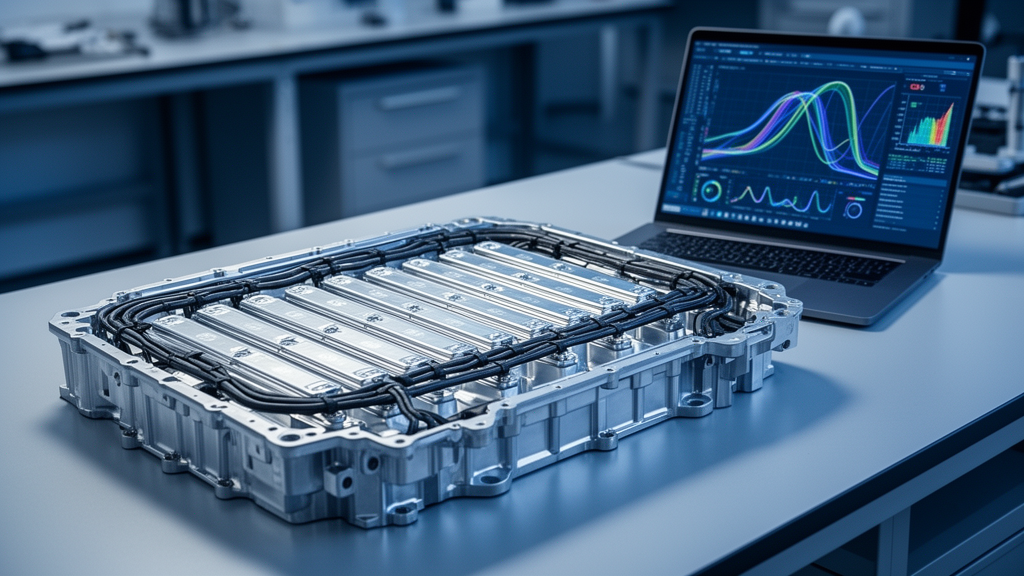
Every electric vehicle on the road today is quietly running one of the most demanding computing problems in modern engineering: keeping hundreds of lithium-ion cells safe, balanced, and healthy at the same time. A new review published in Frontiers in Batteries and Electrochemistry argues that the answer to this challenge lies in artificial intelligence, and that the battery management systems of the next decade will be built on a hybrid of physics-based models and data-driven machine learning rather than on either approach alone.
The study, authored by Mohammad Waseem of Jamia Millia Islamia in New Delhi, takes an unusually broad view of the field. Rather than focusing on a single function, it critically assesses 120 research articles and review papers to build a system-level picture of how artificial intelligence and machine learning are transforming battery management across state estimation, cell balancing, thermal management, fault diagnosis, predictive maintenance, intelligent charging, edge computing, and cloud connectivity. According to the review, this integrated perspective is what previous surveys have lacked, and it reveals both how far the technology has come and where its most stubborn bottlenecks remain.
At the heart of every battery management system, or BMS, lies a deceptively simple question: what is the battery actually doing right now? Two quantities dominate the answer. The state of charge, or SoC, describes how much energy remains in the pack relative to its nominal capacity, while the state of health, or SoH, captures how much the battery has degraded over its lifetime. Neither can be measured directly. Both must be inferred from voltage, current, and temperature readings using computational algorithms, a task made harder by the fact that lithium-ion cells behave in strongly nonlinear ways that shift with temperature, aging, and driving patterns.
Conventional BMS architectures have long relied on model-based techniques such as coulomb counting, equivalent circuit models, and Kalman filtering to estimate these hidden states. These methods have served the industry well, but the review highlights a fundamental weakness: they struggle to represent the nonlinear electrochemical behavior of lithium-ion batteries under varying operating conditions. As battery packs in modern electric vehicles grow larger and more complex, the amount of real-time sensor data they generate has outstripped what traditional models can meaningfully process, and subtle degradation patterns slip through the cracks.
This is where machine learning enters the picture. Artificial neural networks have been widely applied to state of charge estimation because of their ability to capture complex nonlinear battery dynamics, and experimental studies cited in the review show that ANN-based models can achieve significantly improved accuracy compared with conventional estimation techniques, particularly under dynamic operating conditions. Support vector machines and ensemble learning methods have proven effective at detecting battery faults and abnormal operating conditions at early stages, flagging problems before they escalate into safety hazards. The trade-off is real, however: these models demand large training datasets and substantial computational resources, which can complicate deployment on the embedded processors that actually live inside a vehicle.
Deep learning has pushed the frontier further. Long short-term memory networks, convolutional neural networks, and deep neural networks have been extensively explored for predicting battery degradation and remaining useful life, the parameter known as RUL. LSTM networks are particularly well suited to this task because they excel at analyzing time-series data and capturing the temporal dependencies that characterize how batteries age. The review notes that studies published in leading energy journals have demonstrated that deep learning models can achieve high prediction accuracy and improved robustness compared with traditional analytical models, though the price is longer training times and heavier computational demands.
Beyond estimation, artificial intelligence is reshaping how batteries are charged and protected. Reinforcement learning algorithms learn optimal charging policies through interaction with the battery system and its environment, dynamically adjusting charging rates based on real-time inputs such as state of charge, state of health, temperature, and grid conditions. The goal is to balance charging speed against battery longevity while avoiding degradation mechanisms like lithium plating and thermal stress. The review reports that reinforcement learning approaches have shown improved energy efficiency and reduced battery aging compared with traditional charging methods, although they require extensive training cycles and carefully designed reward functions to perform stably.
Thermal management represents another critical frontier. Because lithium-ion battery performance and safety are tightly coupled to temperature, improper thermal regulation can accelerate degradation and, in the worst case, trigger thermal runaway, a failure mode characterized by uncontrolled heat generation and potential fire. Smart BMS designs now incorporate per-cell or per-module temperature sensing using thermistors and integrated sensing devices, feeding real-time thermal data into control units that dynamically activate cooling or heating mechanisms and adjust charge and discharge limits. Convolutional neural networks and autoencoders have proven especially effective at detecting thermal anomalies and hidden fault patterns in sensor data, giving the BMS an early warning system that rule-based logic alone cannot match.
The review also spotlights two emerging hardware and infrastructure trends that could define the next generation of battery management. The first is FPGA-based edge implementation, in which field-programmable gate arrays and embedded processors execute machine learning models with the low latency required for safety-critical real-time control. Recent work on FPGA-based intelligent battery management units demonstrates dynamic power distribution techniques, though the review cautions that these platforms bring higher implementation cost and design complexity. The second is IoT-enabled cloud integration, in which distributed sensors transmit battery data to centralized platforms where machine learning models perform fleet-level optimization, predictive diagnostics, and over-the-air updates. Prototype systems integrating these technologies have demonstrated improved reliability and predictive maintenance capabilities, but they introduce new concerns around cybersecurity, communication latency, and data management at scale.
Perhaps the review’s most consequential conclusion is that no single artificial intelligence technique is universally optimal. Artificial neural networks and LSTM models deliver high estimation accuracy for state of charge and state of health, convolutional architectures excel at fault diagnosis, and support vector machines and random forests offer robust performance with lower computational requirements that suit embedded systems. The most promising pathway forward, the author argues, lies in hybrid approaches that combine model-based methods with data-driven algorithms, leveraging the physical understanding embedded in equivalent circuit models and Kalman filters alongside the pattern-recognition power of machine learning. Future directions identified in the review include physics-informed machine learning, digital twins, edge intelligence, and cloud-connected battery ecosystems, all of which point toward battery management systems that are not merely protective but genuinely predictive and autonomous.
Subject of Research: AI and machine learning applications in smart battery management systems for electric vehicles
Article Title: AI/ML enabled smart battery management systems in electric vehicles
Article References: Waseem, M. (2026). AI/ML enabled smart battery management systems in electric vehicles. Frontiers in Batteries and Electrochemistry, 5, Article 1883201. https://doi.org/10.3389/fbael.2026.1883201
Image Credits: AI Generated
DOI: 10.3389/fbael.2026.1883201
Keywords: battery management system, electric vehicles, lithium-ion batteries, machine learning, artificial intelligence, state of charge, state of health, deep learning, thermal management, predictive maintenance, FPGA, IoT
News Source: Blake Davidson. (October 17, 2026). AI and machine learning are rewriting the rules of electric vehicle battery management. Scienmag.