


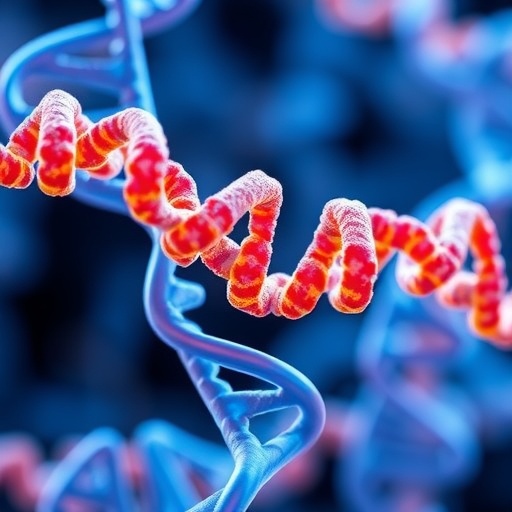
In the intricate molecular tapestry of life, RNA molecules serve as critical mediators, orchestrating a multitude of biological processes crucial for cellular function. Their roles extend beyond mere intermediaries in gene expression; RNAs are pivotal in regulatory networks, enzymatic catalysis, and structural scaffolding. These diverse functionalities are dictated not solely by their nucleotide sequences but, importantly, by their complex three-dimensional conformations. The spatial architecture of RNA determines its stability, interaction specificity, and capacity to engage with proteins, small molecules, and other nucleic acids. Understanding RNA structure is thus a gateway to decoding its functional repertoire, a quest that has galvanized the scientific community in recent years.
Despite the centrality of RNA structures to cellular biology, elucidating these structures with precision has posed considerable challenges. Unlike the relatively stable and well-characterized folds of many proteins, RNA molecules exhibit remarkable dynamism and flexibility. Their propensity to adopt multiple conformations, coupled with intrinsic physicochemical properties such as electrostatic repulsion and transient base pairing, complicates efforts to resolve their three-dimensional arrangements. Traditional structural biology tools, including X-ray crystallography and nuclear magnetic resonance (NMR) spectroscopy, have advanced RNA structural insights but are hindered by size limitations, conformational heterogeneity, and difficulties in crystallization.
Emerging experimental methodologies have begun to surmount some of these obstacles. Cryo-electron microscopy (cryo-EM), a technique revolutionizing protein structural biology, offers unprecedented potential for RNA structure determination. By freezing samples rapidly to preserve native conformations and imaging them at near-atomic resolution, cryo-EM circumvents challenges associated with crystallization. Recent advances in detector technologies and image processing algorithms have enhanced the resolution achievable for RNA assemblies, enabling visualization of complex ribonucleoprotein particles and even solitary RNA molecules in diverse conformational states.
Complementing these experimental strides, artificial intelligence (AI) has surged forward as a transformative force in biomolecular structure prediction. AI-driven models, inspired by breakthroughs in protein folding prediction exemplified by platforms such as AlphaFold, are being adapted to RNA. These computational tools leverage deep learning architectures trained on experimentally derived structures and sequence data to infer RNA folding patterns and tertiary interactions with increasing accuracy. Unlike purely physics-based simulations, AI methodologies can integrate patterns learned from vast datasets, enabling scalable predictions even for challenging RNA sequences.
The integration of experimental techniques with AI-driven computational models represents a paradigm shift in RNA structural biology. By harmonizing cryo-EM data with machine learning predictions, researchers can overcome limitations inherent in each individual approach. Experimental data provide rich, empirical constraints that ground the computational models in reality, while AI enhances interpretative power, fills in unresolved details, and predicts conformational landscapes beyond the reach of current imaging technologies. This symbiosis has not only improved resolution but also accelerated the throughput of RNA structure determination.
Recent studies highlight the power of this integrative strategy in tackling large and flexible RNA molecules, including long non-coding RNAs and viral RNA genomes, which have traditionally resisted high-resolution characterization. By combining experimental snapshots with AI-predicted folding landscapes, these approaches generate dynamic ensembles of plausible structures, capturing RNA plasticity and functional conformers. This multimodal framework offers a holistic view of RNA behavior, linking structural dynamics to biological activity.
Despite these promising developments, challenges remain on the horizon. RNA’s high conformational heterogeneity demands methodologies capable of resolving transient and low-population states critical to function. Moreover, the dearth of high-quality RNA structural data to train AI models restricts generalizability, necessitating continuous enrichment of databases. Experimental sample preparation and cryo-EM imaging conditions must also be optimized to faithfully represent native cellular environments, as isolated RNAs may adopt non-physiological folds.
Addressing these obstacles will require concerted, interdisciplinary efforts. Innovations in chemical probing techniques, crosslinking strategies, and in-cell structural assays promise to furnish richer experimental constraints. Concurrently, advancements in AI architectures, such as integrating molecular dynamics simulations with deep learning, hold potential to refine predictive accuracy. Collaborative frameworks that unify experimentalists, computational biologists, and data scientists are essential to propel this nascent field forward.
The implications of mastering RNA structural determination extend far beyond basic research. Detailed structural insights open avenues for rational design of RNA-targeted therapeutics, including small molecules, antisense oligonucleotides, and RNA-based vaccines. Understanding RNA conformational switches can inform synthetic biology applications, enabling engineered riboswitches and sensors with bespoke functionalities. Additionally, mapping RNA structure-function relationships illuminates mechanisms underlying diseases linked to RNA misfolding and dysregulation, paving pathways for novel diagnostic and intervention strategies.
Intriguingly, the convergence of experimental and AI technologies embodies a model for future biomolecular research, where physical measurements and computational inference coalesce seamlessly. As RNA biology continues to reveal layers of complexity, this dual approach stands as a beacon, illuminating the path toward comprehensive understanding. The field is poised not only to decipher the ‘RNA world’ but also to harness its capabilities in transformative ways that influence medicine, biotechnology, and synthetic biology.
In conclusion, the landscape of RNA structure determination is undergoing a revolutionary transformation, powered by innovations in cryo-electron microscopy and artificial intelligence. This integrative framework melds the strengths of empirical data and computational prediction, surmounting longstanding challenges imposed by RNA’s dynamic nature. As methodologies continue to mature and datasets expand, the precision and scalability of RNA structural elucidation will only improve, unlocking deeper insights into RNA function and facilitating groundbreaking applications. The fusion of experimental ingenuity and AI sophistication is redefining possibilities, heralding a new era in molecular biology.
Crucially, the momentum generated by these advancements underscores a broader narrative—the accelerating convergence of technology and biology. RNA, once enigmatic in its structural complexity, is becoming increasingly accessible to systematic characterization. This evolution not only enriches our fundamental understanding but also empowers a new generation of innovations tailored to the RNA-centric mechanisms underlying health and disease.
As researchers worldwide embrace these tools, collaborative networks will amplify the pace of discovery. Open sharing of structural data and AI models fosters a culture of transparency and reproducibility, enabling iterative refinement and cross-validation. Moreover, educational initiatives will be vital in equipping scientists with the interdisciplinary skills required for this integrated approach, spanning molecular biology, structural biophysics, and machine learning.
Ultimately, the integration of experimental technologies with AI heralds an era in which the mysteries of RNA can be unraveled with unprecedented clarity. This breakthrough promises not only to answer longstanding biological questions but also to empower novel solutions in therapeutics, diagnostics, and synthetic biology. The RNA universe is vast and complex, but with these tools, its secrets are poised to be revealed.
Subject of Research: RNA structure determination through integrated experimental techniques and artificial intelligence.
Article Title: Integrated experimental and AI innovations for RNA structure determination.
Article References:
Wang, W., Su, B., Peng, Z. et al. Integrated experimental and AI innovations for RNA structure determination. Nat Biotechnol (2026). https://doi.org/10.1038/s41587-025-02974-5
Image Credits: AI Generated
DOI: https://doi.org/10.1038/s41587-025-02974-5
Tags: advanced structural biology toolsAI in RNA structure analysischallenges in RNA structure elucidationdecoding RNA functional repertoireenzymatic roles of RNAexperimental methodologies for RNA analysisregulatory networks in RNARNA and protein interactionsRNA dynamics and flexibilityRNA interaction specificityRNA molecule functionalitiesthree-dimensional RNA conformations



