Credit: (C) 2016, American Geriatrics Society
Experts at the American Geriatrics Society (AGS) today unveiled new guidance on care and decision-making for a unique and growing group of older adults: the "unbefriended." Proposed clinical practice and public policy changes would support some of society's most vulnerable individuals while also helping protect more of us from becoming unbefriended as we age.
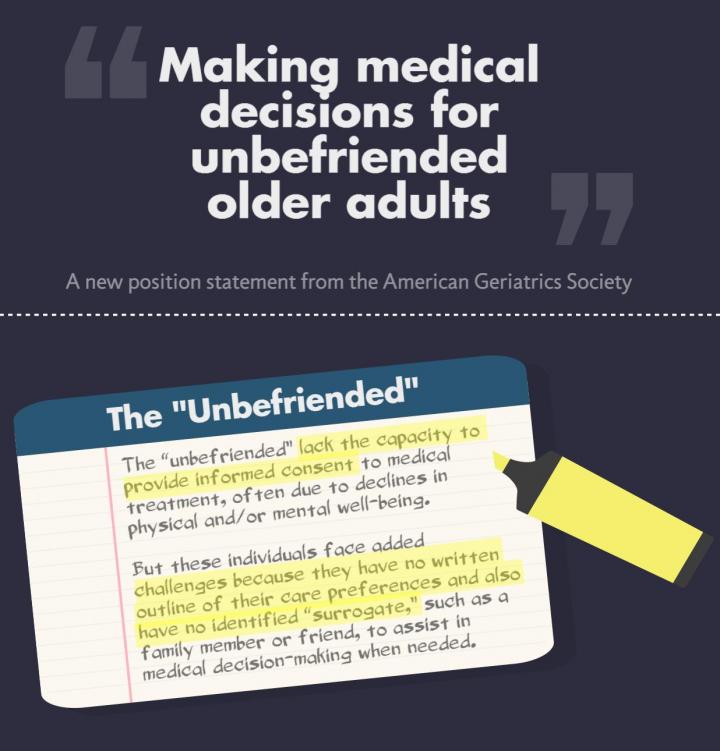
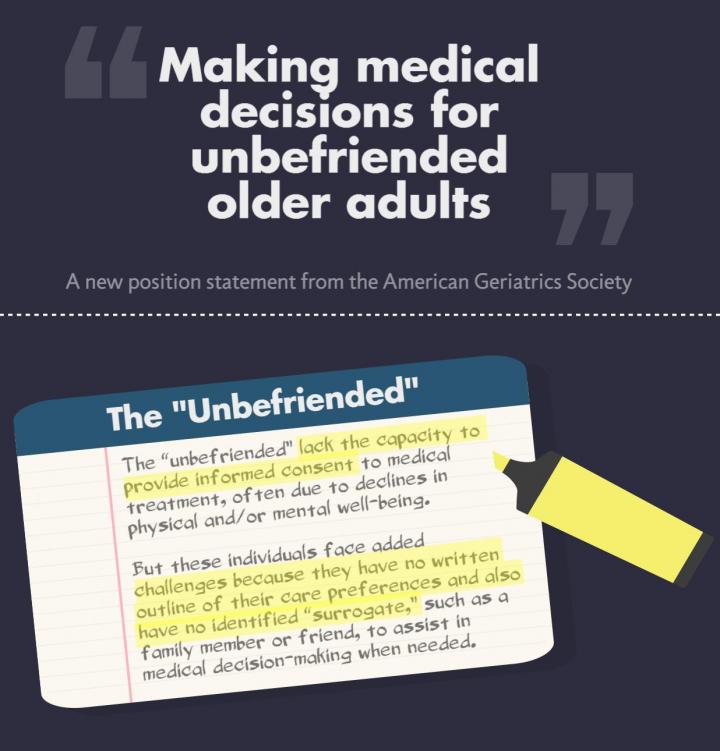
The "unbefriended" lack the capacity to provide informed consent to medical treatment, often due to declines in physical and/or mental well-being. But these individuals face added challenges because they have no written outline of their care preferences and also have no identified "surrogate," such as a family member or friend, to assist in medical decision-making when needed. Baby boomers are at particular risk for becoming unbefriended, since more than 10 million boomers live alone and as many as 20 percent have no children.
"Health professionals have a special responsibility for the unbefriended, but we also face particularly challenging situations when it comes to their medical decisions" notes Timothy W. Farrell, MD, AGSF, a member of the expert panel responsible for the position statement. Added AGS President Ellen Flaherty, PhD, APRN, AGSF: "The AGS has outlined proactive steps we can take to help those at risk of becoming unbefriended. And for older adults who are already facing this reality, our guidance can help create standards and systems of support in more places and for more people. It's not just about improving care; it's about making care more respectful and responsive."
Across clinical practice, AGS experts have called for:
- Avoiding ad hoc approaches to decision-making to ensure fairness and respect;
- Identifying "non-traditional" surrogates–such as close friends, neighbors, or others who know a person well–wherever and whenever possible;
- Putting mechanisms in place to assess decision-making capacity in a systematic fashion;
- Standardizing approaches to caring for the unbefriended in urgent, life-threatening situations;
- Ensuring access to decision-making surrogates who are familiar not only with a person's medical condition but also with his or her needs, preferences, and expectations; and
- Remaining sensitive to all available information–including cultural factors–when considering an unbefriended person's best interests.
At a systemic level, AGS experts also recommend:
- Bringing national stakeholders together to create model legal standards that could be adopted by all states;
- Working with clinicians, healthcare organizations, and other stakeholders to prevent older adults from becoming unbefriended; and
- Developing innovative, efficient, and accessible approaches to protect decision-making for the unbefriended.
As an update to earlier guidance released in 1996, the AGS Ethics Committee developed these new recommendations in collaboration with the AGS Clinical Practice and Models of Care Committee and the AGS Public Policy Committee. The final position statement was published online ahead of print in the Journal of the American Geriatrics Society, and is available for free from GeriatricsCareOnline.org.
###
About the American Geriatrics Society
Founded in 1942, the American Geriatrics Society (AGS) is a nationwide, not-for-profit society of geriatrics healthcare professionals dedicated to improving the health, independence, and quality of life of older people. Its nearly 6,000 members include geriatricians, geriatric nurses, social workers, family practitioners, physician assistants, pharmacists, and internists. The Society provides leadership to healthcare professionals, policymakers, and the public by implementing and advocating for programs in patient care, research, professional and public education, and public policy. For more information, visit americangeriatrics.org.
Media Contact
Daniel E. Trucil
[email protected]
212-822-3589
@AmerGeriatrics
http://www.americangeriatrics.org/