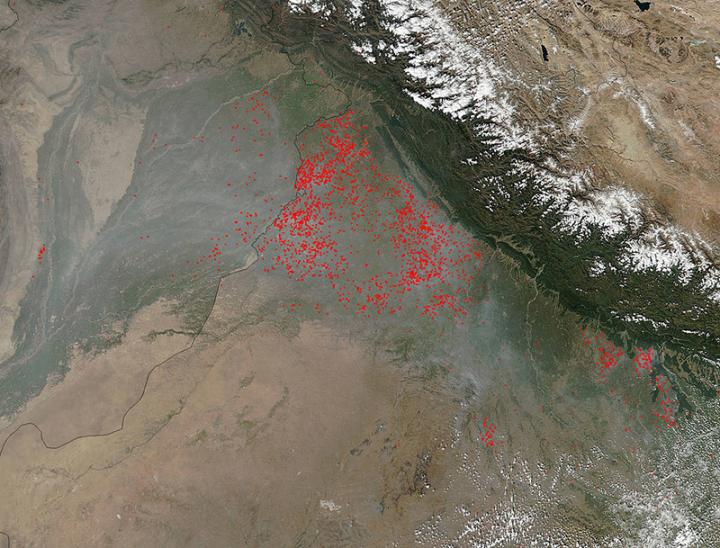
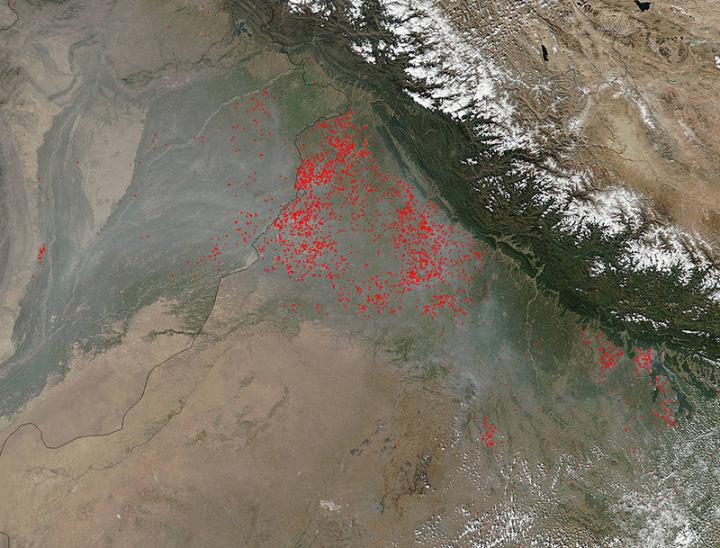
Credit: NASA/ Jeff Schmaltz, MODIS Rapid Response Team
It's become a deadly autumn tradition in northern India: after the rains of the late summer monsoon subside, farmers set fires to their fields to clear stubble after the harvest and send choking smoke rolling across the countryside. New Delhi, already thick with pollution, can grind to a halt for days. Last year, the chief minister of the Delhi state likened the city to "a gas chamber."
While crop burning has been illegal for years, there hasn't been a large enough deterrent to effectively crack down on the practice, in part because it's been difficult to measure exactly how much smoke from the fires is making it downwind to the city.
Now, researchers from the Harvard John A. Paulson School of Engineering and Applied Sciences (SEAS) have demonstrated that in October and November, a peak burning season in nearby Punjab, about half of all pollution in Delhi can be attributed to agricultural fires on some days.
The research is published in Environmental Research Letters.
"On certain days during peak fire season, air pollution in Delhi is about 20 times higher than the threshold for safe air as defined by the World Health Organization," said Daniel H. Cusworth, a graduate student at SEAS and first author of the paper.
To model how much of that pollution is coming from the fires, the researchers used satellite data from NASA to identify hotspots corresponding to active fires. The team gathered available data for October and November, 2012 to 2016 and plugged it into a particle dispersion model — an algorithm that accounts for geography, wind patterns, and physics to predict how far and in what direction smoke particles travel.
During the post-monsoon season, the air in northern India is particularly stagnant, meaning smoke particles don't vent into the atmosphere as they would during other times of the year. Instead, the black carbon and organic particulate matter slowly permeates throughout the entire region, which is home to 46 million people. In urban areas, that smoke mixes with existing pollution from cars and factories creating a thick, deadly haze.
On average, without fires, urban Delhi experiences about 150 micrograms per cubic meter of fine particulate air pollution.
To put that into perspective, the World Health Organization (WHO) puts the threshold for safe air at 25 micrograms per cubic meter, and India's Central Pollution Control Board limits exposure to 60 micrograms per cubic meter, said Cusworth, a member of the Atmospheric Chemistry Modeling Group led by Daniel J. Jacob, the Vasco McCoy Family Professor of Atmospheric Chemistry and Environmental Engineering, and Loretta J. Mickley, Senior Research Fellow at SEAS.
Extreme fires during the post-monsoon season can pump on average about 150 micrograms per cubic meter of fine particulate matter into the city, doubling the amount of pollution and increasing total levels 12 times higher than WHO recommendations, and even 20 times higher on some days.
"A relationship between pollution and mortality is well known," said Mickley, who co-authored of the paper. "We hope this research can help provide policymakers with a quantitative sense of the consequences of agricultural burning in order to inform decision-making."
###
The paper was co-authored by Melissa P. Sulprizio, Tianjia Liu, Miriam E. Marlier, Ruth S. DeFries, and Sarath K. Guttikunda, and Pawan Gupta.
Media Contact
Leah Burrows
[email protected]
617-496-1351
@hseas
http://www.seas.harvard.edu/
Original Source
https://www.seas.harvard.edu/news/2018/03/agricultural-fires-can-double-delhi-pollution-during-peak-burning-season