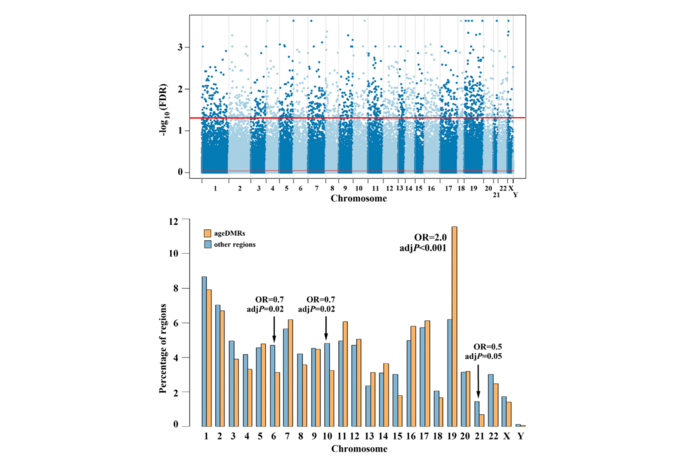
“[…] we identified > 1,000 candidate genes with genome-wide significant age-related methylation changes in sperm.”
Credit: 2023 Bernhardt et al.
“[…] we identified > 1,000 candidate genes with genome-wide significant age-related methylation changes in sperm.”
BUFFALO, NY- March 21, 2023 – A new research paper was published in Aging (listed by MEDLINE/PubMed as “Aging (Albany NY)” and “Aging-US” by Web of Science) Volume 15, Issue 5, entitled, “Age-related methylation changes in the human sperm epigenome.”
Advanced paternal age is associated with increased risks for reproductive and offspring medical problems. Accumulating evidence suggests age-related changes in the sperm epigenome as one underlying mechanism. In a recent study, researchers Laura Bernhardt, Marcus Dittrich, Andreas Prell, Ramya Potabattula, Charis Drummer, Rüdiger Behr, Thomas Hahn, Martin Schorsch, Tobias Müller, and Thomas Haaf from Julius Maximilians University, Partner Site Göttingen and Fertility Center Wiesbaden performed reduced representation bisulfite sequencing (RRBS) on 73 sperm samples of males attending a fertility center in Germany.
“[…] we identified 1,162 (74%) regions which were significantly (FDR-adjusted) hypomethylated and 403 regions (26%) being hypermethylated with age.”
There were no significant correlations with paternal BMI, semen quality, or ART outcome. The majority (1,152 of 1,565; 74%) of age-related differentially methylated regions (ageDMRs) were located within genic regions, including 1,002 genes with symbols. Hypomethylated ageDMRs were closer to transcription start sites than hypermethylated DMRs, half of which reside in gene-distal regions.
In this and conceptually related genome-wide studies, so far 2,355 genes have been reported with significant sperm ageDMRs, however most (90%) of them in only one study. The 241 genes which have been replicated at least once showed significant functional enrichments in 41 biological processes associated with development and the nervous system and in 10 cellular components associated with synapses and neurons.
This supports the hypothesis that paternal age effects on the sperm methylome affect offspring behavior and neurodevelopment. The researchers found it interesting to note that sperm ageDMRs were not randomly distributed throughout the human genome; chromosome 19 showed a highly significant twofold enrichment with sperm ageDMRs. Although the high gene density and CpG content have been conserved, the orthologous marmoset chromosome 22 did not appear to exhibit an increased regulatory potential by age-related DNA methylation changes.
“Collectively, our data support the conclusion that age-induced methylation changes in the sperm epigenome contribute to the increased offspring disease susceptibility for neurodevelopmental disorders.”
Read the Full Paper: DOI: https://doi.org/10.18632/aging.204546
Corresponding Author: Thomas Haaf
Corresponding Email: [email protected]
Keywords: ART outcome, DNA methylation, male germ cells, paternal age effect, human sperm epigenome
Sign up for free Altmetric alerts about this article: https://aging.altmetric.com/details/email_updates?id=10.18632%2Faging.204546
About Aging-US:
Launched in 2009, Aging publishes papers of general interest and biological significance in all fields of aging research and age-related diseases, including cancer—and now, with a special focus on COVID-19 vulnerability as an age-dependent syndrome. Topics in Aging go beyond traditional gerontology, including, but not limited to, cellular and molecular biology, human age-related diseases, pathology in model organisms, signal transduction pathways (e.g., p53, sirtuins, and PI-3K/AKT/mTOR, among others), and approaches to modulating these signaling pathways.
Please visit our website at www.Aging-US.com and connect with us:
- SoundCloud
- YouTube
- LabTube
For media inquiries, please contact [email protected].
Aging (Aging-US) Journal Office
6666 E. Quaker Str., Suite 1B
Orchard Park, NY 14127
Phone: 1-800-922-0957, option 1
###
Journal
Aging-US
DOI
10.18632/aging.204546
Method of Research
Experimental study
Subject of Research
Cells
Article Title
Age-related methylation changes in the human sperm epigenome
Article Publication Date
27-Feb-2023