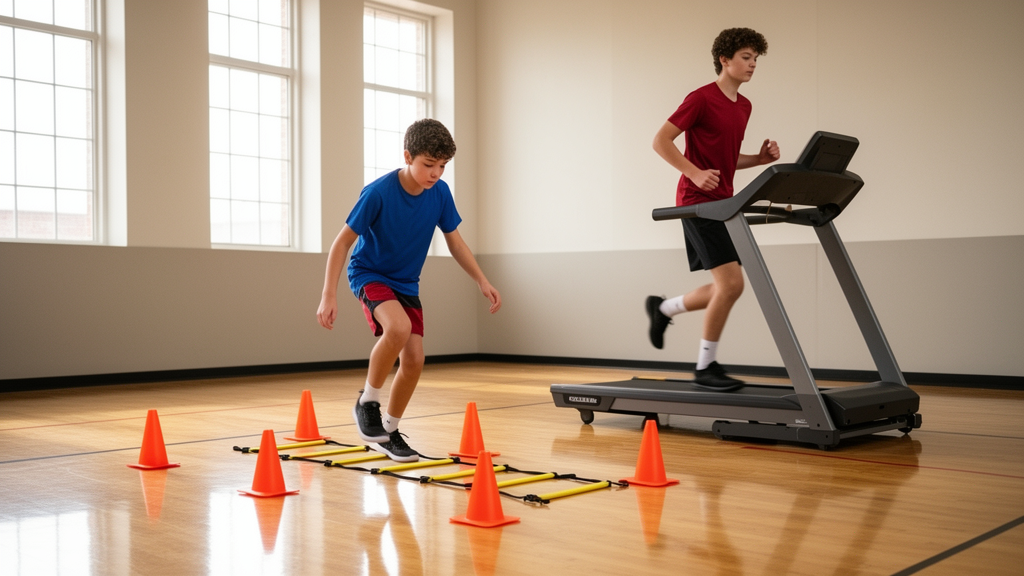
A single session of exercise appears to sharpen attention in adolescent boys, but the type of exercise matters. In a new exploratory study published in Frontiers in Sports and Active Living, researchers in Taiwan report that agility exercise produced the strongest improvements in static and mobile attention, while aerobic cycling delivered the greatest gains in complex attention, among a group of sixty 18-year-old male high school students.
The research team, led by Jiun-Jie Wang of National Taichung University of Education with colleagues at National Tsing Hua University and National Taiwan Normal University, recruited sixty healthy male students from Ruifang Senior Vocational Industrial High School. None of the participants had exercised regularly in the previous three months.
In the Stroop task, participants identify the font color of a word while suppressing the automatic tendency to read the word itself, a classic measure of selective attention and inhibitory control.
Mean heart rates were 99.3 beats per minute in the resistance group, 120.2 in the aerobic group, and 141.4 in the agility group, or roughly fifty, sixty, and seventy percent of maximum heart rate respectively.
After controlling for baseline performance, the analysis of covariance revealed significant group effects in all three attention conditions, with strikingly large effect sizes. For static attention, the group effect was F(3,55) = 84.389, p < .001, with a partial eta squared of .822. For mobile attention, the effect was F(3,55) = 28.466, p < .001, eta squared = .608, and for complex attention, F(3,55) = 44.886, p < .001, eta squared = .710. Bonferroni-adjusted pairwise comparisons showed that the agility group achieved significantly faster completion times than every other group in the static condition, and outperformed the aerobic and control groups in the mobile condition, though it did not differ significantly from the resistance group there. In the complex attention condition, the aerobic group outperformed all other groups, while the agility and resistance groups did not differ significantly from each other.
The pattern of results suggests a degree of modality specificity. Agility training, which demands rapid processing of unpredictable environmental stimuli, frequent attentional shifts, motor planning, and inhibitory control, was associated with the strongest performance in static and mobile attention. Aerobic exercise, by contrast, showed the greatest benefit for complex attention, the condition the authors describe as involving broader integrative cognitive processing. The control group showed the slowest adjusted completion times across all three tasks.
The study’s second, more unconventional contribution lies in its application of the non-parametric cognitive diagnosis model combined with a Q-matrix framework. This approach, drawn from educational and psychological assessment, classifies respondents according to whether they have mastered specific cognitive attributes required by each test item, without assuming particular statistical distributions.
Importantly, the authors emphasize that their mastery classifications are relative rather than absolute. The resulting profiles, presented for all sixty participants, are intended as exploratory and hypothesis-generating rather than as definitive cognitive diagnoses. The authors suggest that such fine-grained attribute-level information could, in future work, inform individualized intervention planning, for example by identifying participants whose profiles suggest they might benefit from particular types of training, though no remedial interventions were actually implemented or tested in this study.
The authors themselves urge considerable caution in interpreting the very large effect sizes. Partial eta squared values of .608 to .822 substantially exceed the small-to-moderate effects typically reported in meta-analyses of acute exercise and cognition, and the authors note that the homogeneous sample of male adolescents, the small group sizes, restricted within-group variability, and possible learning effects from repeated test exposure may all have inflated the estimates. Accuracy scores were uniformly high across groups and conditions, indicating a potential ceiling effect that further limited the interpretability of that measure. The mobile Stroop application showed a strong correlation with the paper-based format in a preliminary validation analysis within this sample, but validation evidence in adolescent athletic populations remains limited.
Several further limitations frame the findings. Only acute, single-session effects were examined, leaving long-term adaptations unaddressed, and the Stroop task captures only a limited slice of executive function. The all-male, single-school sample restricts generalizability across ages, genders, and cultures, and the NPCD classifications await validation against externally referenced mastery criteria. The authors call for replication in larger, more diverse samples using preregistered protocols and confidence intervals for effect-size estimates, along with longitudinal and neuroimaging research to clarify the mechanisms linking different exercise modalities to attentional performance. Within those boundaries, the study offers a preliminary indication that the cognitive consequences of a single workout may depend on what kind of workout it is, and that diagnostic tools from educational measurement might eventually help map those effects at the level of the individual rather than the group.
Subject of Research: Acute effects of different exercise modalities on Stroop test attention performance in male adolescents, analyzed with an exploratory non-parametric cognitive diagnosis model.
Article Title: Effects of acute single-session exercise modalities on stroop test performance in male adolescents: an exploratory study using the nonparametric cognitive diagnosis model
Article References: Wang, J.-J., Li, C.-H., Chiu, W.-H., & Hung, C.-S. (2026). Effects of acute single-session exercise modalities on stroop test performance in male adolescents: an exploratory study using the nonparametric cognitive diagnosis model. Frontiers in Sports and Active Living, 8, 1883836. https://doi.org/10.3389/fspor.2026.1883836
Image Credits: AI Generated
DOI: 10.3389/fspor.2026.1883836
Keywords: agility exercise, aerobic exercise, resistance training, Stroop test, attention, executive function, adolescents, acute exercise, cognitive diagnosis model, Q-matrix, inhibitory control, exercise intensity
News Source: Ophelia Keating. (October 27, 2026). Agility and Aerobic Exercise Show Distinct Acute Effects on Attention in Male Adolescents. Scienmag.