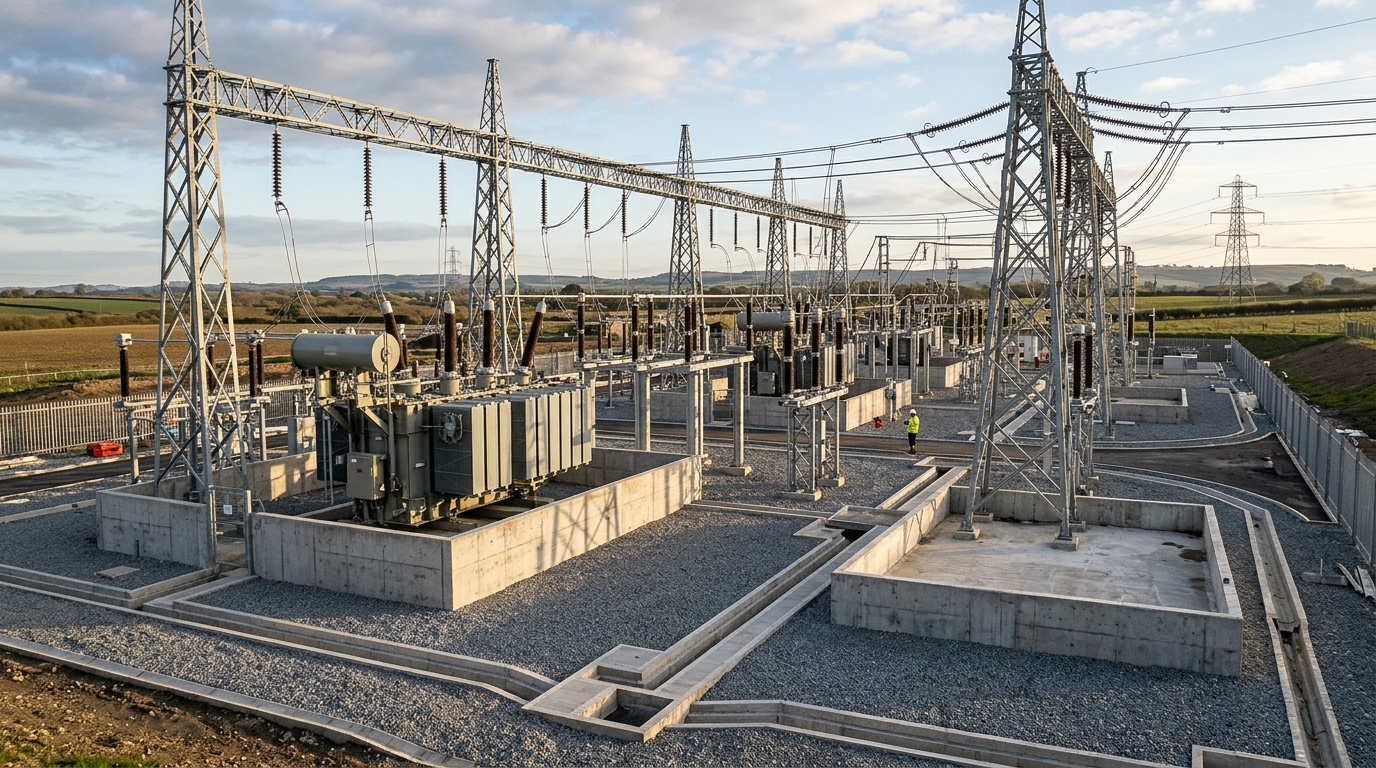
In a controlled single-project study evaluated on an anonymized substation design corpus, researchers demonstrated that an evidence-constrained agentic retrieval-augmented generation framework achieved a 95.0 percent evidence support rate and 97.0 percent cross-section parameter consistency while cutting total operational completion time by 21.4 percent compared to closed-corpus Corrective RAG. The system, termed EC-ARAG and developed by researchers Yizhang Huang and Xinhui Zhang, was tested within a controlled text-only drafting environment for an engineering asset designated as Project X. The authors established that coupling validity-gated retrieval with dual-loop verification and global project-state memory allows language models to synthesize multi-section preliminary design texts without suffering the extensive parameter drift typical of standard pipelines. However, the investigators explicitly cautioned that their measured outcomes reflect within-project repeatability under the evaluated corpus rather than proven generalizability across distinct substation configurations, emphasizing that evidence support must not be conflated with autonomous engineering approval or certified physical calculation correctness.
Substation civil engineering preliminary design documents represent foundational technical deliverables that establish the formal basis for administrative project reviews, investment estimation, multidisciplinary engineering coordination, detailed structural design, and on-site construction preparation. Under standard drafting workflows, these comprehensive deliverables must systematically cover an extensive array of specialized domains, including the project overview, design basis, general layout, functional zoning, architectural planning, structural systems, building and equipment foundations, station roads, vertical planning, site drainage, boundary walls, site entrances, fire-related civil provisions, and key technical indicators. Within this engineering domain, general layout dictates the spatial arrangement and functional zoning of facilities, while vertical planning governs site elevations, grading slopes, and road drainage alignment. Furthermore, standardized typical designs serve strictly as reusable configurations to guide rather than automatically resolve site-specific problems, requiring human engineers to manually coordinate complex interdependencies while reconciling conflicting requirements from diverse historical and national references.
Conventional practice forces human design teams to manually consult disparate regulatory texts, enterprise criteria, standardized typical-design catalogues, and archived project reports to assemble cohesive multi-section deliverables. While standardized design templates help reduce repetitive drafting labor, engineers still expend substantial manual effort parsing conditional regulatory applicability, distinguishing binding mandatory constraints from optional recommendations, verifying recurring numerical values, and resolving discrepancies across disciplinary interfaces. Modern Large Language Models offer powerful text structuring and instruction-following capabilities, but their static parametric weights cannot guarantee that technical assertions remain chronologically current, conditionally applicable, complete, or traceable. Although standard Retrieval-Augmented Generation connects generative models with external text corpora to anchor statements to factual context, conventional retrieval mechanics optimize primarily for lexical or semantic similarity rather than verified engineering validity, leaving automated pipelines highly vulnerable to retrieving conditionally incompatible clauses and producing unverified assertions.
The researchers observed three fundamental methodological limitations that have historically hindered the successful deployment of retrieval-augmented generation across complex civil engineering workflows. First, existing technical retrieval systems do not systematically preserve or evaluate the specific conditional constraints governing regulatory clauses, meaning that semantically similar passages are frequently retrieved even when invalidated by mismatched voltage classes, foundation types, building categories, or structural configurations. Second, conventional frameworks treat preliminary design as isolated question-answering tasks rather than document-level synthesis, failing to ensure that claims generated across successive chapters remain faithful to locked project parameters. Third, traditional multi-source retrieval treats reference documents as interchangeable text chunks, completely ignoring institutional hierarchy, source authority, publication dates, and operational roles. In real-world engineering, project inputs provide confirmed factual anchors, national standards impose mandatory constraints, typical designs provide reusable guidelines, and historical project files offer stylistic precedent that should never supersede binding standards.
To overcome these structural limitations, the authors developed the EC-ARAG framework, which coordinates six specialized functional layers spanning corpus ingestion, regulation-aware evidence representation, validity-gated hybrid retrieval, source-role-aware conflict resolution, dual planning-retrieval and generation-verification-repair loops, and document-level project-state memory. The system architecture structures raw regulations into formal schema-governed evidence units that capture the original text, constrained engineering object, conditional criteria, prescribed actions, numerical intervals, measurement units, legal exceptions, obligation modalities, authority levels, version metadata, and cross-references. Simultaneously, confirmed project facts are represented with explicit entity tags, numerical values, and verification states ranging from confirmed to provisional. A dedicated planning agent decomposes each assigned chapter into atomic design propositions, while an adaptive retrieval router queries a property graph and dense vector indices. Candidate passages are filtered through validity gates before reaching generation agents, guaranteeing that text synthesis proceeds solely from admissible evidence and locked project memory.
To evaluate the framework under rigorous conditions while preventing data contamination, the authors assembled an experimental corpus consisting of 36 national and industry standards, 12 enterprise specifications, 18 typical-design documents, 64 historical preliminary design reports, and nine confirmed project-input documents. The initial historical repository of 92 files was systematically sanitized by computing file hashes to eliminate eight exact duplicates, manually removing seven Project X files and five derivative drafts, and screening near-duplicate candidates using BGE-M3 embedding cosine similarities above a 0.92 threshold. Crucially, the completed Project X reference document was strictly isolated from retrieval corpora, section schemas, prompt engineering, query formulations, parameter selection, and agent configuration. The held-out experimental evaluation comprised 120 specialized retrieval queries, 80 conditional applicability challenges, 48 multi-source evidence conflict cases, 318 atomic design propositions, and five fully independent end-to-end generation trials across the complete preliminary design document scope.
In rigorous empirical benchmarking against the held-out test suite, EC-ARAG achieved a Recall@5 of 94.1 percent and an applicability Macro-F1 score of 90.6 percent, demonstrating strong sensitivity to conditional engineering constraints. Across full multi-section drafting runs, the architecture achieved a 95.0 percent evidence support rate, 96.0 percent section completeness, and a cross-section parameter consistency score of 97.0 percent across recurring engineering parameters. To examine resilience against flawed inputs, the authors conducted expanded robustness evaluations featuring 120 state-write gating cases and 24 deliberate erroneous-state propagation stress tests. The internal state-write gate achieved an F1 score of 94.1 percent and successfully intercepted 22 of the 24 injected early-state write errors before memory admission, preventing cascading parameter corruption. The overall generation pipeline restricted unsafe engineering claims to 3.4 percent and recorded a character-level manual edit rate of only 7.6 percent during downstream technical review.
The study also analyzed the computational and operational trade-offs introduced by multi-agent reflection, verification loops, and state tracking. Although the continuous claim-level verification and iterative local repair routines substantially increased machine inference latency compared to simple unconstrained generation, the overall operational completion time was 21.4 percent lower than that of closed-corpus Corrective RAG. This net operational saving emerged because the marked reduction in unsupported assertions, parameter drift, and cross-section contradictions significantly decreased the manual editing and verification burden imposed on human engineering reviewers. Rather than forcing senior human designers to comb through hundreds of unverified assertions and correct drifted numerical values across multiple project chapters, the framework produced structured drafts with high evidence traceability, clear conflict ledgers, and explicit abstention flags that directed human attention solely to unconfirmed items.
Methodologically, the authors emphasized that EC-ARAG does not claim to introduce a fundamentally new foundation model or learning algorithm, but rather provides an engineering-oriented control architecture over established language models, graph retrieval, and agentic workflows. By treating evidence as an institutional object characterized by source precedence, conditional applicability, and explicit abstention rules, the framework establishes a verifiable mechanism for grounded technical synthesis. The document-level state machine formalizes inter-section dependencies so that parameters established in preliminary chapters—such as building footprint, floor count, structural framing, foundation specifications, road geometry, and technical economic indicators—are carried forward without drift into downstream foundation and site planning chapters. This explicit coupling of verified state propagation and claim-level auditability bridges the divide between open-ended conversational agents and the strict governance demands of heavy industrial engineering documentation.
Despite these favorable numerical results, the authors outlined substantial operational boundaries and safety limitations governing the practical interpretation of their findings. The primary evaluation was conducted exclusively as a text-only investigation centered on the Project X corpus, deliberately omitting site survey maps, photographic data, point clouds, structural calculation engines, and three-dimensional Building Information Modelling geometry. Because geometric coordinates, geotechnical bore profiles, topographic grading models, and structural loading calculations were represented solely through textual statements, the authors stressed that textual evidence support cannot serve as a proxy for structural safety, physical equilibrium, or geometric feasibility. Furthermore, the reported metrics validate repeatability within the single evaluated Project X environment rather than universal reliability across disparate electrical voltage tiers, regional seismic categories, or heterogeneous organizational knowledge bases. Consequently, the research team reiterated that automated evidence-constrained generation must remain an assistive drafting tool, leaving ultimate statutory engineering approval and design liability entirely with qualified human professionals.
Subject of Research: Agentic retrieval-augmented generation for substation civil engineering preliminary design documents
Article Title: Evidence constrained agentic retrieval augmented generation for substation civil engineering preliminary design documents in a single project study
Article References: Huang, Y., & Zhang, X. (2026). Evidence constrained agentic retrieval augmented generation for substation civil engineering preliminary design documents in a single project study. Discover Artificial Intelligence, 6(1), Article 1806. https://doi.org/10.1007/s44163-026-02612-2
Image Credits: AI Generated
DOI: 10.1007/s44163-026-02612-2
Keywords: retrieval-augmented generation, agentic AI, civil engineering, substation design, knowledge management, document generation, engineering informatics, natural language processing, Evidence, constrained, agentic, retrieval
News Source: Denise Maddox. (November 13, 2026). Agentic Retrieval System Improves Preliminary Civil Engineering Documents in Single Substation Study. Scienmag.