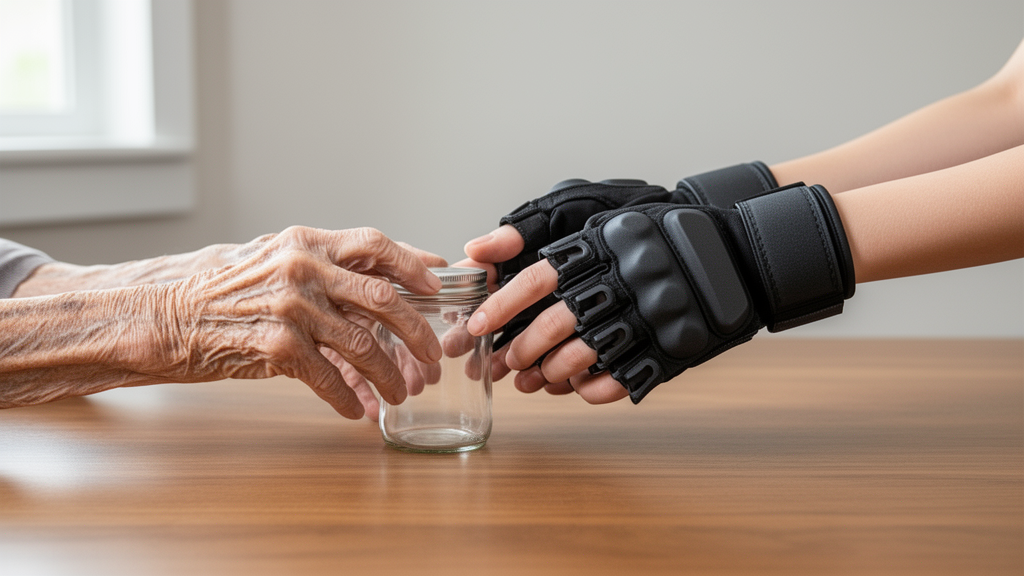
A new systematic review in the European Journal of Ageing has now examined how well these devices actually reproduce age-related declines in hand function, and its conclusion is cautious: they reduce hand performance, but only partially replicate the effects of ageing.
The review, conducted by Esma Hidayet Lüleci, Lukenny Freire Tinta and Angela E. Kedgley, set out to identify studies that used age simulation suit hand modules or age simulation gloves to reproduce age-related decline in hand function, and to critically assess how effective and realistic those simulations are. The authors also propose an assessment framework for future studies in this field.
The researchers searched five electronic databases — PubMed, Scopus, Web of Science (including MEDLINE), CINAHL and Cochrane — with no restrictions on language or publication date. From 1620 records identified, 24 studies proceeded to full-text screening, and four studies met the final inclusion criteria: each had to involve an age simulation suit hand module or age simulation glove and report physical, quantitative outcomes. Risk of bias was evaluated using the ROBINS-I tool.
The outcomes measured across the included studies covered several dimensions of hand performance. These included grip strength assessed with a Jamar dynamometer, fine motor dexterity assessed with the Purdue Pegboard Test, performance of activities of daily living assessed with the Sollerman Hand Function Test, and a study-specific carrying cube test, with reported reliability for the measures used.
Across those studies, the simulation produced large declines in grip strength, fine dexterity and activities of daily living performance. Wearing the gloves or hand modules clearly made hand-based tasks harder for the wearers, consistent with the intention behind these devices.
However, the review found an important caveat. The reductions observed under simulation did not consistently align with normative data for older adults. In other words, the magnitude of the simulated decline did not reliably match the reductions that are actually referenced to age in the general population. The authors conclude that applications of age simulation suits and gloves reduce hand performance, but only partially replicate the effects of ageing.
On the basis of this analysis, the review recommends that future studies consider multiple hand assessments beyond strength and dexterity, align participants’ baselines with normative age ranges, analyse the relative decline against age-referenced reductions, and interpret results using proportional changes rather than absolute scores alone. These suggestions form the assessment framework the authors outline for the field.
Because only four studies met the review’s inclusion criteria, the evidence base for judging the accuracy of these devices remains small, and the findings should be understood as an assessment of the existing literature rather than a definitive measure of any single glove’s performance. The review is published as an open-access article and, at the time of this report, is available as a peer-reviewed accepted manuscript carrying a permanent DOI, subject to further editorial edits before the final version of record.
Subject of Research: How accurately age simulation gloves reproduce age-related decline in hand function
Article Title: Accuracy of age simulation gloves: a systematic review
Article References: Lüleci, E. H., Freire Tinta, L., & Kedgley, A. E. (2026). Accuracy of age simulation gloves: a systematic review. European Journal of Ageing. https://doi.org/10.1007/s10433-026-00948-3
Image Credits: AI Generated
DOI: 10.1007/s10433-026-00948-3
Keywords: age simulation gloves, ageing suits, hand function, grip strength, fine motor dexterity, systematic review, empathy training, activities of daily living, gerontology, simulation accuracy, Accuracy, simulation
News Source: Beatrice Stafford. (October 28, 2026). Age simulation gloves only partly mimic how ageing weakens the hand. Scienmag.