“[…] we see our work as an indication that combining different molecular data types could be a general strategy to improve future aging clocks.”
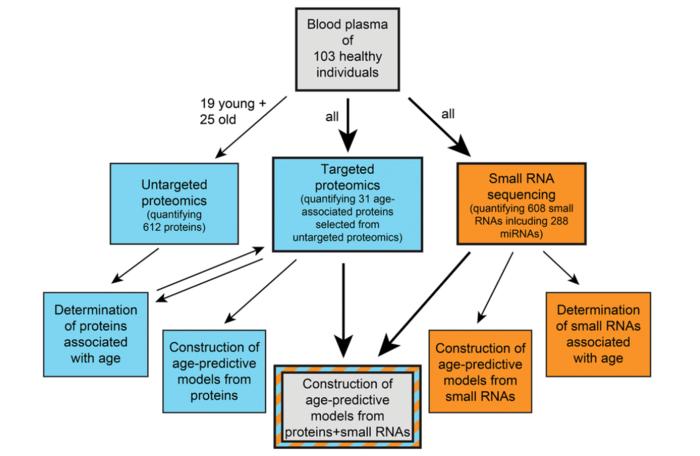
Credit: 2023 Salignon et al.
“[…] we see our work as an indication that combining different molecular data types could be a general strategy to improve future aging clocks.”
BUFFALO, NY- June 30, 2023 – A new research paper was published on the cover of Aging (listed by MEDLINE/PubMed as “Aging (Albany NY)” and “Aging-US” by Web of Science) Volume 15, Issue 12, entitled, “Age prediction from human blood plasma using proteomic and small RNA data: a comparative analysis.”
Aging clocks, built from comprehensive molecular data, have emerged as promising tools in medicine, forensics, and ecological research. However, few studies have compared the suitability of different molecular data types to predict age in the same cohort and whether combining them would improve predictions. In this new study, researchers Jérôme Salignon, Omid R. Faridani, Tasso Miliotis, Georges E. Janssens, Ping Chen, Bader Zarrouki, Rickard Sandberg, Pia Davidsson, and Christian G. Riedel from Karolinska Institutet, University of New South Wales, Garvan Institute of Medical Research, and AstraZeneca explored this at the level of proteins and small RNAs in 103 human blood plasma samples.
“Here we expand the limited portfolio of comparisons between aging clocks built from different types of molecular data from the same cohort.”
First, the researchers used a two-step mass spectrometry approach measuring 612 proteins to select and quantify 21 proteins that changed in abundance with age. Notably, proteins increasing with age were enriched for components of the complement system. Next, they used small RNA sequencing to select and quantify a set of 315 small RNAs that changed in abundance with age. Most of these were microRNAs (miRNAs), downregulated with age, and predicted to target genes related to growth, cancer, and senescence. Finally, the team used the collected data to build age-predictive models.
Among the different types of molecules, proteins yielded the most accurate model (R² = 0.59 ± 0.02), followed by miRNAs as the best-performing class of small RNAs (R² = 0.54 ± 0.02). Interestingly, the use of protein and miRNA data together improved predictions (R2 = 0.70 ± 0.01). Future work using larger sample sizes and a validation dataset will be necessary to confirm these results.
“Nevertheless, our study suggests that combining proteomic and miRNA data yields superior age predictions, possibly by capturing a broader range of age-related physiological changes. It will be interesting to determine if combining different molecular data types works as a general strategy to improve future aging clocks.”
Read the full study: DOI: https://doi.org/10.18632/aging.204787
Corresponding Author: Christian G. Riedel – [email protected]
Keywords: human blood plasma small RNAs proteomics aging age prediction
Sign up for free Altmetric alerts about this article: https://aging.altmetric.com/details/email_updates?id=10.18632%2Faging.204787
About Aging-US:
Launched in 2009, Aging (Aging-US) publishes papers of general interest and biological significance in all fields of aging research and age-related diseases, including cancer—and now, with a special focus on COVID-19 vulnerability as an age-dependent syndrome. Topics in Aging go beyond traditional gerontology, including, but not limited to, cellular and molecular biology, human age-related diseases, pathology in model organisms, signal transduction pathways (e.g., p53, sirtuins, and PI-3K/AKT/mTOR, among others), and approaches to modulating these signaling pathways.
Please visit our website at www.Aging-US.com and connect with us:
- SoundCloud
- YouTube
- LabTube
Click here to subscribe to Aging publication updates.
For media inquiries, please contact [email protected].
Aging (Aging-US) Journal Office
6666 E. Quaker Str., Suite 1B
Orchard Park, NY 14127
Phone: 1-800-922-0957, option 1
###
Journal
Aging-US
DOI
10.18632/aging.204787
Method of Research
Data/statistical analysis
Subject of Research
Human tissue samples
Article Title
Age prediction from human blood plasma using proteomic and small RNA data: a comparative analysis
Article Publication Date
20-Jun-2023