Researchers have developed an open-source laboratory system called Drosben that combines 3D-printed hardware, color-coded paper datasheets, and computer-vision software to reduce fruit fly lifespan assay labor by eighty-five percent. While Drosophila melanogaster is a foundational model across aging, immunity, toxicology, and metabolic research, measuring longevity has traditionally demanded exhausting manual labor to maintain large cohorts. The reported platform enables researchers to flip multiple vials simultaneously without costly robotics or volatile anesthetics that could alter insect physiology. Benchmarking trials across novice and veteran laboratory personnel demonstrated that the apparatus accelerates vial transfers three-fold to five-fold while maintaining experimental accuracy.
Survival analysis provides crucial quantitative insight into how genetic modifications, environmental perturbations, and pharmacological treatments shape organismal vitality throughout adult life. Fruit flies are well suited for longevity studies because their compact size, low culturing costs, and typical adult lifespan under one hundred days permit laboratories to track cohorts encompassing thousands of individuals. However, acquiring high-quality survival curves requires continuous manual maintenance known as flipping, wherein surviving flies are transferred into fresh culture media every two to three days to avoid medium degradation. Historically, technicians performed this task by manually inverting individual vials, tapping the insects into fresh containers, and manually counting every deceased or escaped animal. Although specialized robotic systems can flip vials in massive institutional repositories, such installations remain financially prohibitive for most academic laboratories and rely on anesthetics that disrupt longitudinal survival evaluations.
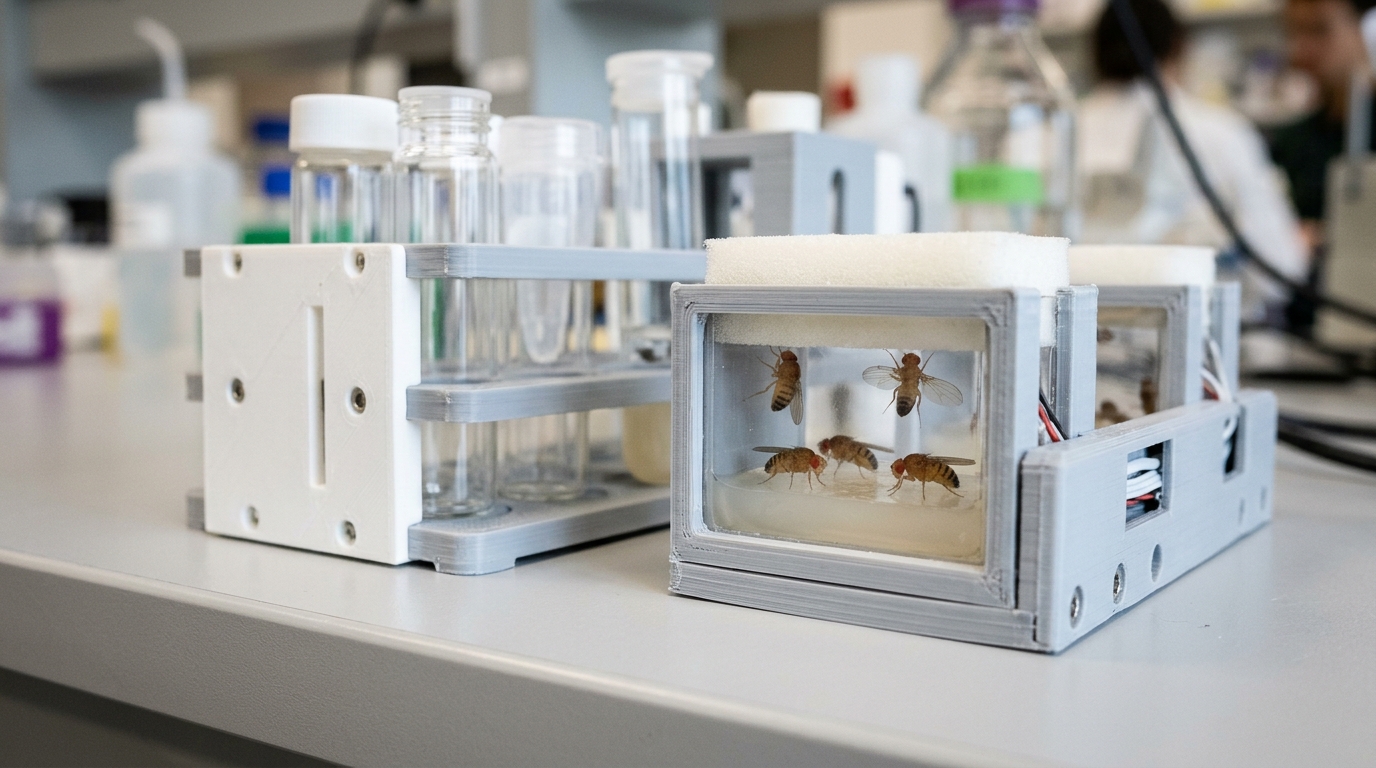
To overcome manual bottlenecks without expensive equipment, the researchers designed Drosben around an entirely mechanical transfer process utilizing interconnected modular components. The hardware centers on custom racks holding twelve standard polystyrene culture vials in a honeycomb arrangement that conserves incubator space by allowing storage on either the base or the spine. Instead of plugging individual vials with foam bungs, an entire twelve-vial cohort is secured simultaneously using a collective lid fitted with embedded rare-earth magnets. During transfers, the magnetic lid is temporarily replaced by an intermediary chamber known as the multiflipper, which aligns twelve extruded acrylic tubes over the racked vial openings. A mobile slider mechanism within the multiflipper enables handlers to open or close all twelve chamber passages at once, ensuring individual vial positions are consistently preserved across the array throughout serial flips.
The physical apparatus was engineered for rapid fabrication using consumer 3D printers and common laboratory supplies. Structural parts, including housing racks, collective lids, multiflipper bodies, sliders, and depositor guides, were modeled in FreeCAD and Autodesk Fusion before being archived in open-access online repositories. Fabrication benchmarks on entry-level printers, including the Anycubic i3 Mega, Prusa i3 MK3S+, and Bambu Lab A1mini, demonstrated consistent results using standard 1.75-millimeter polylactic acid or acrylonitrile butadiene styrene filaments with 0.4-millimeter nozzles. The authors utilized polylactic acid with twenty-five percent infill and sub-0.2-millimeter layer heights, noting fabricated components suffered no mechanical degradation after months inside humidified incubators maintained between twenty-five and thirty degrees Celsius. Assembly requires only cyanoacrylate glue, acrylic cement, cut carbon-steel nail shafts for rigidity, woven stainless steel wire mesh or nylon fabric, and grade-N52 neodymium disc magnets.
Accompanying the hardware is an integrated computational pipeline written in Python 3.11 and R 4.6.0 that automates experimental tracking from setup through final survival analysis. Investigators input experimental variables—such as genotypes, drug treatments, sex, and cohort numbers—into an Excel template, which the software converts into printable, rack-specific datasheets and identifying pouch labels. To eliminate confirmation bias, the system can assign randomized alphanumeric identifiers or QR codes to maintain blinded testing conditions during daily handling. Laboratory personnel record daily events on printed datasheets by marking circular grids corresponding to the honeycomb tube array using distinct colored pens for confirmed deaths, censorings, and carried-over carcasses. These sheets are digitized using flatbed document scanners or photocopiers at resolutions exceeding two hundred pixels per inch, after which computer-vision algorithms extract markings, rectify rotational skew, verify event tallies, and compile digital life tables.
Conducting longevity experiments follows a standardized five-step operating protocol designed to minimize insect stress while maximizing administrative efficiency. Newly emerged adult flies mate for forty-eight hours before being sorted by sex and loaded into fresh twelve-vial racks using a custom depositor lid fitted with flexible neoprene rubber cuspid valves. This initial loading step deposits ten to fifteen flies per vial and takes under five minutes per rack, keeping carbon dioxide exposure safely below toxicological thresholds. Routine passaging occurs three days per week: handlers dock the multiflipper onto the culture rack, withdraw the slider, tap flies into the acrylic chambers, replace the exhausted rack with fresh tubes, and tap the cohort into new vials. Handlers inspect vacated tubes to tally dead flies stuck in food, note escaped or live-stuck individuals as censored, and record loose dead bodies transferred into fresh vials as carried-overs, which software back-dates upon immobilization.
Controlled benchmarking trials demonstrated that the integrated system delivers massive time savings across all levels of laboratory experience. In parallel longitudinal trials tracking identical cohorts, a novice researcher with three months of fly-handling experience spent 130 minutes managing flies under conventional flipping, but required only twenty minutes using Drosben, an eighty-five percent reduction in labor. An intermediate researcher with over one year of experience achieved an eighty-three percent reduction, decreasing cumulative passaging time from ninety-one minutes conventionally to sixteen minutes with the new platform. To evaluate broader usability, the authors recruited eleven independent researchers from Cardiff University whose experience spanned from four months to twenty years, categorizing them into novice, intermediate, and expert cohorts. While experienced researchers handled conventional vials faster than novices, every participant achieved a three-fold to five-fold speed increase with the multi-vial system, proving the hardware accelerates workflow regardless of prior dexterity.
The experimental trials also highlighted the biological sensitivity of fruit flies to mechanical handling forces during batch transfers, leading to crucial procedural recommendations. In the novice researcher’s comparative trial, flies transferred using Drosben exhibited elevated mortality compared to conventionally flipped controls, reflected in a Cox proportional hazards regression ratio of 1.40 with a p-value of 0.04. Conversely, the intermediate researcher’s cohorts exhibited a non-significant protective effect under Drosben handling, yielding a hazard ratio of 0.80 with a p-value of 0.07. Observational analysis revealed that the novice handler struck the multi-vial apparatus against the benchtop with excessive physical force during transfer maneuvers. Because repetitive mechanical trauma compromises fruit fly survival, the authors concluded sub-optimal handling technique caused the observed mortality increase.
A comprehensive cost behavior analysis demonstrated that implementing the Drosben methodology requires minimal initial capital and scales exceptionally well for high-capacity longevity screening. Fabricating foundational components—including a depositor stencil, multiflipper, slider, depositor, two racks, and a lid—costs approximately £71 in baseline materials, rising to approximately £120 or £300 if a laboratory must purchase hand tools or a desktop 3D printer. Individual component costs remain remarkably low, with printing and assembling a dual-rack set costing £2.28, a collective lid costing £0.90, a depositor costing £3.49, and a multiflipper costing £38.91 in raw plastic, acrylic, and hardware. Under a baseline workflow of four passaging hours three times weekly at thirty-two seconds per rack, a single operator can manage cohorts of up to 27,000 flies before requiring an additional multiflipper and technician. The authors determined an entire laboratory could expand experimental throughput to maintain 30,000 flies simultaneously for a one-off capital investment of approximately £900.
The research team further validated the platform by investigating whether embedded rare-earth magnets or common chemical degron ligands alter baseline Drosophila lifespan. Modeling indicated that flies in vials closest to the N52 neodymium magnets experienced static magnetic fields up to 1,790 microteslas—substantially exceeding the Earth’s natural background of twenty-five to sixty-five microteslas—yet log-rank trend testing demonstrated no significant effect on longevity across tube positions. In subsequent pharmacological evaluations, the authors investigated chronic feeding of compounds used to regulate Auxin-Inducible Degron and Destabilizing Domain protein systems at concentrations up to ten millimolar. Chronic ingestion of indole-3-acetic acid and 1-naphthalene-acetic acid mildly shortened adult lifespan across both sexes, yielding hazard ratios of 1.37 and 1.68, respectively. In contrast, the antibiotic trimethoprim significantly extended female longevity without affecting males, producing a protective hazard ratio of 0.73 at ten millimolar. These physiological responses demonstrate that degron-regulating compounds are not biologically inert in fruit flies, while establishing Drosben as a highly efficient, scalable system for modern biomedical aging research.
Subject of Research: Scalable survival analysis and open-source laboratory hardware for Drosophila melanogaster lifespan assays
Article Title: Drosben, an affordable system for scalable survival analysis in Drosophila
Article References: Trinca, T. M., Berenguer-Molins, P., Fernandez-Garcia, C., & de Navascués, J. (2026). Drosben, an affordable system for scalable survival analysis in Drosophila. Frontiers in Cell and Developmental Biology, 14, Article 1926696. https://doi.org/10.3389/fcell.2026.1926696
Image Credits: AI Generated
DOI: 10.3389/fcell.2026.1926696
Keywords: Drosophila melanogaster, survival analysis, lifespan assays, open-source hardware, 3D-printed laboratory equipment, Drosben, indole-3-acetic acid, 1-naphthalene-acetic acid, trimethoprim, targeted protein degradation, auxin-inducible degron, static magnetic fields, aging research, computer vision, Cox proportional hazards, laboratory automation, biomedical assays
News Source: Drew Townsend. (November 19, 2026). Affordable 3D-Printed System Dramatically Cuts Labor in Fruit Fly Lifespan Assays. Scienmag.