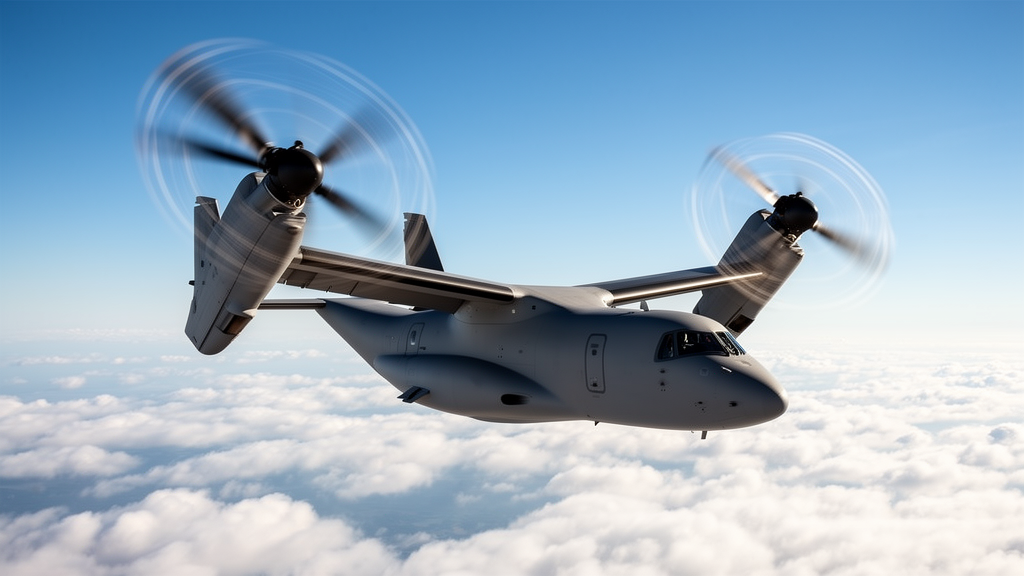
A computational investigation led by researchers Mengtian Wang, Tai Jin, and Yao Zheng has established an advanced numerical framework to resolve the complex dynamic thrust characteristics of propellers operating in oblique flows throughout the continuous conversion mode of tiltrotor aircraft. During the operational transition between vertical hover and forward cruising flight, tiltrotors pass through an aerodynamic conversion mode marked by pronounced nonlinear behaviors that critically dictate transition efficiency, flight safety, and operational reliability. Propeller propulsion systems operating in this conversion phase experience oblique inflow conditions where the flight trajectory is misaligned with the rotational axis of the blades. To capture these unsteady aerodynamic interactions without resorting to the oversimplifications of static tilt angles or idealized volumetric force models, the research team developed a dynamic simulation workflow utilizing an overset mesh methodology capable of tracking continuous rotational and pitching motions simultaneously.
In a continuous tiltrotor transition, the orientation of the propeller nacelle tilts progressively upward and forward, introducing significant angular misalignment and forming a pinch angle against the oncoming freestream air. The researchers noted that while extensive historical investigations have examined steady-state edgewise flight or fixed cruise orientations in isolation, dynamic transitions involving continuous variation of the tilt angle remain sparsely documented due to the physical difficulties and instrumentation limits of experimental testing. Common dynamic mesh methodologies frequently suffer from significant computational cell distortion or numerical divergence when large-displacement mechanical movements occur. By contrast, the implementation of overset meshing allows independent generation and movement of body-fitted blade grids within stationary background domains, preventing geometric mesh skewness and maintaining numerical precision over extreme spatial motions across six degrees of freedom.
The computational domain and geometric configurations adopted in the study were modeled directly on an established experimental propeller-wing assembly to ensure realistic physical interactions between the rotating blades and the stationary aerodynamic lifting surfaces. The physical configuration featured a standard 8038 propeller coupled with an unswept rectangular wing characterized by a constant chord length of 0.1 meters, a total wingspan of 0.4 meters, and a B-29 TIP airfoil section oriented at an angle of attack of six degrees. The tilting rotation center was positioned at the exact height of the wing leading edge, offset by 0.08 meters ahead of the leading edge with a defined tilt radius of 0.07 meters. In the initial cruise flight configuration, the propeller hub center was situated 0.15 meters ahead of the wing leading edge. Numerical solutions were executed within the OpenFOAM computational fluid dynamics platform utilizing the overPimpleDyMFoam solver, which resolves unsteady, incompressible flow fields using the Reynolds-averaged Navier-Stokes equations closed with the standard two-equation k-epsilon turbulence model.
To ensure numerical accuracy and solution stability across disparate operational phases, pressure-velocity coupling was computed through the combined PIMPLE algorithm, blending steady-state SIMPLE iterations with dynamic PISO corrections across each pseudo time step. Spatial discretization utilized a robust second-order upwind differencing scheme, while physical temporal advancement was maintained via an implicit Euler scheme alongside an adaptive time-stepping protocol constrained by a maximum Courant number of unity. Mesh resolution sensitivity was rigorously analyzed using three spatial grid densities ranging from 514,000 cells up to 2.0 million cells, evaluating background cell resolution alongside boundary refinement layers over both the wing and the propeller surfaces. Grid independence evaluations showed that calculated wing lift histories stabilized consistently between the 1.68 million and 2.0 million cell configurations, with boundary layer first-cell spacings yielding representative wall y-plus values between 43 and 51 on the wing and 11.3 to 37.7 near the propeller blade tips. Consequently, the medium mesh comprising 1.68 million cells was retained for all production simulation runs.
Validation of the computational framework was established by comparing computed aerodynamic parameters against benchmark experimental measurements. Preliminary solver schemes were verified against experimental pressure coefficient records from Helishape 7A rotor tests at spanwise blade sections of 0.82R for azimuthal orientations of 90 degrees and 180 degrees, exhibiting strong agreement with measured values. Furthermore, simulation results for the propeller-wing assembly across varying advance ratios were compared directly against wind tunnel lift coefficient measurements. Both empirical wind tunnel tests and the current numerical model recorded consistent diminishing trends in the overall wing lift coefficient as the advance ratio increased, with more pronounced lift depreciation occurring at lower advance ratios. Having verified that baseline flow fields stabilized within 0.08 seconds of cruise operation, the simulated transition phase commenced with uniform mechanical tilting from a cruise tilt angle of zero degrees to an edgewise flight angle of ninety degrees over a controlled duration of 1.0 second under a fixed freestream velocity of six meters per second.
Detailed flow field examinations demonstrated that the dynamic thrust generated by the propeller increases progressively as the mechanical tilt angle advances from cruise to edgewise flight, an effect further amplified when operating at reduced advance ratios. This thrust amplification is largely driven by a reduction in effective normal inflow entering the blade disk as the rotor pitches upward, progressively increasing the local effective blade angle of attack. Simultaneously, the wake and concentrated slipstream generated by the spinning propeller are deflected directly toward the upper surface of the trailing wing structure. Unlike conventional tractor aircraft where slipstream flows cleanly pass downstream, the tilting motion forces the propeller wake into the wing, creating a localized aerodynamic blockage effect analogous to ground effect. This aerodynamic interference elevates static pressure in the intervening region between the propeller disk and the wing leading edge, which in turn feeds back into the rotor disk to augment overall mechanical thrust production.
The continuous pitching motion also introduced substantial cyclic fluctuations in the aerodynamic loads sustained across the propeller disk. In cruise configuration, advancing and retreating blades experience largely symmetric relative velocities, yielding nearly identical chordwise pressure coefficient distributions between the opposing blade sections. However, as the tilt angle increases in continuous conversion mode, the incoming oblique airflow introduces severe velocity asymmetries between the advancing and retreating blades. At an advance ratio of 0.533 and full tilt, the maximum local pressure difference across the advancing blade chord at radial station 0.75R reached 3.7 times that observed on the retreating blade. Conversely, when the advance ratio was reduced to 0.20, higher blade rotational velocities diminished the relative impact of the incoming freestream crossflow, lowering the peak pressure ratio between advancing and retreating blades to 2.2, representing a 40.5 percent reduction in loading asymmetry compared to the higher advance ratio condition.
Decomposition of the total resultant propeller force revealed distinct behavioral partitions between the forward horizontal force component and the vertical normal force component across varying advance ratios. Throughout the 90-degree conversion trajectory, the dominant force vector gradually transitions from purely propulsive horizontal thrust to vertical sustaining lift. The crossover point where vertical forces surpass forward thrust occurred systematically earlier at higher advance ratios. Notably, at an advance ratio of 0.533, the forward force component exhibited an initial rise before decreasing, whereas lower advance ratios exhibited monotonic forward force declines. Comparative analyses showed that the advance ratio exerted negligible influence on the absolute trajectory of the vertical force coefficient across most operating points, meaning that the advance ratio predominantly governs total dynamic thrust by modifying the magnitude of the forward horizontal thrust component throughout the continuous tilting maneuver.
Crucially, the study determined that the resultant aerodynamic force vector produced by the propeller does not align coaxially with the mechanical tilt angle of the propeller shaft. Because aerodynamic forces must simultaneously generate axial thrust while overcoming rotational blade profile drag, the resultant force direction consistently exceeded the physical tilt angle by an angular deviation ranging from two degrees to ten degrees. This angular discrepancy widened systematically as the advance ratio increased, driven by escalating blade loading imbalances and heightened rotational resistance induced by oblique freestream ingestion.
To make these findings directly applicable to propulsion engineering and trajectory planning, the authors formulated an analytical relationship for an equivalent inflow velocity capable of substituting complex oblique conditions into classical blade element and vortex equations. By calculating the cruise-equivalent inflow velocity required to replicate the instantaneous dynamic thrust produced at any given tilt angle, the researchers established that the equivalent velocity correlates tightly with a cosine function of the tilt angle governed by the formula Veq equals V0 multiplied by the cosine of keq times alpha. Linear regression across tested advance ratios demonstrated that the angular scaling coefficient satisfies keq equals minus 0.37 times J plus 1.28, achieving an R-squared correlation of 0.992.
Subject of Research: Aerodynamic thrust dynamics of tiltrotor propellers during continuous mode conversion
Article Title: Dynamic thrust of the propeller in oblique flows in continuous conversion mode of tiltrotor
Article References: Wang, M., Jin, T., & Zheng, Y. (2025). Dynamic thrust of the propeller in oblique flows in continuous conversion mode of tiltrotor. Advances in Aerodynamics, 7(1), Article 20. https://doi.org/10.1186/s42774-025-00212-9
Image Credits: AI Generated
DOI: 10.1186/s42774-025-00212-9
Keywords: Tiltrotor aerodynamics, Dynamic thrust, Continuous conversion mode, Overset mesh method, Computational fluid dynamics, Propeller wing interaction, Advance ratio, Oblique flow, Dynamic, thrust, propeller, oblique
News Source: Audrey Campbell. (November 12, 2026). Aerodynamic Simulations Reveal Tiltrotor Propeller Thrust Dynamics During Continuous Conversion Flights. Scienmag.