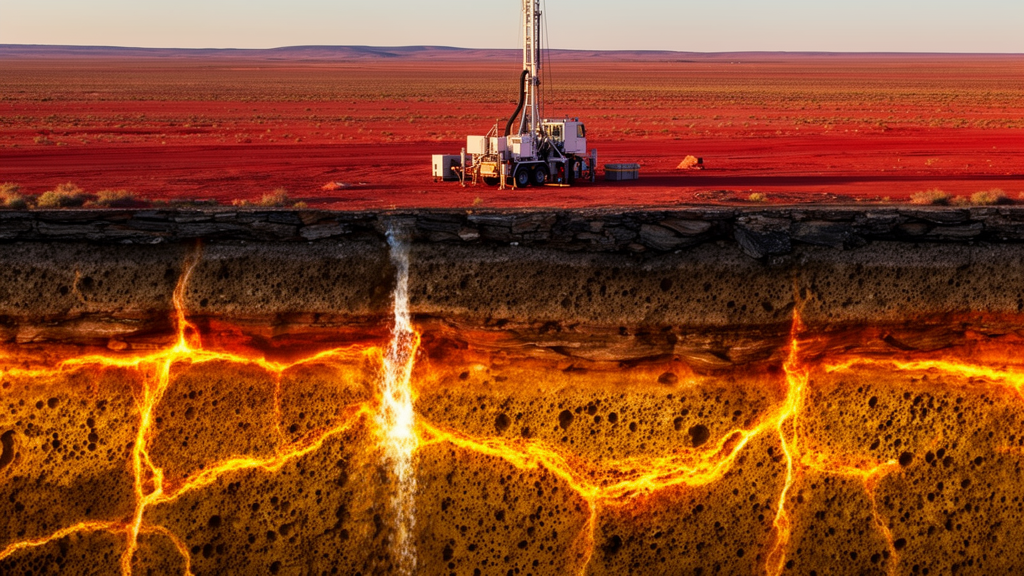
The study, published in the journal Geothermal Energy, integrates petrophysical analysis, seismic interpretation, and thermal energy assessment to evaluate the viability of the formation near the previously unsuccessful Celsius-001 well. The central finding is that the Hutton Sandstone, located in the Nappamerri Trough, contains temperatures exceeding 120 degrees Celsius, high thermal conductivity, and net sand thicknesses over 60 meters, making it a potential hot sedimentary aquifer (HSA) for geothermal power generation.
The Cooper and Eromanga Basins are situated in the central shield province of Australia, a tectonically stable region characterized by old, hot basement rocks. The basement rock in this area exhibits high radiogenic heat production, exceeding 5 microwatts per cubic meter, which drives the region’s high geothermal gradients. This thermal anomaly is largely attributed to the Big Lake Suite Granodiorite, a Carboniferous-age intrusion rich in radioactive elements such as uranium, thorium, and potassium. The thick overlying sedimentary strata act as a thermal blanket, insulating the heat and allowing temperatures to reach up to 250 degrees Celsius at depths of 4.2 kilometers in some parts of the basin.
The motivation for this study stems from the failure of the Celsius-001 exploration well, which was drilled into the Hutton Sandstone but failed to yield the anticipated flow rates for economic power generation. Previous analyses attributed this failure to diagenetic factors that reduced reservoir permeability or formation damage. By leveraging these lessons, the research team sought to identify a location with better reservoir characteristics and lower geological risk. The study focuses on the area around the Gashnitz-001 well, which was drilled outside of structural closure and benefited from high total heat content and favorable porosity and thickness conditions.
The dataset used in this study includes four merged prestack depth-migrated 3D seismic volumes covering approximately 13,500 square kilometers, wireline logs and stratigraphic tops from 50 wells, and 1,272 corrected bottom hole temperature data points across the Cooper and Eromanga basins. The seismic data were interpreted to determine the lateral extent of the formation and to identify faults, while the well logs were used to estimate porosity and permeability. The bottom hole temperatures were corrected using Horner plot techniques to account for mud-cooling effects, providing a more accurate representation of the actual formation temperatures.
Petrophysical evaluation revealed that the Hutton Sandstone has an average gross thickness of approximately 150 meters, with a net-to-gross ratio of about 80%. The average total porosity ranges from 5 to 18 percent, with the highest values observed in wells located outside the regions of highest geothermal gradient. The estimated intrinsic permeability values range from 0.3 to 51 millidarcies, with an average of less than 10 millidarcies. Notably, the Gashnitz-001 well exhibits favorable characteristics with porosity exceeding 10 percent and permeability in the range of 20 to 30 millidarcies, contrasting with the Celsius-001 well, which had an average porosity of about 5 percent.
Seismic interpretation indicates probable lateral reservoir continuity up to 11 kilometers east of the Gashnitz-001 well. The sand lobes of the Hutton Sandstone appear to be continuous without significant faulting or compartmentalization, which is essential for long-term geothermal energy production. A prospective area of 100 to 683 square kilometers is interpreted as having over 50 meters of net sand in the Hutton formation, with an average effective porosity exceeding 16 percent and temperatures exceeding 120 degrees Celsius. This area represents the most favorable region for geothermal exploration, characterized by high confidence of success.
The in-place potential thermal energy in the identified prospect is estimated to be as high as 245 megawatts thermal, with a mean of 164 megawatts thermal. The risked mean electrical energy is estimated at 16.4 megawatts using an efficiency conversion of 10 percent. The optimistic scenario (P90) is estimated at 8.3 megawatts electrical, while the pessimistic scenario (P10) is estimated at 24.5 megawatts electrical. These estimates are based on an assumed flow rate of 100 liters per second and an Organic Rankine Cycle (ORC) system with an inlet temperature of 130 degrees Celsius and an outlet temperature of 50 degrees Celsius.
The study highlights a significant inverse relationship between temperature and porosity in the Hutton Sandstone. Porosity is lower in the region of higher temperature, specifically the Nappamerri Trough, and increases away from these high geothermal gradient zones. This trend is likely due to diagenetic geochemical reactions, such as pressure solution and cementation, which reduce porosity in hotter regions. The Gashnitz-001 well, located in a slightly cooler area, retains better reservoir quality, making it a more viable target for geothermal development.
Limitations of the study include the reliance on pseudo-3D seismic volumes generated by interpolating dense 2D seismic lines in areas lacking continuous 3D coverage. This interpolation can smooth short-wavelength lateral variability, reducing confidence in the identification of small faults and fracture networks. Additionally, permeability was estimated using log-derived porosity-permeability transforms, which may vary by a factor of two or more at the lowest permeabilities. Future research could utilize high-resolution 3D seismic data and additional core data to constrain these uncertainties and enhance the assessment of sustainable thermal and electrical energy potential.
The findings suggest that the Hutton Sandstone in the Eromanga Basin represents a promising prospect for developing a low-risk hot sedimentary aquifer geothermal resource. The high geothermal gradient, favorable reservoir properties, and lateral continuity of the sand units make the area around the Gashnitz-001 well a strong candidate for further exploration. The study recommends drilling offset horizontal wells to test flow rates and acquiring additional 3D seismic data to de-risk the structural interpretations. Successful development of this resource could contribute significantly to Australia’s renewable energy portfolio and support carbon mitigation goals.
The research was published in the journal Geothermal Energy in February 2026. The primary objective was to investigate the potential for geothermal energy production in the Cooper–Eromanga Basin area, specifically targeting the Eromanga Basin Hutton Sandstone overlying the Cooper Basin. The team aimed to build upon previous research and lessons learned from the failed Celsius-001 well to assess the geothermal viability of the Hutton Sandstone at a distance from that unsuccessful site. This approach was designed to address the persistent challenge of identifying suitable locations for optimal thermal energy production in a region where high temperatures have not always translated into economic flow rates.
The geological context of the study area is defined by the central shield province of Australia, which is tectonically stable and underlain by Proterozoic crust. This crust is characterized by abnormally high concentrations of heat produced by radioactive elements, including uranium and thorium. The Cooper and Eromanga basins consist of sedimentary rocks deposited over this primarily igneous and metamorphic bedrock. Rifting and basin formation began 250 to 300 million years ago, associated with the breakup of the supercontinent Gondwana. Sedimentation continued through the Permian and Triassic periods, followed by the deposition of the more areally extensive Eromanga Group during the Cretaceous period. The structural framework includes the Nappamerri Trough, which contains the thickest and deepest Cooper Basin sediments, and the Patchawarra Trough in the west. These troughs are separated by structural highs such as the Gidgealpa-Merrimelia-Innamincka and Murteree Ridges, which are connected to the reactivation of northwest-directed thrust faults in the underlying Warburton Basin.
The thermal characteristics of the basin are driven by the high radiogenic heat production of the basement rocks, which exceeds 5 microwatts per cubic meter. The Big Lake Suite Granodiorite, a Carboniferous-age intrusion, is particularly significant in the Nappamerri Trough, where it contributes to the high geothermal gradients observed in the study area. The thick overlying sedimentary strata create a thermal blanketing effect, which insulates the heat generated by the basement rocks. This insulation allows temperatures to reach up to 250 degrees Celsius at a depth of 4.2 kilometers in some parts of the basin. The geothermal gradient in the Cooper–Eromanga basin varies regionally, ranging from approximately 32 to 55 degrees Celsius per kilometer. This high gradient is consistent with previous studies and is attributed to the high heat flow values and the presence of hot sedimentary aquifers that may facilitate geothermal energy production.
The study utilized a comprehensive dataset to evaluate the reservoir properties and thermal potential of the Hutton Sandstone. This dataset included four merged prestack depth-migrated 3D seismic volumes covering the Nappamerri and part of the Patchawarra troughs, with a total study area of approximately 13,500 square kilometers. The team also analyzed wireline logs and stratigraphic tops from 50 wells, as well as 1,272 corrected bottom hole temperature data points across the Cooper and Eromanga basins. The seismic data were used to interpret the lateral extent of the formation and identify potential faults, while the well logs provided data for estimating porosity and permeability. The bottom hole temperatures were corrected using Horner plot techniques to account for mud-cooling effects, ensuring a more accurate representation of the actual formation temperatures. This multi-faceted approach allowed the researchers to integrate petrophysical analysis, seismic interpretation, and thermal energy assessment to provide a robust evaluation of the geothermal prospectivity in the region.
Subject of Research: Geothermal energy prospectivity in the Hutton Sandstone, Eromanga Basin, Australia
Article Title: Geothermal energy prospectivity in the Hutton Sandstone, Eromanga Basin, Australia
Article References: Akinyemi, O. D., Shipper, K., Greene, J. T., & Castagna, J. P. (2026). Geothermal energy prospectivity in the Hutton Sandstone, Eromanga Basin, Australia. Geothermal Energy, 14(1), Article 4. https://doi.org/10.1186/s40517-026-00377-6
Image Credits: AI Generated
DOI: 10.1186/s40517-026-00377-6
Keywords: Geothermal, energy, prospectivity, Hutton, Sandstone, Eromanga, Basin, Australia, scientific research
News Source: Denise Maddox. (November 12, 2026). New Study Maps Geothermal Potential in Australia’s Hutton Sandstone. Scienmag.