Credit: Carnegie Mellon University
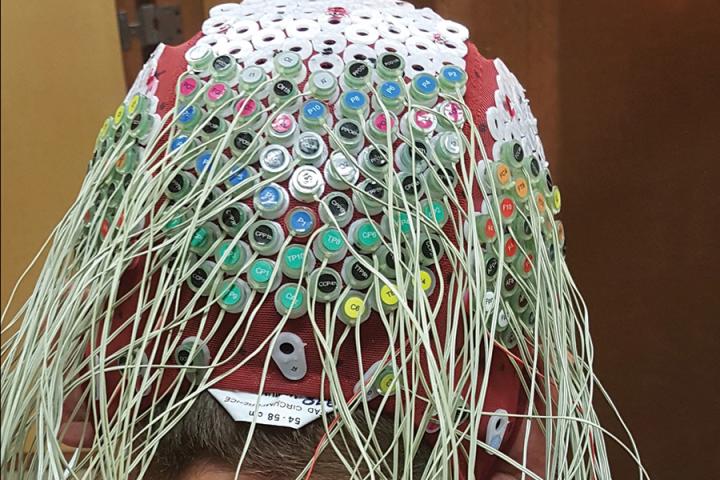
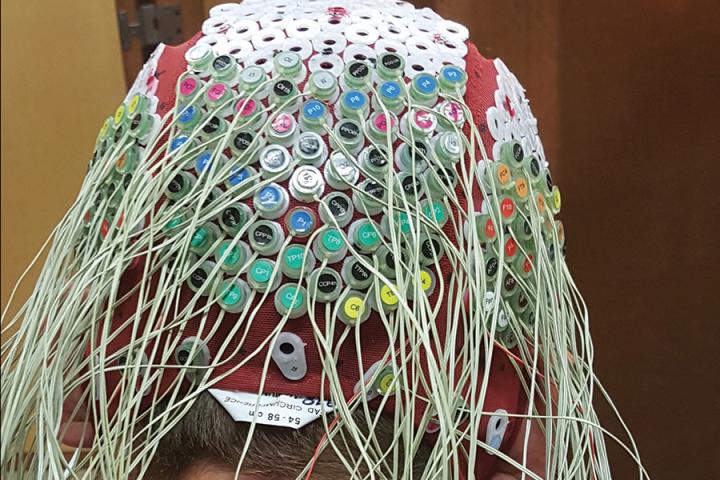
Carnegie Mellon University engineers and cognitive neuroscientists have demonstrated that a new high-density EEG can capture the brain's neural activity at a higher spatial resolution than ever before.
This next generation brain-interface technology is the first non-invasive, high-resolution system of its kind, providing higher density and coverage than any existing system. It has the potential to revolutionize future clinical and neuroscience research as well as brain-computer interfaces.
To test the custom-modified EEG, the research team had 16 participants view pattern-reversing black and white checkerboards while wearing the new "super-Nyquist density" EEG. They compared the results from all electrodes to results when using only a subset of the electrodes, which is an accepted standard for EEG density. Published in Scientific Reports, the results showed that the new "super-Nyquist" EEG captured more information from the visual cortex than any of the four standard "Nyquist density" versions tested.
"These results are crucial in showing that EEG has enormous potential for future research. Ultimately, capturing more neural information with EEG means we can make better inferences about what is happening inside the brain. This has the potential to improve source detection, for example in localizing the source of seizures in epilepsy," said Amanda K. Robinson, the lead author and a postdoctoral fellow in CMU's Department of Psychology and Center for the Neural Basis of Cognition (CNBC) during the study. Robinson is now a postdoctoral research fellow at the University of Sydney.
To create the new tool, the team modified an EEG head cap from a 128-electrolode system, which increased its sensor density by two to three folds over occipitotemporal brain regions. They designed the experiments to use visual stimuli with low, medium and high spatial frequency content.
Then, they used a visual paradigm designed to elicit neural responses with differing spatial frequencies in the brain and examined how the new super-Nyquist density EEG performed, revealing that the new configuration captured more neural information than standard Nyquist density EEG. The subtle patterns of neural activity uncovered by the new super-Nyquist EEG were closely related to a model of primary visual cortex.
"It is exciting to see that exceeding these 'engineers'' Nyquist densities can provide new information about brain activity, and it opens doors for utilizing higher-density EEG systems for clinical and neuroscientific applications. It also validates some of our fundamental information-theoretic studies in the past few years," said Pulkit Grover, assistant professor of electrical and computer engineering and a member of the CNBC.
Grover added, "Development of higher density systems is underway, in collaboration with Shawn Kelly in the Engineering Research Accelerator at CMU."
Early financial support to modify and test the new EEG was provided by CMU's BrainHub initiative and ProSEED program.
"This collaboration arose out of CMU's unique BrainHub Initiative that was created to encourage collaboration between brain and behavioral scientists, engineers and computer scientists. Our project is but one example of how working across disciplines can push the boundaries of our science, enabling new methods for studying and, ultimately, understanding the brain. Novel partnerships such as ours are our best avenue for making real progress that can eventually be translated into devices and theories that will help improve our lives," said Michael J. Tarr, the Trustee Professor of Vision Science and head of CMU's Psychology Department.
In addition to Robinson, Grover and Tarr, CMU's Praveen Venkatesh and Marlene Behrmann and the University of Pittsburgh's Matthew J. Boring participated in the study.
Instrumentation of the novel cap was in part funded by the SONIC center of the Semiconductor Research Corporation. Venkatesh was supported by the Phil and Marsha Dowd fellowship, and Boring was funded by the CNBC computational neuroscience undergraduate fellowship.
###
Media Contact
Shilo Rea
[email protected]
412-268-6094
@CMUScience
http://www.cmu.edu
Original Source
https://www.cmu.edu/dietrich/news/news-stories/2017/december/neuroscientists-engineers-new-eeg.html http://dx.doi.org/10.1038/s41598-017-16377-3