Osaka, Japan – Imagine stoplights and cars communicating with each other to optimize the flow of traffic. This isn’t science fiction – it’s the Internet of Things (IoT), i.e., objects that sense their surroundings and respond via the internet. As the global population rises and such technologies continue to develop, you might wonder – what will power this digital world of tomorrow?
Credit: Yoshiaki Nakamura
Osaka, Japan – Imagine stoplights and cars communicating with each other to optimize the flow of traffic. This isn’t science fiction – it’s the Internet of Things (IoT), i.e., objects that sense their surroundings and respond via the internet. As the global population rises and such technologies continue to develop, you might wonder – what will power this digital world of tomorrow?
Wind, solar, yes. Something all around us might not immediately come to mind though – heat. Now, in a study recently published in Nature Communications, a multi-institutional research team including Osaka University has unveiled a breakthrough in clean energy: greatly improved thermoelectric conversion. One of its many potential applications? That’s right, the IoT.
Large-scale, global integration of the IoT is limited by the lack of a suitable energy supply. Realistically, an energy supply for the IoT must be local and small scale. Miniaturization of thermoelectric conversion can help solve this energy-supply problem by applying the otherwise wasted heat from microelectronics as a source of electricity. However, for practical applications, the efficiency of current thermoelectric-energy conversion is insufficient. Improving this efficiency was the goal of the research team’s study.
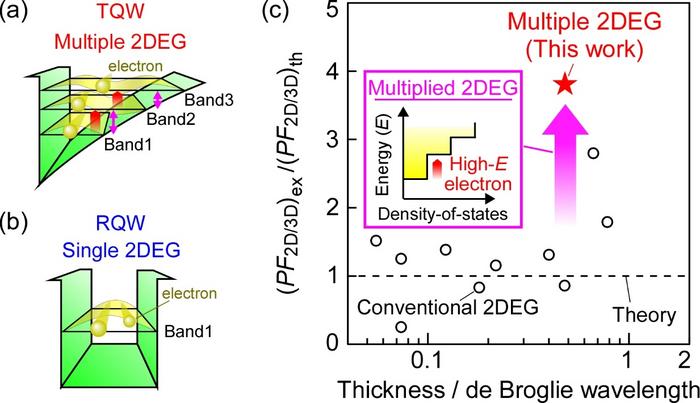
“In our work, we demonstrate a two-dimensional electron gas (2DEG) system with multiple subbands that uses gallium arsenide. The system is different from conventional methods of thermoelectric conversion,” explain Yuto Uematsu and Yoshiaki Nakamura, lead and senior authors of the study. “Our system facilitates better conversion from temperature (heat) to electricity, and improves the mobility of electrons in their 2D sheet. This readily benefits everyday devices like semiconductors.”
Incredibly, the researchers were able to improve the power factor of thermoelectric conversion by a factor of 4 compared with conventional 2DEG systems. Other technologies like resonant scattering have not been as efficient for thermoelectric conversion.
The team’s findings could open the way to a sustainable power source for the IoT. Thin thermoelectric films on substrates made of gallium arsenide would be suitable for IoT application. For example, these could power environmental monitoring systems in remote locations or wearable devices for medical monitoring.
“We’re excited because we have expanded upon the principles of a process that is crucial to clean energy and the development of a sustainable IoT,” says Yoshiaki Nakamura, senior author. “What’s more, our methodology can be applied to any element-based material; the practical applications are far reaching.”
This work is an important step forward in maximizing the utility of thermoelectric power generation in modern microelectronics and is especially suitable for the IoT. As the results are not limited to gallium arsenide, further advancements to the system are possible, with sustainability and the IoT potentially benefitting greatly.
###
The article, “Anomalous enhancement of thermoelectric power factor in multiple two-dimensional electron gas system,” was published in Nature Communications at DOI: https://doi.org/10.1038/s41467-023-44165-3
About Osaka University
Osaka University was founded in 1931 as one of the seven imperial universities of Japan and is now one of Japan’s leading comprehensive universities with a broad disciplinary spectrum. This strength is coupled with a singular drive for innovation that extends throughout the scientific process, from fundamental research to the creation of applied technology with positive economic impacts. Its commitment to innovation has been recognized in Japan and around the world, being named Japan’s most innovative university in 2015 (Reuters 2015 Top 100) and one of the most innovative institutions in the world in 2017 (Innovative Universities and the Nature Index Innovation 2017). Now, Osaka University is leveraging its role as a Designated National University Corporation selected by the Ministry of Education, Culture, Sports, Science and Technology to contribute to innovation for human welfare, sustainable development of society, and social transformation.
Website: https://resou.osaka-u.ac.jp/en
Journal
Nature Communications
DOI
10.1038/s41467-023-44165-3
Method of Research
Experimental study
Article Title
Anomalous enhancement of thermoelectric power factor in multiple two-dimensional electron gas system
Article Publication Date
16-Jan-2024