A retrospective single-center observational study conducted at a specialized deep brain stimulation center in Germany has revealed that advanced stimulation settings are increasingly adopted during the first postoperative year in patients undergoing bilateral subthalamic nucleus deep brain stimulation for Parkinson’s disease. Tracking one hundred forty-five patients across routine follow-up intervals at three, six, and twelve months, investigators observed that the application of advanced programming configurations expanded from 40.7 percent of the cohort at three months to 55.9 percent at six months, ultimately reaching 73.8 percent by the end of the first postoperative year. Concurrently, the proportion of individuals managed exclusively with conventional basic stimulation settings experienced a statistically significant reduction over time, declining from the initial postoperative baseline with an odds ratio of 0.41, whereas overall utilization of advanced modalities demonstrated a significant upward trajectory reflected by an odds ratio of 2.47. Directional and vertical current steering, along with frequency adjustments, drove this pronounced transition.
In defining the intervention parameters within the clinical cohort, the researchers established strict comparative categories distinguishing traditional programming from contemporary advanced options. Basic stimulation settings were defined as omnidirectional single-contact cathodic delivery maintained at an established standard pulse width of 60 microseconds and a standard frequency of 130 Hertz. In contrast, advanced stimulation settings encompassed directional current steering, vertical current steering, pulse width modifications diverging from 60 microseconds, frequency adjustments diverging from 130 Hertz, bipolar stimulation montages, and interleaving or independent frequency programs. Directional and vertical current steering architectures permitted individualized contact selection alongside independent amplitude titrations per electrode contact, allowing clinicians to tailor current distribution along the implanted lead. Continuous high-frequency stimulation at 130 Hertz has historically represented the default therapeutic standard for subthalamic nucleus interventions, but emerging hardware capabilities allow clinicians to manipulate the electrical field geometry and temporal delivery to address persistent motor symptoms or stimulation-induced adverse side effects.
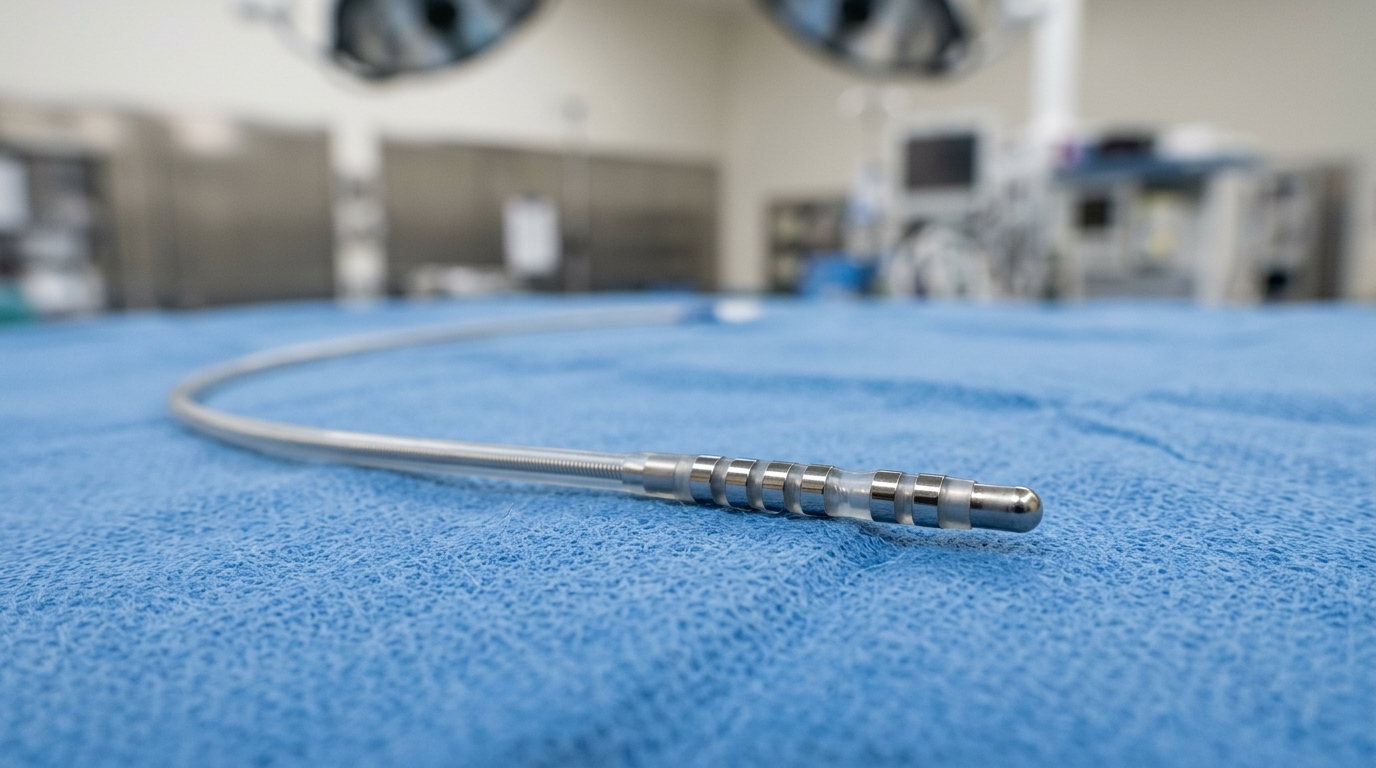
The evaluated patient population was selected from an initial screening cohort of one hundred seventy-three Parkinson’s disease patients who underwent bilateral surgical implantation at the center. To ensure analytical uniformity, twenty-eight individuals were excluded: two patients because of unilateral subthalamic nucleus stimulation, six individuals following surgical hardware revisions within the first postoperative year, and twenty patients due to missing follow-up evaluations across the designated clinical schedule, comprising twelve patients lacking one visit, three lacking two visits, and five lost to follow-up. The final cohort of one hundred forty-five patients was implanted with directional lead systems from two principal manufacturers. Boston Scientific Cartesia directional leads were implanted in one hundred thirty-four patients, paired with Vercise Gevia pulse generators in seventy-four patients, Vercise Genus R16 in forty-seven, Vercise PC in eleven, and Vercise Genus P16 in two. Additionally, one patient received Boston Scientific Cartesia X directional leads coupled to a Vercise Genus R32 device, while ten patients received Medtronic SenSight directional leads connected to Percept PC neurostimulators.
Postoperative programming followed a standardized clinical trajectory beginning five to seven days after surgical placement at the contact level demonstrating optimal intraoperative efficacy during clinical evaluation and electrophysiological recordings, initiated at 130 Hertz and 60 microseconds. Following hospital discharge, fine amplitude and medication adjustments were titrated across multiple weeks at an external neurorehabilitation center. At the three-month postoperative milestone, patients returned for a comprehensive in-house monopolar contact review performed after the overnight withdrawal of all dopaminergic medication to systematically reassess contact efficacy. Programmers selected active contacts and electrical parameters to maximize clinical benefit while monitoring and avoiding stimulation-induced side effects, while allowing patients controlled handheld amplitude titration within defined limits. Subsequent clinical and therapeutic parameter adjustments were conducted during formal visits at six and twelve months. To quantify the actual energy delivered into surrounding neural tissue across varying impedance environments, investigators computed the charge per second for each program by multiplying pulse width, amplitude, and frequency.
Electrode localization and anatomical trajectory reconstructions were executed through advanced neuroimaging pipelines utilizing the Lead-DBS computational environment. Preoperative magnetic resonance imaging scans and postoperative computed tomography volumes were co-registered using Statistical Parametric Mapping 12 in one hundred forty-three patients and Advanced Normalization Tools in two patients, while postoperative computed tomography scans were linearly aligned using Advanced Normalization Tools in one hundred forty-two patients or FMRIB’s Linear Image Registration Tool in three patients. Brain shift corrections were applied through the automated subcortical refinement algorithm within Lead-DBS, followed by nonlinear normalization into Montreal Neurological Institute stereotactic space using symmetric diffeomorphic registration in one hundred forty-two cases, three-step affine normalization in two cases, and FMRIB’s Nonlinear Image Registration Tool in one patient. Lead trajectories were reconstructed via the PaCER algorithm in one hundred forty-four patients and TRAC/CORE in one patient where PaCER failed. Anatomical boundaries of the motor, associative, and limbic subthalamic nucleus compartments were established utilizing the DBS Intrinsic Template atlas to calculate electrode distances.
Across the twelve-month monitoring period, 77.9 percent of the patient cohort, representing one hundred thirteen individuals, utilized advanced stimulation settings at least once. Clinicians implemented programming strategy modifications in 41.4 percent of patients between the three- and six-month visits, and in 33.8 percent between the six- and twelve-month follow-ups. By the twelve-month mark, 26.2 percent of patients remained programmed on basic stimulation, 73.8 percent utilized advanced configurations, and 37.2 percent operated with at least two advanced parameters simultaneously. Directional current steering was the most frequently utilized advanced modality, followed by vertical current steering, with multi-level activations primarily involving adjacent contacts and only three patients utilizing non-adjacent levels. At six months, pulse width adjustments surpassed frequency variations in frequency of use, a relationship that reversed by twelve months. Within the cohort, therapeutic pulse widths ranged from 30 to 90 microseconds, while stimulation frequencies spanned 60 to 204 Hertz. Furthermore, both middle contact levels were actively stimulated in 88.9 percent of cases during long-term monitoring.
Anatomical distance calculations revealed distinct structural relationships between lead positioning and the subsequent necessity for advanced electrical steering. Leads programmed with advanced stimulation settings at least once during follow-up exhibited a significantly greater median distance to the motor subthalamic nucleus center of gravity, measuring 1.9 millimeters with an interquartile range of 1.3 to 2.5 millimeters across two hundred twelve analyzed leads. Conversely, seventy-six leads maintained continuously on basic stimulation settings demonstrated a significantly shorter median distance of 1.5 millimeters, with an interquartile range of 1.1 to 2.0 millimeters, establishing a statistically significant difference evaluated by Mann-Whitney U testing at p equals 0.002. Ninety-five percent confidence ellipsoids modeled around mean contact coordinates confirmed these subtle spatial displacements relative to the motor subthalamic target. The authors emphasized that these anatomical differences were marginal and did not represent gross surgical electrode misplacement, but rather illustrated the clinical utility of advanced configurations in compensating for slight deviations from the target center.
To evaluate pharmacological outcomes, patients were categorized into three distinct subgroups: individuals remaining on basic settings throughout the study, patients initiated on advanced settings at three months, and patients switched from basic to advanced settings after three months. Preoperative levodopa responsiveness showed no statistically significant differences across subgroups, with percentage improvements of 54.6 percent in the basic group, 47.9 percent in the initial advanced group, and 48.4 percent in the crossover group. At three months, patients switched to advanced settings after the three-month milestone achieved significantly less reduction in levodopa-equivalent daily dose than those remaining on basic settings (p equals 0.013) or those initially programmed with advanced parameters (p equals 0.003). A similar disparity persisted at six months (p equals 0.021 and p equals 0.022, respectively). However, by twelve months, medication reductions converged across all three cohorts without statistically significant differences (p equals 0.283), accompanied by comparable median charge per second measurements among groups.
The researchers contextualized their observational results within the broader neurostimulation literature examining specific parameter manipulations. Directional current steering expands the therapeutic window by elevating side-effect thresholds, corroborating multicenter findings such as those by Karl and colleagues, where 39 percent of patients utilized directional stimulation at one year compared to 42.1 percent in this cohort. Vertical steering redistributes charge along the lead axis, shaping the electrical field to target complex symptoms while reducing total electrical energy delivery. Pulse width reductions below 60 microseconds, applied in 23.4 percent of long-term patients with 94.1 percent involving decreased durations down to 30 microseconds, widen the therapeutic margin without compromising clinical noninferiority. Frequency adjustments, utilized in 26.8 percent of twelve-month patients with 71.8 percent set above 130 Hertz, addressed refractory tremor, whereas published literature indicates low frequencies between 60 and 85 Hertz target gait, postural stability, and speech. Bipolar and interleaving montages were utilized sparingly in three and two patients, respectively, serving exclusively as secondary rescue strategies.
The authors acknowledged several methodological limitations inherent to their single-center retrospective design, which captured routine clinical programming practices at a single German academic hospital that may not generalize across international institutions with divergent programming conventions. Because clinical rationale for specific parameter adjustments was not systematically documented in electronic records, the observed transitions cannot establish direct causal relationships governing stimulation changes. Furthermore, motor examinations in the standardized medication-off state were not systematically recorded across routine postoperative follow-ups, preventing direct quantification of how specific parameter shifts influenced individual motor signs. The investigators concluded that while advanced stimulation settings provide essential clinical flexibility to compensate for slight anatomical lead displacement and achieve equivalent medication sparing, prospective randomized double-blind trials are required. Such studies must establish rigorous programming algorithms and define clear therapeutic indications for individual advanced modalities, particularly as novel sensing-enabled neurostimulators capable of closed-loop adaptive deep brain stimulation enter mainstream clinical practice.
Subject of Research: Advanced stimulation settings and electrode placement in subthalamic nucleus deep brain stimulation for Parkinson's disease
Article Title: Stimulation settings in subthalamic nucleus deep brain stimulation for parkinson’s disease – a retrospective single-center observational study
Article References: Schedlich-Teufer, C., Brandt, G. A., van der Linden, C., Jergas, H., Baldermann, J. C., Stopic, V., Fink, G. R., Visser-Vandewalle, V., Dembek, T. A., Barbe, M. T., & Petry-Schmelzer, J. N. (2026). Stimulation settings in subthalamic nucleus deep brain stimulation for parkinson’s disease – a retrospective single-center observational study. Neurological Research and Practice, 8(1), Article 53. https://doi.org/10.1186/s42466-026-00477-5
Image Credits: AI Generated
DOI: 10.1186/s42466-026-00477-5
Keywords: Deep Brain Stimulation, Subthalamic Nucleus, Parkinson's Disease, Advanced Stimulation Settings, Directional Current Steering, Vertical Current Steering, Levodopa-Equivalent Daily Dose, Pulse Width Modulation, Frequency Variation, Lead-DBS, DISTAL Atlas, Charge Per Second, Motor Subthalamic Nucleus, Contact Review, Boston Scientific Cartesia, Medtronic SenSight, Bipolar Stimulation, Interleaving Stimulation
News Source: Cassandra Pierce. (November 22, 2026). Advanced Stimulation Settings Offset Subthalamic Lead Placement Deviations in Parkinson’s Disease. Scienmag.