Credit: Rebecca Gentry
TALLAHASSEE, Fla. — Earth's vast oceans brim with potential for commercial activities ranging from tourism to shipping to alternative energy, but planning for the sustainable coexistence of different and competing industries has proved a complicated task.
Now, researchers led by Florida State University Assistant Professor of Geography Sarah Lester have introduced an advanced, holistic analytical model that could herald a new paradigm of environmentally sustainable ocean industry management.
"In the past, we haven't always maximized the benefits we get from the oceans, nor have we done a good enough job protecting vulnerable ocean ecosystems," Lester said. "We wanted to ask the question: How can we come up with analytical approaches that allow us to make better decisions about what happens where?"
In an article published today in the journal Nature Communications, Lester and her colleagues outline a novel marine spatial planning strategy they developed to answer that complicated question.
Their model design, which accounts for and quantifies relevant environmental, industrial and societal interests in a given area, allows for planning that supports a variety of harmonious, economically productive activities without condemning a region to ecological disaster.
"Our goal was to create a system that can simultaneously plan for multiple uses while optimizing the benefits of those different uses and minimizing the negative impacts on other uses and the environment," Lester said.
To demonstrate their approach, Lester and her colleagues applied their innovative model to the development of offshore aquaculture along the crowded Southern California coast.
The United States — which operated at a $14 billion seafood trade deficit in 2016– lags far behind other countries in aquaculture development due to complex regulatory policies and social opposition. Moreover, concerns about the environmental impact of offshore aquaculture, as well as potential conflicts with other sectors such as wild-capture fisheries, have hampered development, even in areas primed for aquacultural success.
That made aquaculture the perfect case study for these marine spatial planning models, Lester said.
"There's been very little aquaculture development in the U.S. despite the fact that other analyses have shown that the U.S. has some of the world's best growing conditions," she said. "The U.S. could be a global leader in aquaculture, but one of the hurdles has been siting, or where to place it. Our model provided a tool for exploring those issues."
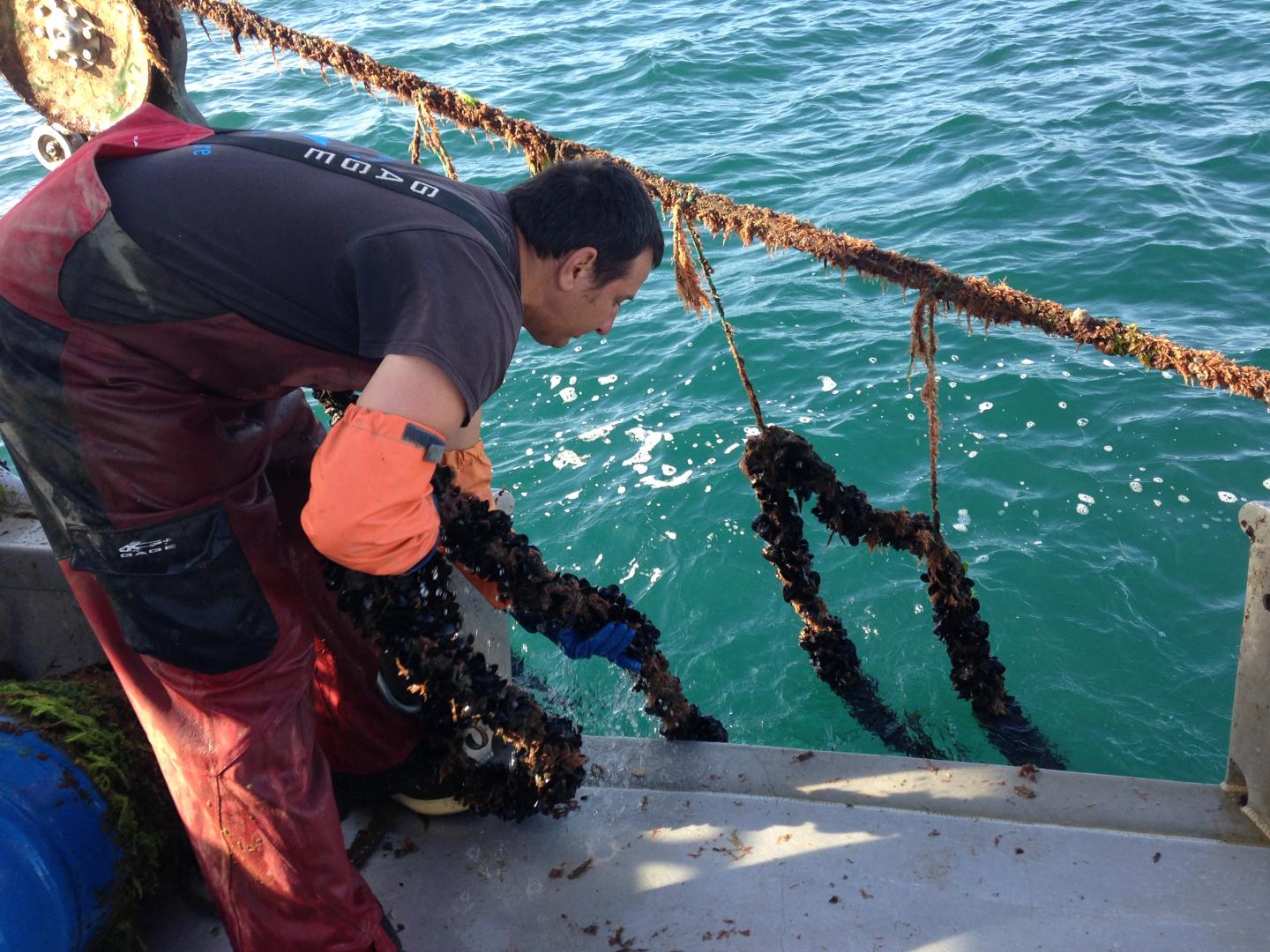
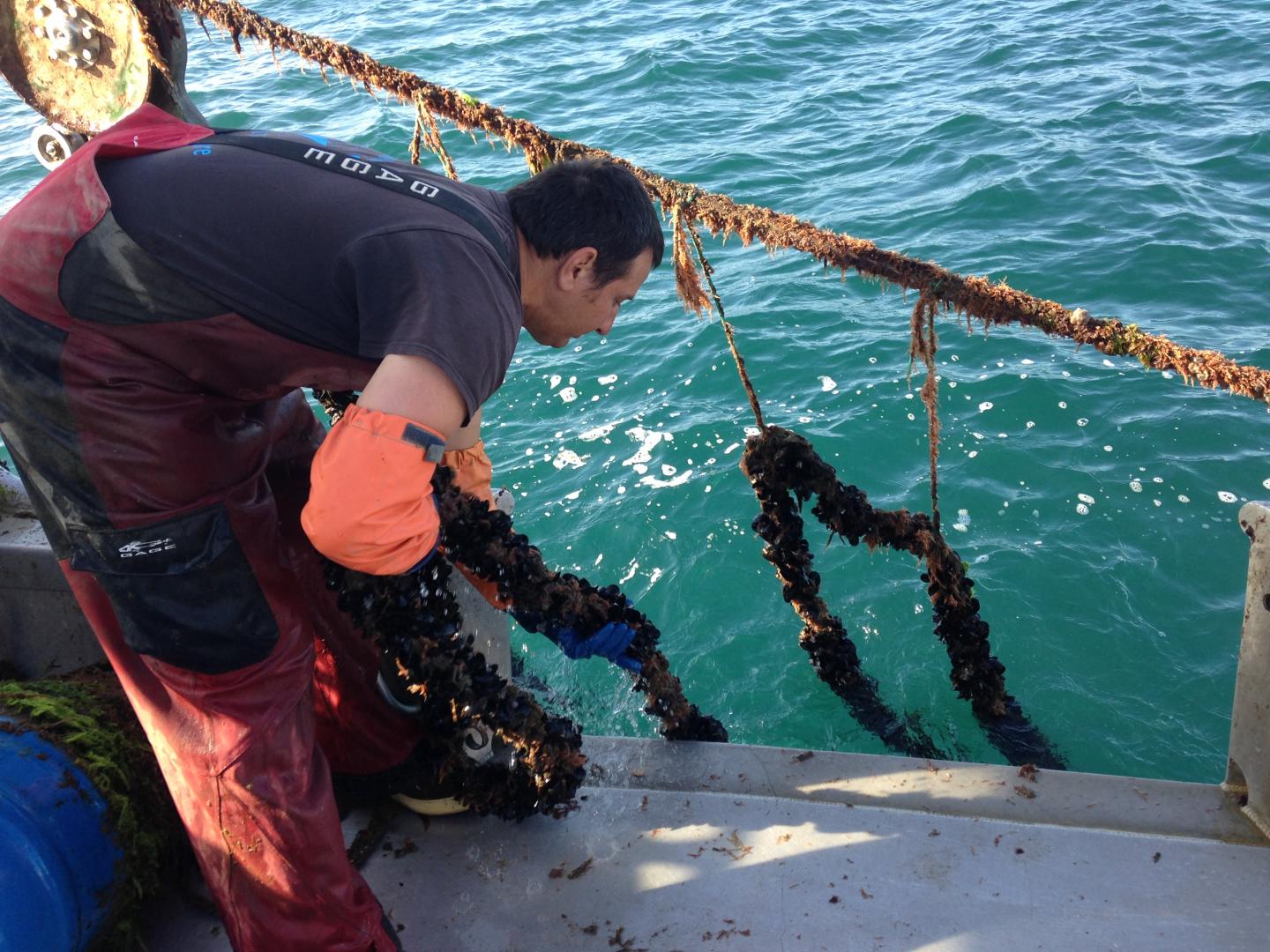
Lester and her colleagues developed models for three representative types of aquaculture farms with industry potential in Southern California: Mediterranean mussels, striped bass and sugar kelp.
In order to address the array of area-specific stakeholder concerns, the research team accounted for four overarching factors when making their computations:
- The wild-capture California halibut fishery, which draws from the same soft-bottom habitat that would be developed for aquaculture.
- The environmental health of the flora and fauna that occupy the seabed, which could be harmed by oxygen-poor conditions caused by fish farms.
- The quality of views from public and private lands that could be blemished by aquaculture structures on the ocean's surface.
- The risk of disease spread among fish farms connected by ocean currents.
By pairing these models with an analytical tradeoff analysis, the team was able to identify tens of thousands of optimal spatial plans, a subset of which satisfied all four stakeholder concerns and therefore would be especially instructive for decision makers.
Ultimately, it was determined that the models could increase sector values by millions of dollars and reduce harmful impacts to less than 1 percent compared to conventional approaches to spatial planning.
"We made sure our model included dimensions that accounted for industry and environmental interests," Lester said. "We were able to find ways to locate aquaculture in a way that minimizes conflict, minimizes environmental impact and yields huge value in terms of seafood produced."
But it's not just this one stretch of the Southern California coastline that could benefit from these models. The goal of this research, Lester said, was to develop an approach that could be applied anywhere.
"For example, I think this approach could easily be applied to the Gulf of Mexico, where there is great potential for aquaculture and a regulatory environment that may be more amenable to aquaculture development," she said.
And, importantly, these models are not limited to aquaculture. Any industry with a marine spatial planning component could stand to gain from the team's refined analyses. For example, study co-authors Crow White of California Polytechnic State University and Carrie Kappel of UC Santa Barbara have applied this analytical approach to the siting of wind farms off the coast off Massachusetts.
"I think this is a particularly useful approach when we think of new and emerging uses," she said. "There's a trend toward new ocean industries — whether it's aquaculture, alternative energy or deep sea mining — that could make great use of this approach."
###
This research was funded by the National Oceanic and Atmospheric Administration Sea Grant program, the Waitt Foundation and the Gordon and Betty Moore Foundation.
Media Contact
Zachary Boehm
[email protected]
850-645-1504
@floridastate
http://www.fsu.edu
Related Journal Article
http://dx.doi.org/10.1038/s41467-018-03249-1