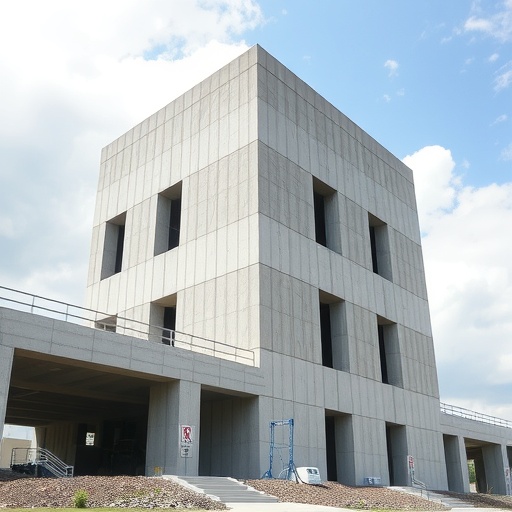
In a groundbreaking advancement heralding a new era of infrastructure safety, researchers at the University of Shanghai for Science and Technology have developed a revolutionary machine learning framework that dramatically enhances the real-time prediction of compressive stress in ultra-high performance concrete (UHPC). This innovative approach leverages the integration of electrical resistivity with traditional displacement parameters to unlock unprecedented accuracy in stress monitoring, offering profound implications for the longevity and safety of critical structures such as long-span bridges and towering skyscrapers.
Conventional stress monitoring solutions in UHPC often depend on embedded sensors like piezoelectric devices or fiber-optic systems. Despite their utility, these technologies face intrinsic limitations—ranging from fragility and high capital expense to incompatibility with concrete’s complex deformation dynamics. Overcoming these hurdles, the Shanghai research team’s methodology sidesteps the need for fragile sensors by deeply embedding a multi-physics perspective into their predictive models, centering around the concrete’s own electrical resistivity as a passive, self-sensing parameter.
At the crux of the breakthrough lies the recognition that the mechanical behavior of UHPC is tightly coupled with microstructural changes occurring within the material under load. Dr. Lin Chi, associate professor and corresponding author, emphasizes that prior models have largely overlooked this critical insight. “Electrical resistivity functions as a microscopic window into the material’s evolving internal structure,” Lin explains. “It captures subtle variations that displacement measurements alone cannot reveal, enabling a more holistic understanding of concrete’s stress state.”
The team embarked on an exhaustive experimental campaign, compiling an extensive dataset comprising 446 tests on highly electro-sensitive UHPC subjected to uniaxial loading conditions. Their machine learning architecture synthesizes three advanced algorithms—double-layer neural networks (DLNN), boosting tree techniques (BT), and squared exponential Gaussian process regression (SE-GPR). Each was evaluated with two distinct input configurations: one including mix proportions and displacement data, and the other augmenting these with electrical resistivity.
Results were compelling. Models incorporating resistivity consistently outperformed their displacement-only counterparts, achieving statistically significant gains in predictive fidelity. The SE-GPR model, in particular, achieved an R² value of 0.85 and an RMSE of 0.11—benchmarks that translate to a 41.1% reduction in mean absolute error. Boosting tree and neural network models similarly demonstrated enhanced performance, with error reductions of 12.3% and 16.9%, respectively, underscoring the robustness of the resistivity-enhanced approach.
An incisive sensitivity analysis further dissected the contributions of each parameter. Displacement demonstrated the strongest individual correlation with compressive stress (coefficient of 0.51), validating its relevance in mechanical characterization. However, electrical resistivity surfaced as a distinctively complementary variable, exhibiting a moderate positive correlation (0.20) with stress and a notably low correlation with displacement (0.26). Such orthogonality suggests the dual inputs impart diverse, non-redundant insights—a key factor that amplifies model accuracy while mitigating risks of overfitting.
Exploring the origins of resistivity’s sensitivity, the study examined the influence of two critical conductive additives—steel fibers and carbon nanotubes (CNTs). While neither directly correlated strongly with stress, their impact on electrical resistivity was profound. Steel fibers showed a moderate positive association with resistivity (0.30), primarily due to their crack-bridging effects that modify electrical conduction pathways. Conversely, CNTs exhibited a strong inverse correlation (-0.66), reflecting their role in forming percolation networks that dynamically alter under mechanical strain.
The implications for structural health monitoring are transformative. Unlike traditional sensor arrays, which can degrade or fail within the concrete matrix, the resistivity-based framework enables passive sensing rooted in inherent material properties. Lin Chi highlights this paradigm shift: “Our approach eliminates dependence on fragile hardware by essentially turning the concrete itself into a sensor—offering higher reliability and reduced maintenance.”
Beyond laboratory validation, the researchers are already planning real-world deployments to tackle environmental variables like temperature fluctuations, humidity, and long-term cyclic stresses. Integrating their machine learning system with wireless data acquisition platforms is a priority, paving the way for scalable, cost-effective monitoring of infrastructure spanning bridges, tunnels, and skyscrapers worldwide.
The deployment of this multi-physics machine learning framework signals a critical leap forward in the smart management of civil infrastructure. It not only enables precise, real-time detection of stress-induced damage but also reduces reliance on costly, failure-prone embedded sensors. As urban environments grow ever more complex and demanding, such innovations will be vital for safeguarding the structural integrity and extending the service life of critical public assets.
Supported by the Guangdong Provincial Key Laboratory of Intelligent Disaster Prevention and Emergency Technologies for Urban Lifeline Engineering, this research represents a compelling fusion of materials science, structural engineering, and advanced computation. It underscores the extraordinary potential of combining multi-parameter sensing with state-of-the-art machine learning to overcome longstanding challenges in infrastructure resilience.
In sum, the University of Shanghai’s pioneering work redefines how engineers conceptualize stress monitoring in concrete. By harnessing resistivity as a dynamic proxy for internal microstructural evolution and skillfully integrating it with displacement through sophisticated algorithms, this framework unlocks a level of predictive precision and robustness previously unattainable. The resulting self-sensing capability charts a path toward more intelligent, enduring, and safe infrastructure systems worldwide.
Subject of Research: Dynamic stress prediction in ultra-high performance concrete (UHPC) using resistivity-enhanced machine learning frameworks.
Article Title: Resistivity-enhanced multi-physics machine learning framework for dynamic stress prediction in high sensitive UHPC
News Publication Date: April 1, 2026
Web References: DOI link
Image Credits: Lifeline Emergency and Safety, Tsinghua University Press
Keywords
Ultra-high performance concrete, electrical resistivity, dynamic stress prediction, machine learning, double-layer neural network, boosting tree, Gaussian process regression, structural health monitoring, passive sensing, microstructural changes, multi-physics modeling
Tags: advanced concrete deformation analysisdynamic stress modeling in UHPCelectrical resistivity in concrete monitoringinfrastructure safety using machine learninglong-span bridge stress predictionmachine learning in structural health monitoringmicrostructural changes in concrete under loadmulti-physics machine learning frameworkreal-time compressive stress predictionresistivity-based self-sensing concretesensor-free concrete stress monitoringultra-high performance concrete stress prediction