• HOME
  • NEWS
  • EXPLORE
    • CAREER
      • Companies
      • Jobs
    • EVENTS
    • iGEM
      • News
      • Team
    • PHOTOS
    • VIDEO
    • WIKI
  • BLOG
  • COMMUNITY
    • FACEBOOK
    • INSTAGRAM
    • TWITTER
Wednesday, June 24, 2026
BIOENGINEER.ORG
No Result
View All Result
  • Login
  • HOME
  • NEWS
  • EXPLORE
    • CAREER
      • Companies
      • Jobs
        • Lecturer
        • PhD Studentship
        • Postdoc
        • Research Assistant
    • EVENTS
    • iGEM
      • News
      • Team
    • PHOTOS
    • VIDEO
    • WIKI
  • BLOG
  • COMMUNITY
    • FACEBOOK
    • INSTAGRAM
    • TWITTER
  • HOME
  • NEWS
  • EXPLORE
    • CAREER
      • Companies
      • Jobs
        • Lecturer
        • PhD Studentship
        • Postdoc
        • Research Assistant
    • EVENTS
    • iGEM
      • News
      • Team
    • PHOTOS
    • VIDEO
    • WIKI
  • BLOG
  • COMMUNITY
    • FACEBOOK
    • INSTAGRAM
    • TWITTER
No Result
View All Result
Bioengineer.org
No Result
View All Result
Home NEWS Science News Biology

Advanced analysis of Apollo sample illuminates Moon’s evolution

Bioengineer by Bioengineer
December 14, 2021
in Biology
Reading Time: 3 mins read
0
Lunar sample under polarized light microcope
Share on FacebookShare on TwitterShare on LinkedinShare on RedditShare on Telegram

Sophisticated analysis of a rock sample taken from the Moon during the Apollo 17 mission revealed new information about the complex cooling and evolutionary history of the Moon. The findings, from University of Hawai‘i (UH) at Mānoa researchers, were published today in Nature Communications.
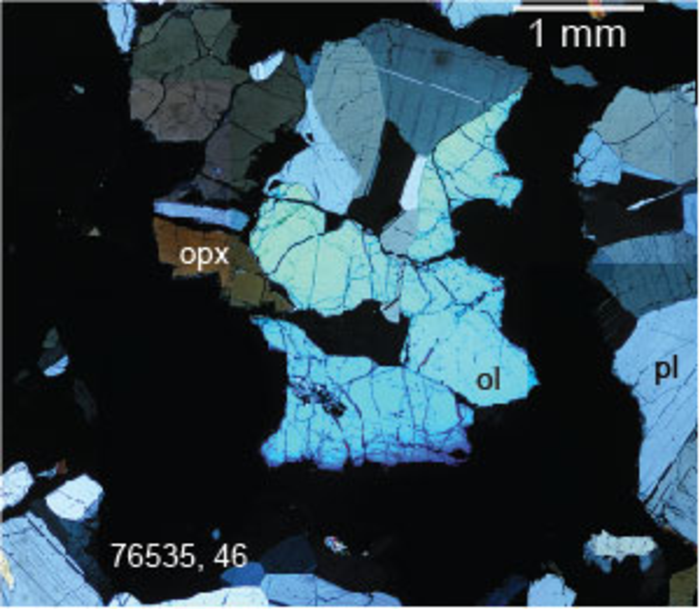
Lunar sample under polarized light microcope

Credit: Nelson et al., 2021

Sophisticated analysis of a rock sample taken from the Moon during the Apollo 17 mission revealed new information about the complex cooling and evolutionary history of the Moon. The findings, from University of Hawai‘i (UH) at Mānoa researchers, were published today in Nature Communications.

Apollo 17 astronauts collected the rock sample troctolite 76535 from the Moon’s surface in 1972, and it remains one of the most scientifically valuable samples of the Moon due to its pristine nature. Further, the rock type is widespread on the Moon and likely contains important clues to understanding lunar formation.

William Nelson, lead author of the study and Earth Sciences graduate student in the UH Mānoa School of Ocean and Earth Science and Technology (SOEST), and co-authors used a specialized electron microprobe to perform high-resolution analysis of troctolite 76535.

“Previous reports suggest the minerals in the Apollo 17 sample were chemically homogeneous,” said Nelson. “Surprisingly, we found chemical variations within crystals of olivine and plagioclase. These heterogeneities allow us to constrain the earliest, high-temperature cooling histories of these minerals using numerical models.”

SOEST researchers used the UH High-Performance Computing facilities, Mana, to consider the effects of a variety of computer-simulated cooling paths—well over 5 million chemical diffusion models.

“The simulations revealed that these heterogeneities could only survive a relatively short period of time at high temperatures,” said Nelson.

The diffusion patterns preserved in the mineral grains and observed with the microprobe were consistent with a rapid cooling history of no more than 20-million-years at high temperatures. The finding challenges previous estimates of a 100-million-year cooling duration and supports initial rapid cooling of magmas within the lunar crust.

“This is changing our outlook on how an important suite of lunar rocks formed,” said Nelson.

To reconcile high-temperature cooling rates with the generally accepted view of the way in which these rocks formed, the research team proposed that perhaps this rock type is formed by a process called reactive infiltration wherein a melt interacts with rock—changing its chemical and physical makeup.

The study also demonstrates the value of re-examining previously analyzed samples using modern techniques and how quickly new data can reshape our understanding of planetary evolution.

To better understand the observed chemical heterogeneity, the research team is currently investigating how quickly phosphorus can diffuse in olivine crystals. Additionally, they are searching for similar heterogeneities in other Apollo samples.


Journal

Nature Communications

DOI

10.1038/s41467-021-26841-4

Method of Research

Computational simulation/modeling

Subject of Research

Not applicable

Article Title

Chemical heterogeneities reveal early rapid cooling of Apollo Troctolite 76535

Article Publication Date

14-Dec-2021

COI Statement

The authors declare no competing interests.

Share12Tweet7Share2ShareShareShare1

Related Posts

Unraveling the Genetic Buzz: Insights into Worker Honeybee Metamorphosis — Biology

Unraveling the Genetic Buzz: Insights into Worker Honeybee Metamorphosis

June 24, 2026
Why Birds Lay Surprisingly Large Eggs: New Study Reveals the Link to Bigger Brains — Biology

Why Birds Lay Surprisingly Large Eggs: New Study Reveals the Link to Bigger Brains

June 24, 2026

Unraveling m6A RNA Modification in Colorectal Cancer: Key Regulatory Mechanisms, Oncogenic Signals, and Metabolic Pathways

June 24, 2026

Rice Bioengineer Receives Federal Award for Advancements in Ewing Sarcoma Research

June 23, 2026

POPULAR NEWS

  • Saying Goodbye to PGY-6: Pediatric Fellowship Realities

    103 shares
    Share 41 Tweet 26
  • Multi-Hospital Study Reveals Long Covid Burden Is Twice as High as Current Estimates

    92 shares
    Share 36 Tweet 23
  • Detection of EDCs in Breast Milk and Infant Urine Up to Six Months Highlights Early Exposure Risks

    77 shares
    Share 31 Tweet 19
  • New Drug Candidate Developed at McMaster Shows Potential for Treating Brain Cancer

    58 shares
    Share 23 Tweet 15

About

BIOENGINEER.ORG

We bring you the latest biotechnology news from best research centers and universities around the world. Check our website.

Follow us

Recent News

Germline Mutations in Young Women’s Breast Cancer Genes

Breakthrough Chip Enhances Tiny Robots’ Ability to Navigate Complex Terrains

Caution for Consumers: How “Green” Are Your Sustainable Shopping Choices Really?

Subscribe to Blog via Email

Enter your email address to subscribe to this blog and receive notifications of new posts by email.

Join 82 other subscribers
  • Contact Us

Bioengineer.org © Copyright 2023 All Rights Reserved.

Welcome Back!

Login to your account below

Forgotten Password?

Retrieve your password

Please enter your username or email address to reset your password.

Log In
No Result
View All Result
  • Homepages
    • Home Page 1
    • Home Page 2
  • News
  • National
  • Business
  • Health
  • Lifestyle
  • Science

Bioengineer.org © Copyright 2023 All Rights Reserved.