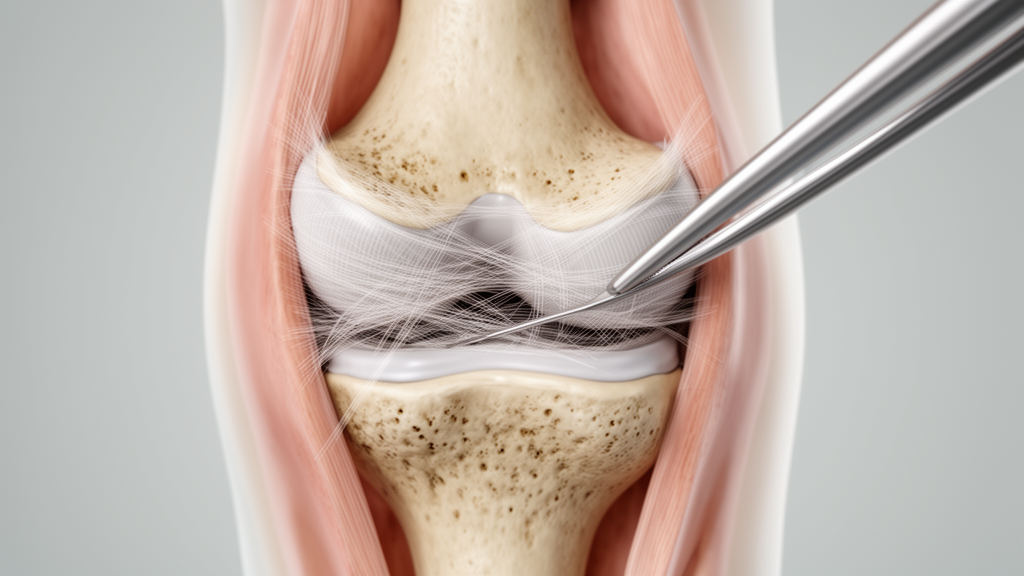
Adding single-anchor meniscal centralization to transtibial pullout repair for medial meniscus posterior root tears does not provide sustained reduction in meniscal extrusion or improve functional outcomes at one year, according to a retrospective cohort study published in the Journal of Orthopaedic Surgery and Research. Although combining the procedures produced greater reduction in extrusion during the early postoperative period, the radiographic advantage disappeared by twelve months of follow-up.
To evaluate whether this combination provides lasting structural and clinical benefits, researchers analyzed clinical and radiographic records from 59 patients treated between March 2021 and June 2025. The study compared two surgical approaches: isolated double-loop transtibial pullout repair performed in 27 patients, designated as group A, and transtibial pullout repair combined with single-anchor meniscal centralization performed in 32 patients, designated as group B.
Investigators assessed meniscal extrusion using coronal magnetic resonance imaging at baseline before surgery, immediately after the procedure, and at follow-up intervals of three, six, and twelve months. Healing of the posterior root was specifically evaluated on twelve-month magnetic resonance imaging scans. Patient clinical outcomes were tracked using validated functional measures, including the Lysholm score, the International Knee Documentation Committee subjective score, the visual analogue scale for pain, and knee range of motion.
The study established the between-group difference in meniscal extrusion at twelve months as its primary outcome measure, with root healing on imaging and clinical functional scores designated as secondary outcomes. Prior to surgery, baseline meniscal extrusion measurements were similar between the two treatment cohorts. Following surgical intervention, both patient groups exhibited a significant immediate reduction in meniscal extrusion on postoperative coronal magnetic resonance imaging.
During early recovery, patients in group B demonstrated significantly greater reduction in meniscal extrusion than those in group A at three and six months postoperatively. However, this structural advantage was not sustained over time. By twelve months, coronal magnetic resonance imaging revealed meniscal extrusion measuring 4.24 plus or minus 0.43 millimeters in group A compared with 4.18 plus or minus 0.41 millimeters in group B, yielding an insignificant difference of 0.05 millimeters.
Secondary outcomes mirrored these primary structural findings at the conclusion of the twelve-month monitoring period. Evaluation of twelve-month magnetic resonance imaging scans demonstrated similar posterior root healing rates between patients who received isolated pullout repair and those who received supplemental centralization. Furthermore, functional evaluations across Lysholm, International Knee Documentation Committee, visual analogue scale pain scores, and knee range of motion showed comparable recovery between cohorts.
The authors concluded that while adding single-anchor meniscal centralization to double-loop transtibial pullout repair temporarily curbs meniscal extrusion in the early postoperative months, the structural gain is lost by one year. Because the additional procedure demonstrated no detectable benefit in root healing or patient-reported functional outcomes at twelve months, its long-term clinical utility in this surgical setting remains unsupported.
Subject of Research: Meniscal centralization combined with transtibial pullout repair for medial meniscus posterior root tears
Article Title: Single-anchor centralization added to transtibial pullout repair for medial meniscus posterior root tears: early but not sustained extrusion reduction, no detectable clinical benefit at 12 months
Article References: He, K., Yuan, L., Jiao, X., Zhou, J., Li, Y., Peng, X., Sun, G., Yin, Y., Luo, Z., & Leng, Y. (2026). Single-anchor centralization added to transtibial pullout repair for medial meniscus posterior root tears: early but not sustained extrusion reduction, no detectable clinical benefit at 12 months. Journal of Orthopaedic Surgery and Research. https://doi.org/10.1186/s13018-026-07368-0
Image Credits: AI Generated
DOI: 10.1186/s13018-026-07368-0
Keywords: medial meniscus posterior root tears, meniscal centralization, transtibial pullout repair, double-loop suture, meniscal extrusion, coronal MRI, knee functional outcomes, Lysholm score, IKDC score, VAS score, range of motion, root healing, single-anchor fixation, orthopaedic surgery, retrospective cohort study, Journal of Orthopaedic Surgery and Research
News Source: Ophelia Keating. (November 20, 2026). Adding Meniscal Centralization to Pullout Repair Shows No 12-Month Advantage. Scienmag.