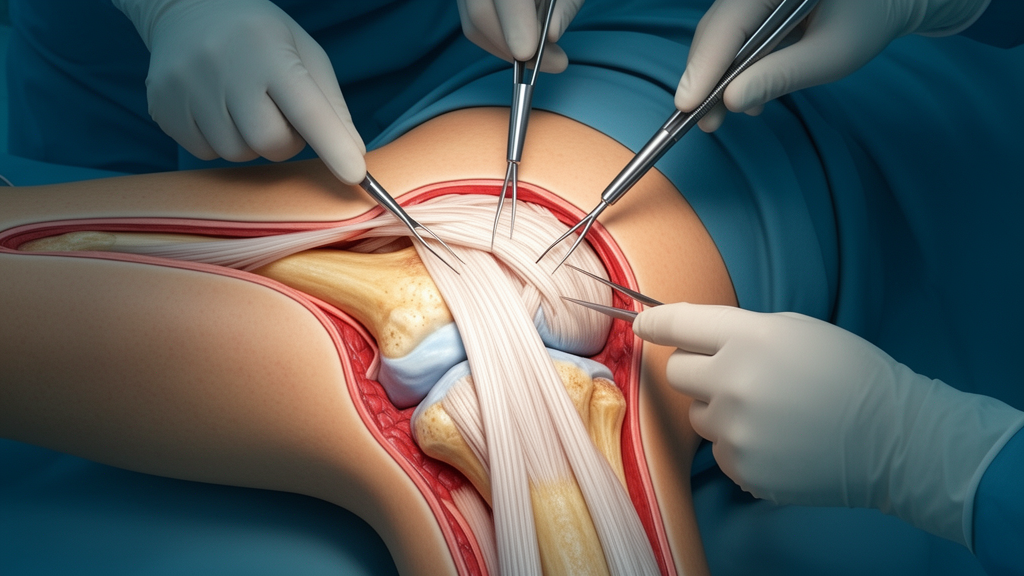
Adding anterolateral ligament reconstruction to primary hamstring tendon autograft anterior cruciate ligament reconstruction significantly improves objective rotatory knee stability and markedly lowers the rate of secondary graft failure. In a comprehensive systematic review and meta-analysis of comparative clinical studies, researchers evaluated twelve investigations comprising 1,274 participants to assess whether the adjunctive anterolateral procedure confers tangible biomechanical and clinical advantages over isolated anterior cruciate ligament reconstruction. The pooled results demonstrate that combining the two procedures substantially curbs residual laxity and reduces the incidence of graft rupture without driving up complication rates, providing compelling quantitative evidence for an intervention that has historically been confined to narrow subsets of elite or high-demand athletic populations.
Anterior cruciate ligament reconstruction is performed to restore stability to the knee joint following an anterior cruciate ligament rupture, with the ultimate objective of preventing subsequent intra-articular injuries and enabling a return to standard daily and athletic activities. Hamstring tendon autografts, composed of the gracilis and semitendinosus tendons, represent the most widely utilized graft option globally due to their relative accessibility, biological integration, and considerable mechanical strength, which ranges from roughly 2,160 newtons to over 4,000 newtons. Despite these favorable baseline attributes, hamstring tendon grafts are well recognized for exhibiting greater residual rotational laxity when compared to bone-patellar tendon-bone autografts. This residual laxity often manifests as persistent postoperative instability during pivot-shift testing, which has motivated surgeons to incorporate adjunct lateral extra-articular stabilization techniques into primary reconstruction pathways.
To investigate the clinical consequences of these combined interventions, the investigators executed a systematic electronic search between January and February 2025 across multiple databases, including Cochrane, PubMed, Europe PubMed Central, ClinicalTrials.gov, and the Directory of Open Access Journals, complemented by manual and free-web searches. Screening was conducted independently by two researchers using the Nested Knowledge AutoLit platform, evaluating records identified through search strings containing variations of anterior cruciate ligament and anterolateral ligament terminology. The inclusion criteria required comparative clinical studies assessing patients receiving primary single-bundle hamstring tendon autograft anterior cruciate ligament reconstruction against cohorts receiving the combined procedure. Noncomparative, biomechanical, anatomical, and cadaveric studies, as well as those involving non-hamstring grafts, prior knee surgeries, revision procedures, or lateral extra-articular tenodesis, were strictly excluded.
Out of an initial total of 4,373 screened studies, twelve investigations satisfied the selection criteria and were incorporated into the quantitative meta-analysis, capturing records from 1,274 patients. Among the eleven studies reporting patient sex across 1,153 individuals, 70.69 percent were male and 29.31 percent were female. Baseline athletic activity was documented in 819 individuals, representing 64.28 percent of the patient cohort, with 46.39 percent of athletes undergoing isolated reconstruction and 53.6 percent undergoing the combined procedure. Patient age was reported for 1,123 individuals, revealing a weighted mean age of 27.08 years in the standalone group and 25.00 years in the combined group, reflecting a statistically significant baseline difference. The average interval from injury to surgery was 6.86 months in the isolated cohort and 6.20 months in the combined cohort, while mean follow-up duration spanned 31.87 months and 31.01 months, respectively, with no statistically significant differences in body mass index, sex distribution, follow-up length, or athlete prevalence.
The primary outcome of the meta-analysis focused on high-grade pivot shift, defined as grade two or higher, which reflects objective rotatory instability and serves as an established clinical surrogate for functional failure. High-grade pivot shift was evaluated across nine studies encompassing 664 patients. In the standalone reconstruction group, high-grade pivot shift occurred in 36 of 346 patients, corresponding to an incidence of 10.40 percent, whereas only 6 of 318 patients in the combined reconstruction group developed the condition, yielding an incidence of 1.89 percent. The pooled odds ratio was calculated at 0.20 with a 95 percent confidence interval of 0.09 to 0.45, demonstrating an 81.86 percent relative risk reduction, an absolute risk reduction of 8.52 percent, and a number needed to treat of 11.74 to prevent a single event of high-grade pivot shift, with zero observed statistical heterogeneity across studies.
Because the isolated group was slightly older at baseline, the researchers conducted a study-level meta-regression to confirm whether the rotatory stability benefits were influenced by chronological age. Given prior surgical literature suggesting that each additional year of patient age is associated with an approximate nine percent reduction in failure risk, older age would typically be expected to bias results toward lower failure in the standalone group. Instead, failure rates remained noticeably higher in the isolated reconstruction group, and the meta-regression demonstrated no statistically significant association between the mean age difference and failure risk, confirming that the protective effect of the adjunctive anterolateral procedure remained independent and statistically robust across sensitivity analyses, including leave-one-out testing and random-effect modeling.
The meta-analysis similarly demonstrated a substantial reduction in graft re-tear rates across eight studies encompassing 941 patients. In the isolated anterior cruciate ligament reconstruction cohort, graft re-tears occurred in 11.37 percent of cases, whereas patients undergoing the combined procedure experienced a re-tear rate of only 2.58 percent. This difference achieved high statistical significance, corresponding to an odds ratio of 0.25, a relative risk reduction of 77.33 percent, and a number needed to treat of 11.4 to prevent one graft rupture event. Sensitivity analyses excluding individual studies and testing both fixed and random-effects models showed consistent effect directions and preserved statistical significance, confirming that secondary graft failure is significantly mitigated when an anterolateral reconstruction is added to primary hamstring autograft repairs.
Translational stability outcomes provided additional insights into the biomechanical profile of the combined procedure. Evaluation of the Lachman test across five studies revealed that grade two or higher laxity was documented in 10.77 percent of patients receiving isolated reconstruction compared to 4.66 percent receiving the combined intervention, reflecting an odds ratio of 0.37, an absolute risk reduction of 6.11 percent, and a number needed to treat of 16. In contrast, high-grade anterior drawer testing showed no statistically significant difference between groups, with a p-value of 0.06. Side-to-side laxity differences evaluated across nine studies using instrumented arthrometry, such as KT-1000, KT-2000, and Rolimeter devices, yielded a weighted mean difference of 0.81 millimeters favoring the combined group, though this parameter exhibited substantial heterogeneity with an I-squared value of 97 percent, reflecting the primary role of anterolateral reconstruction in controlling rotational rather than translational displacement.
Safety assessments indicated that the addition of an anterolateral ligament procedure did not produce a corresponding rise in postoperative morbidity. Overall complication rates were statistically comparable between the two cohorts, with an odds ratio of 1.56 that failed to reach statistical significance. Specific adverse outcomes, including screw malposition, surgical site infection, persistent stiffness, and arthrofibrosis, occurred at low and equivalent frequencies. Postoperative pain represented the most commonly documented adverse event, accounting for 84.6 percent of complications in the standalone group and 78.3 percent in the combined group. Although the procedure requires an extra incision and typically extends operative duration by 10 to 15 minutes, the avoidance of revision surgery and secondary joint damage appears to offset procedural time and resource demands.
Despite demonstrable gains in objective physical stability and graft durability, patient-reported outcome measures did not exhibit statistically significant divergence between the surgical groups. Weighted mean International Knee Documentation Committee subjective scores were 84.60 in the isolated group and 85.04 in the combined group, while Lysholm scores reached 90.40 and 90.76, respectively, with both falling into standard good outcome classifications. Tegner Activity Scale ratings were similarly comparable at 6.73 and 6.90. The authors noted that general knee score instruments frequently encounter ceiling effects in active, athletic cohorts, diluting isolated improvements in cutting or pivoting biomechanics within broad composite symptom inventories that may require longer follow-up horizons to fully capture clinical divergence.
The authors acknowledged several key methodological limitations that contextualize the study’s conclusions. The exclusive focus on hamstring tendon autografts precludes direct extrapolation of these findings to other common graft sources, such as bone-patellar tendon-bone autografts, quadriceps tendon autografts, or allograft tissue. Furthermore, the systematic review pooled data from both prospective randomized controlled trials and retrospective observational cohort studies, introducing inherent risks of selection bias and unmeasured confounding. The review was also conducted without formal PROSPERO registration, and several clinical variables, such as concomitant meniscal or chondral lesions, specific fixation angles, graft diameter, and postoperative rehabilitation protocols, were incompletely or inconsistently documented across the original studies, highlighting the necessity for standardized reporting in future randomized trials.
Subject of Research: Anterolateral ligament reconstruction combined with hamstring autograft ACL reconstruction
Article Title: Addition of anterolateral ligament reconstruction to primary hamstring autograft ACLR improves objective rotatory stability and reduces re-tear rates: a systematic review and meta-analysis
Article References: Mukh, A. A., Abdelatif, E. A., Yang, S., Hong, H. S., Kang, L., Rhim, H. C., & Jang, K.-M. (2026). Addition of anterolateral ligament reconstruction to primary hamstring autograft ACLR improves objective rotatory stability and reduces re-tear rates: a systematic review and meta-analysis. Knee Surgery & Related Research, 38(1), Article 23. https://doi.org/10.1186/s43019-026-00327-3
Image Credits: AI Generated
DOI: 10.1186/s43019-026-00327-3
Keywords: anterior cruciate ligament reconstruction, anterolateral ligament reconstruction, hamstring tendon autograft, rotatory knee stability, pivot shift test, graft failure, knee surgery, orthopedic biomechanics, sports medicine, systematic review, meta-analysis, Lachman test, anterior drawer test, surgical complications, patient-reported outcome measures, knee laxity
News Source: Ophelia Keating. (November 19, 2026). Adding Anterolateral Ligament Reconstruction to Hamstring ACL Surgery Reduces Re-Tear Rates. Scienmag.