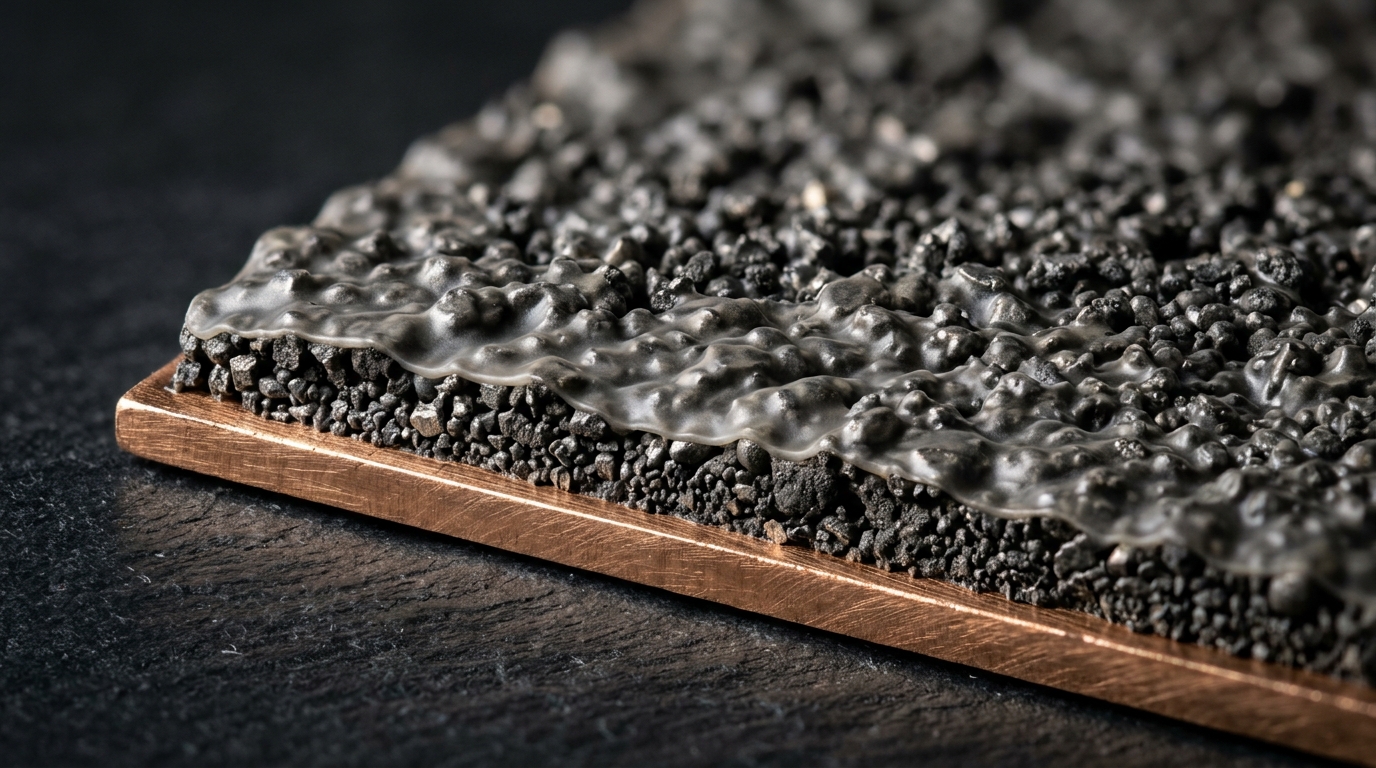
A scientific review published in The Innovation argues that resolving the severe volume expansion of silicon anodes in lithium-ion batteries requires protective interfaces that adapt dynamically to physical changes rather than rigidly resisting them. Anodes currently limit the overall performance of rechargeable lithium-ion cells, acting as the primary electrode that determines total energy storage capacity and governing how far electric vehicles can travel between charging stops. Silicon possesses significant theoretical potential because it stores roughly eleven times more electrical charge per gram than standard commercial graphite, offering approximately 4,200 milliampere-hours per gram compared to just 372 milliampere-hours per gram. However, silicon particles swell by up to 400 percent as lithium ions enter during charging. The review contends that two decades of battery research have focused on the wrong objective by attempting to construct ever-tougher rigid shells around silicon, arguing instead that the fundamental goal should be designing an interface capable of moving synchronously with the expanding electrode.
During the initial charging cycle of a battery, liquid electrolyte decomposes directly on the anode surface to form a solid electrolyte interphase, commonly known as the SEI. This nanometre-thin surface skin performs the essential role of conducting lithium ions while blocking electrons to halt ongoing chemical degradation. While this passivation film remains stable and anchored on conventional graphite anodes, the severe physical swelling of silicon tears the layer during every operational cycle. Each resulting fracture exposes unreacted silicon directly to the electrolyte solution, prompting the growth of additional solid electrolyte interphase material. Over repeated cycling, this continuous breakdown and formation thickens into a porous, three-dimensional network that severely chokes lithium-ion transport through the cell. Although engineering strategies such as particle nanostructuring and protective carbon coatings have helped soften initial mechanical shocks, they have left this destructive loop of fracture and regeneration fundamentally intact.
To dismantle this continuous degradation cycle, the authors propose a dimensional transition from bulky three-dimensional networks to compact two-dimensional configurations. By utilizing concentrated and locally concentrated liquid electrolytes, researchers can alter reduction dynamics so that salt anions reduce at the anode surface before solvent molecules can decompose. This chemical reduction process produces a compact two-dimensional interphase measuring only 5 to 10 nanometres in thickness, characterized by densely packed nanodomains of lithium fluoride, lithium oxide, and lithium nitride with virtually no internal porosity. Such ultra-thin films generate far lower stress concentrations during phase transformations. Finite-element mechanical simulations cited in the publication demonstrate noticeably flatter strain gradients distributed across the silicon particles, alongside rapid lithium-ion transport along grain boundaries with low activation energy barriers below 0.3 electron volts.
The review demonstrates that relying exclusively on structural rigidity or mechanical softness inevitably leads to interfacial failure under cycling stresses. Instead, the authors advocate for hierarchical material coupling, utilizing crystalline lithium fluoride clusters measuring 2 to 5 nanometres across to serve as load-bearing inorganic fillers within a flexible polymer matrix. The surrounding polymeric network incorporates C-O-C and Si-O-Si chemical backbones that readily stretch and flex, effectively dissipating accumulated mechanical strain. Mechanical analysis illustrates why this spatial distribution proves critical for anode durability. Conventional solid electrolyte interphases typically exhibit an elastic modulus spanning tens of gigapascals positioned over a silicon substrate of about 10 gigapascals. In contrast, the hierarchically coupled architecture establishes a graded mechanical profile, transitioning smoothly from a soft, compliant polymer exterior of 0.2 to 0.5 gigapascals to a rigid, lithium-fluoride-rich interior measuring 6.5 gigapascals or higher.
Interfacial resilience is further augmented through dynamic chemical bonds integrated directly into the polymer network, providing a self-healing mechanism against mechanical damage. Reversible chemical linkages, specifically dynamic disulfide and imine bonds, possess the capability to dissociate under severe local strain and subsequently re-form once stress subsides. This molecular reversibility grants the interphase a limited yet valuable capacity to self-seal microscopic cracks that inevitably develop during continuous expansion and contraction cycles. Rather than attempting to resist particle expansion through brute structural hardness, this design makes the interphase sufficiently compliant and chemically dynamic so that localized fracture stresses can be absorbed and repaired without exposing fresh silicon surfaces.
To ensure that academic research translates into functional energy storage technologies, the authors assembled specific benchmarks from literature to define the threshold of practical engineering relevance. Effective silicon anodes must achieve an areal capacity exceeding 4 milliampere-hours per square centimetre while restricting total electrode thickness to less than 100 micrometres. In addition, realistic cell deployment requires maintaining an electrolyte-to-capacity ratio below 2 grams per ampere-hour, alongside sustaining stable operation across more than 500 continuous cycles while retaining at least 80 percent of original cell capacity. Meeting these combined criteria is necessary to determine whether a silicon anode configuration can actually function within the severe operating constraints of commercial electric vehicle packs.
The authors emphasize that these rigorous benchmark metrics represent aspirational targets compiled from published literature rather than verified outputs produced by a single operational battery cell. The review synthesizes findings from more than 100 published scientific papers, yet the vast majority of these studies investigated small laboratory half-cells rather than complete battery systems. Consequently, very few existing reports evaluate cells under the high-mass-loading and lean-electrolyte conditions that ultimately dictate whether an anode survives within an automotive battery pack. Furthermore, the authors acknowledge that adaptive interphases currently lack a standardized measurement metric to quantify adaptation, while proposed future developments, such as data-driven materials design and machine-learning screening, remain theoretical proposals that require extensive experimental validation.
Subject of Research: Adaptive solid electrolyte interphases for silicon battery anodes
Article Title: Silicon anodes swell by 400% — the fix may be a thinner skin that heals itself
Article References: Silicon anodes swell by 400% — the fix may be a thinner skin that heals itself. Original publication (Bibliographic details unavailable.)
Image Credits: AI Generated
DOI: Not provided
Keywords: silicon anodes, solid electrolyte interphase, lithium-ion batteries, energy storage, volume expansion, lithium fluoride, polymer matrix, self-healing materials, dynamic bonds, finite-element simulations, areal capacity, lean electrolyte, electrochemical degradation, interfacial stability, battery interfaces, The Innovation, disulfide bonds
News Source: Faith Mcneil. (November 20, 2026). Adaptive Solid Electrolyte Interphases Could Stabilize Expanding Silicon Battery Anodes. Scienmag.