


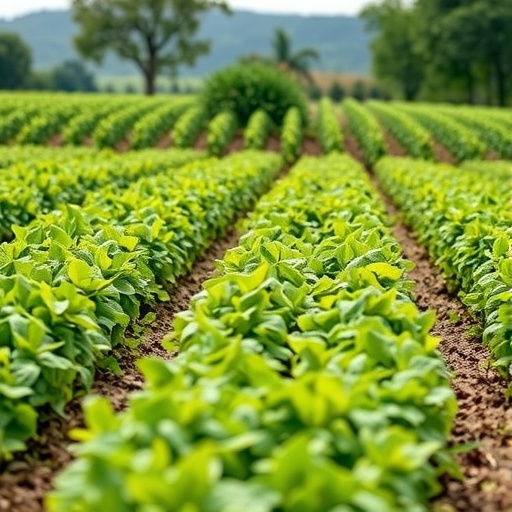
A new study published in Scientific Reports has introduced an artificial-intelligence framework designed to tackle one of precision agriculture’s most difficult challenges: predicting how much food a field will produce before the harvest arrives. Titled “Adaptive generalized regressive deep convolutional reinforcement learning for crop yield prediction in smart precision farming,” the research by Preethi and R.M. Devadas brings together several advanced machine-learning techniques in an attempt to make agricultural forecasting more responsive, data-driven and adaptable. The work arrives as farmers worldwide face increasingly volatile weather, water shortages, soil degradation and rising pressure to produce more food from limited land.
Crop-yield prediction is far more complicated than simply measuring rainfall or counting plants. Harvest outcomes are shaped by a constantly changing combination of soil characteristics, temperature, humidity, sunlight, irrigation, fertilizer use, pest activity, disease, planting density and crop variety. Even neighboring fields can produce dramatically different results when their soil structure or management history differs. Conventional prediction models often struggle because they are trained on historical relationships that may no longer apply when growing conditions shift. A drought, an unexpected heatwave or a new pest outbreak can make yesterday’s agricultural patterns unreliable.
The framework described in the study combines deep convolutional learning with reinforcement learning and a generalized regression approach. Convolutional neural networks are widely known for their ability to detect patterns in images, but their mathematical architecture can also be adapted to identify meaningful relationships in complex, multidimensional datasets. In farming applications, those datasets may include satellite imagery, drone observations, sensor readings, weather records and field-management information. By processing spatial and temporal signals together, a convolutional system can potentially distinguish subtle differences between healthy and stressed crops that would be difficult to capture through manual inspection.
The “regressive” element of the model is focused on estimating a continuous value rather than assigning a simple category. Instead of merely labeling a field as healthy or unhealthy, a regression system attempts to calculate an expected yield, such as the amount of grain, fruit or biomass likely to be harvested. The generalized approach is important because agricultural data rarely behave in a perfectly uniform way. Different crops, regions and seasons can produce different relationships between environmental conditions and yield. A flexible regression component may therefore help the system remain useful across diverse farming situations rather than being restricted to a single set of conditions.
Reinforcement learning adds another layer of adaptation. In a reinforcement-learning system, an algorithm learns how to make decisions by receiving feedback from its environment. Actions that improve a defined outcome receive a favorable signal, while less effective decisions receive a weaker or negative signal. For precision farming, this idea can be connected to decisions such as irrigation timing, nutrient management or the prioritization of fields for closer monitoring. In the context of yield prediction, adaptive learning could enable the model to update its expectations as new information arrives, rather than relying entirely on a fixed prediction generated at the beginning of a growing season.
That adaptability could prove especially valuable as climate change makes agricultural conditions less predictable. Historical data remain essential for training artificial-intelligence systems, but they can also become a limitation when the future no longer resembles the past. A model trained mainly on moderate temperatures and regular rainfall may perform poorly during prolonged drought or extreme heat. An adaptive architecture is intended to respond to changing inputs and refine its internal predictions over time. The goal is not to eliminate uncertainty, which is impossible in farming, but to turn incoming data into earlier and more actionable warnings.
Smart precision farming depends on the ability to collect information at the right scale and speed. Soil sensors can report moisture and nutrient conditions, weather stations can track microclimates, and satellites or drones can reveal changes in crop color, canopy density and plant development. Artificial intelligence provides the computational layer needed to convert those streams into operational guidance. A yield-prediction model may help farmers estimate production well before harvest, identify underperforming areas and allocate water, fertilizer, labor and equipment more efficiently. It could also support storage and transport planning by giving agricultural businesses an early indication of the volume likely to enter the supply chain.
The potential economic and environmental consequences are significant. More accurate forecasts could reduce waste by preventing unnecessary irrigation or fertilizer application, while helping farmers respond to crop stress before damage becomes irreversible. Better estimates could also improve market planning and reduce the risk of sudden shortages or oversupply. For smallholder farmers, however, the value of such technology will depend on affordability, connectivity and ease of use. A sophisticated model cannot transform agriculture if the data required to operate it are unavailable, unreliable or too expensive to collect. Successful deployment will require interfaces that translate technical predictions into clear recommendations that farmers can trust.
The study also highlights a central issue in agricultural artificial intelligence: prediction quality depends heavily on the data used to build and test a model. Sensor failures, missing records, inconsistent measurements and regional differences can all distort results. A model may appear highly accurate in one location but perform less effectively in another with different soil, climate or farming practices. Independent validation across multiple seasons and agricultural regions is therefore essential. Researchers and technology developers will also need to examine how the system handles unusual conditions, including extreme weather events, new diseases and changes in crop varieties. Transparent reporting of uncertainty will be just as important as the predicted yield itself.
As artificial intelligence moves deeper into food production, the most influential systems may not be those that simply generate the fastest forecast, but those that can learn responsibly from changing conditions. The adaptive generalized regressive deep convolutional reinforcement-learning approach presented by Preethi and Devadas reflects that broader shift toward agricultural models designed to combine pattern recognition, numerical prediction and continual adaptation. Its significance lies in the attempt to connect complex data analysis with practical field management. If validated through extensive real-world testing, technologies of this kind could help farmers make earlier decisions, conserve scarce resources and prepare more effectively for an unpredictable agricultural future.
Subject of Research: Crop yield prediction using adaptive deep learning, generalized regression and reinforcement learning for smart precision farming.
Article Title: Adaptive generalized regressive deep convolutional reinforcement learning for crop yield prediction in smart precision farming.
Article References: Preethi, P., Devadas, R.M. “Adaptive generalized regressive deep convolutional reinforcement learning for crop yield prediction in smart precision farming.” Scientific Reports (2026). https://doi.org/10.1038/s41598-026-66501-5
Image Credits: AI Generated
DOI: 10.1038/s41598-026-66501-5
Keywords: Crop yield prediction, smart precision farming, deep convolutional learning, reinforcement learning, generalized regression, agricultural artificial intelligence, precision agriculture.
Tags: adaptive reinforcement learning in agricultureaddressing environmental variability in crop forecastingadvanced agricultural forecasting techniquesAI-driven agricultural decision support systemsclimate-resilient crop prediction modelsCrop yield predictiondeep convolutional reinforcement learning for farmingmachine learning for sustainable farmingprecision farming machine learningreal-time crop yield modelingsmart agriculture data-driven forecastingsoil and weather data analysis in agriculture


