Researchers have developed a method using accelerometer-derived activity data to estimate the timing of den entry and exit in brown bears. Published in Animal Biotelemetry, the study demonstrates that analyzing fine-scale movement patterns can distinguish true behavioral inactivity from mere presence at a den site. This approach addresses limitations of traditional GPS telemetry, which often fails to differentiate between a bear resting at a den and a bear actively hibernating. The findings provide a robust framework for monitoring denning phenology in Scandinavian brown bear populations.
The study focused on a brown bear population in south-central Sweden, specifically in Dalarna and Gävleborg counties and the southern part of Jämtland County. The research team equipped 148 bears, comprising 111 females and 37 males, with GPS collars fitted with accelerometers between spring 2003 and spring 2024. This effort resulted in a dataset of 388 bear-winters, with an average of 18.5 observations per winter. The bears were captured using a remote drug delivery system from a helicopter, with capture efforts directed primarily at females accompanied by yearling offspring.
Traditional methods for estimating denning timing often rely on GPS telemetry data, such as signal loss or stationary positions. However, these approaches have significant drawbacks. GPS signals can be coarse, and bears may reduce movement gradually over several days or weeks before fully entering a den, making it difficult to pinpoint the exact onset of hibernation. Furthermore, GPS telemetry cannot detect complete immobility and may miss brief emergence events. The new method uses hidden Markov models to analyze day-to-day changes in activity, identifying the start and end of inactivity periods as a proxy for denning.
The researchers used a hidden Markov model with three behavioral states: active, transitional, and inactive. This model accounts for individual variation in baseline activity by using adaptive, individual-specific thresholds rather than fixed cut-off values. The transitional state captures the gradual behavioral changes associated with pre- and post-denning phases, where bears progressively reduce and resume activity. By using this approach, the method overcomes the limitations of fixed thresholds and small sample sizes, providing a flexible and reproducible way to detect den entry and exit.
The activity-based method successfully identified inactivity periods in 360 of the 388 bear-winters, representing a 93% success rate. In the remaining 28 cases, the method failed to detect clear hibernation start and end dates, often due to unusually high or low activity at the boundaries of the inactivity period. Den occupancy, defined by GPS telemetry, ranged from September 5 to June 2, lasting between 112 and 260 days. In contrast, the inactivity periods identified by the accelerometer data spanned from September 6 to May 13, lasting between 83 and 217 days.
Comparisons between the activity-based estimates and GPS-derived den occupancy revealed significant temporal discrepancies. Bears often arrived at den sites several weeks before the start of the main inactive period and left several weeks after it ended. The mean lag between den-site arrival and the start of inactivity was 7.7 days, while the mean lag between the end of inactivity and departure from the den site was 15.2 days. These findings suggest that den site occupancy includes active phases that occur both before and after the actual period of inactivity, highlighting the complexity of denning transitions.
The study also examined variation in denning behavior across different demographic groups. Pregnant females started their inactivity period significantly earlier than other groups, with a difference of 9.9 to 17.2 days. Females giving birth during hibernation ended their inactivity period 11.2 to 21.5 days later than all other demographic groups. Females with cubs-of-the-year stayed the longest at the den site after activity resumed, with a median duration of 20 days. These demographic differences underscore the importance of considering individual characteristics when studying denning phenology.
Temporal trends in denning behavior were also analyzed over the study period. The researchers found a significant effect of year on the end of the inactivity period, with bears emerging progressively earlier over the last two decades. The estimated shift was approximately 0.35 days per year, resulting in a total shift of about seven days over the 20-year period. In contrast, no significant effect of year was detected for the start of the inactivity period. This suggests that changes in denning phenology are specific to den exit timing rather than the entire denning cycle.
The study highlights the complementary strengths of different biologging approaches for studying denning behavior. GPS telemetry provides information on den-site occupancy, while accelerometer data capture behavioral inactivity associated with denning. Physiological sensors, such as body temperature or heart rate loggers, offer insights into hibernation physiology and gestation. By combining these data sources, researchers can gain a more comprehensive understanding of the complex interactions among environment, physiology, and energetic constraints that influence denning timing.
The method developed in this study offers a reliable tool for monitoring phenological shifts in response to climate change. As winters become shorter and milder, accurate estimation of denning timing is essential for assessing the potential effects of climate change on hibernating species. The individual-level approach improves accuracy in assessing ecological mechanisms underlying hibernation and enhances the interpretation of environmental drivers. This framework can be applied to other hibernating species to advance our understanding of hibernation ecology and support wildlife management decisions.
Beyond movement tracking, the study setting and specialized biologging instrumentation provided vital context for interpreting bear behavior. The research took place across Dalarna, Gävleborg, and southern Jämtland counties, an environment dominated by managed boreal forest of Scots pine and Norway spruce interspersed with deciduous stands, peat bogs, and berry-rich dwarf shrubs such as bilberry and lingonberry. The motion sensors within the collar packages sampled acceleration six to eight times per second along two orthogonal axes, averaging readings over five-minute intervals on an arbitrary scale from zero to 255. By combining these directional values, researchers produced daily activity indices analyzed using three-state Hidden Markov Models with zero-mass gamma distributions. To supplement movement metrics, a subset of sixty female bear-winters included surgically implanted abdominal temperature loggers and subcutaneous cardiac monitors recording daytime and nighttime heart rates. These internal instruments were retrieved following collar recovery under ethical protocols approved by Swedish conservation and animal welfare authorities.
Determining physical den occupancy required spatial clustering criteria applied to interpolated telemetry paths. The researchers aggregated GPS positions into clusters using a 50-meter radius, a three-day window, and a minimum of three location fixes, establishing a 50-meter boundary around each cluster centroid. Arrival and departure dates required at least six consecutive days outside this perimeter immediately before entry or following exit. Even with these standardized parameters, GPS telemetry successfully located the initial den in only 75 percent of monitored winters and the final den in 57 percent of cases. This reduced detection efficiency stemmed from extended signal loss while bears remained sheltered underground, as well as occasional midwinter den changes. In one notable instance, an individual bear switched shelters after spending fewer than three days at its initial site, causing the calculated arrival date to appear two days after the model-derived onset of inactivity.
Detailed demographic comparisons revealed nuanced disparities that extended beyond broad entry timelines. Solitary adult females initiated inactivity only 6.9 days later than pregnant females, a gap that was not statistically significant after multiple-comparison adjustments. In contrast, subadult females entered inactivity 7.2 days later than females with cubs-of-the-year and 10.3 days later than solitary adult females. In the spring, females accompanied by yearling offspring concluded inactivity significantly later than subadult females by 9.5 days, females that lost cubs by 13.8 days, and adult males by 16.6 days. Total den site occupancy also varied markedly according to maternal status. Females emerging with new cubs occupied den sites for an average of 206.9 days and a median of 208.5 days, spending an average of 174.8 days in continuous inactivity. Non-birthing bears maintained substantially shorter commitments, averaging 165.9 days of site occupancy and 147.6 days of inactive behavior.
The investigation also documented specific methodological boundaries and handling constraints. Twenty-seven solitary bears captured within winter dens in February or March were excluded from exit analyses because physical handling often provoked immediate den abandonment. Among the twenty-eight bear-winters with unresolved transition dates, atypical activity spikes or prolonged lulls near boundary periods compromised model classification. In one pregnant female, elevated physical movement during late gestation caused her behavior to be categorized as transitional rather than inactive, an anomaly that did not recur across the remaining 144 pregnant bear-winters. In addition, modern den entry spanned a broader timeframe than historical VHF tracking from 1986 to 2001 in the same area, which had recorded entries between September 28 and November 20.
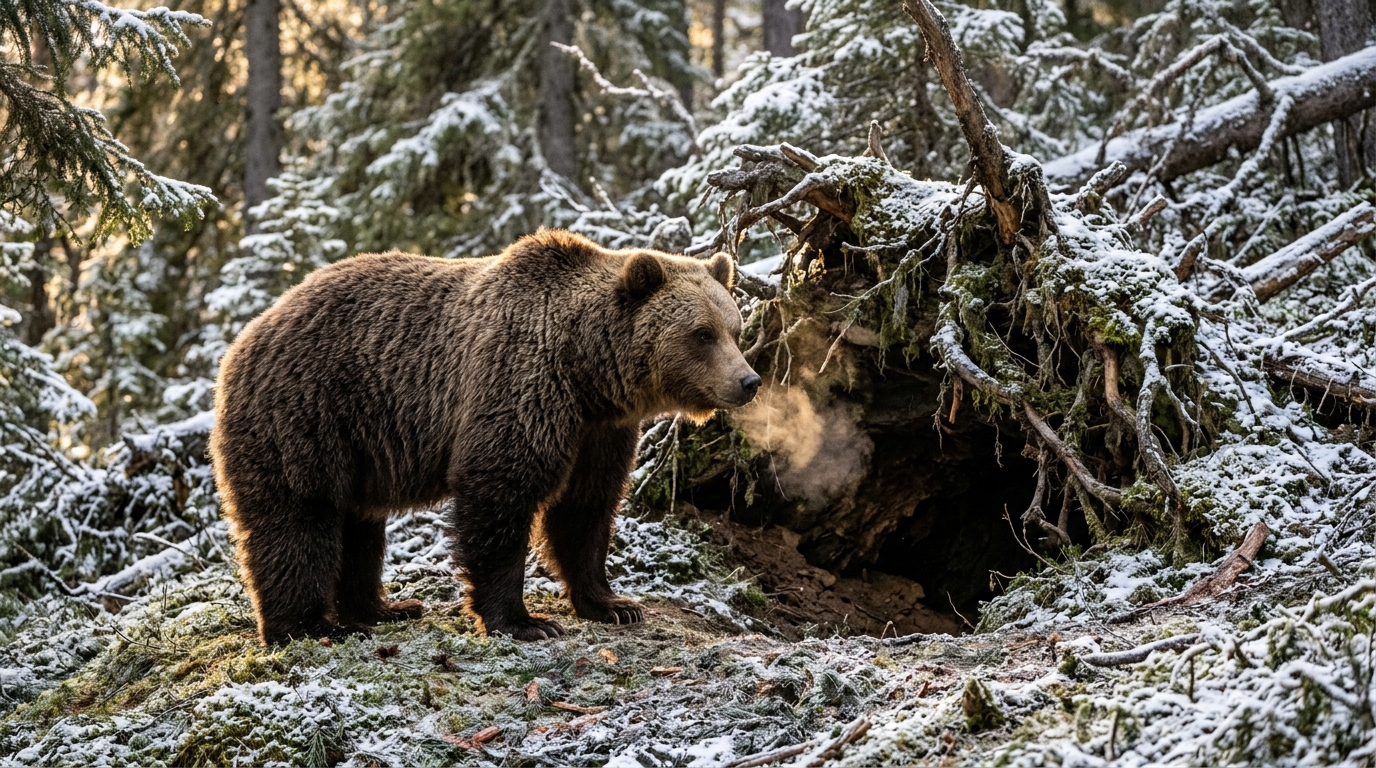
Finally, the pre-denning delay carries practical relevance for wildlife conservation and human safety. During the autumn weeks when bears linger around prospective dens, diminished mobility and a reduced tendency to flee coincide with Sweden’s active autumn hunting season, increasing the risk of sudden encounters near excavation sites. Subadult bears exhibited longer delays before entering dormancy than solitary adults, pointing to behavioral maturation in den construction efficiency. Furthermore, the absence of an autumn entry trend suggests that entry timing is governed by nutritional constraints and berry availability during hyperphagia, whereas warming conditions primarily drive the observed advancement in spring emergence.
Subject of Research: Estimating brown bear denning phenology using accelerometer activity data
Article Title: Using activity data to estimate brown bear den exit and entry dates
Article References: Brault, B., Clermont, J., Zedrosser, A., Friebe, A., Kindberg, J., & Pelletier, F. (2026). Using activity data to estimate brown bear den exit and entry dates. Animal Biotelemetry, 14(1), Article 40. https://doi.org/10.1186/s40317-026-00479-9
Image Credits: AI Generated
DOI: 10.1186/s40317-026-00479-9
Keywords: brown bear, denning, accelerometry, GPS telemetry, phenology, hibernation, wildlife monitoring, climate change, animal behavior, Sweden, activity, data
News Source: Drew Townsend. (November 7, 2026). Activity Data Reveals Brown Bear Denning Timing. Scienmag.