


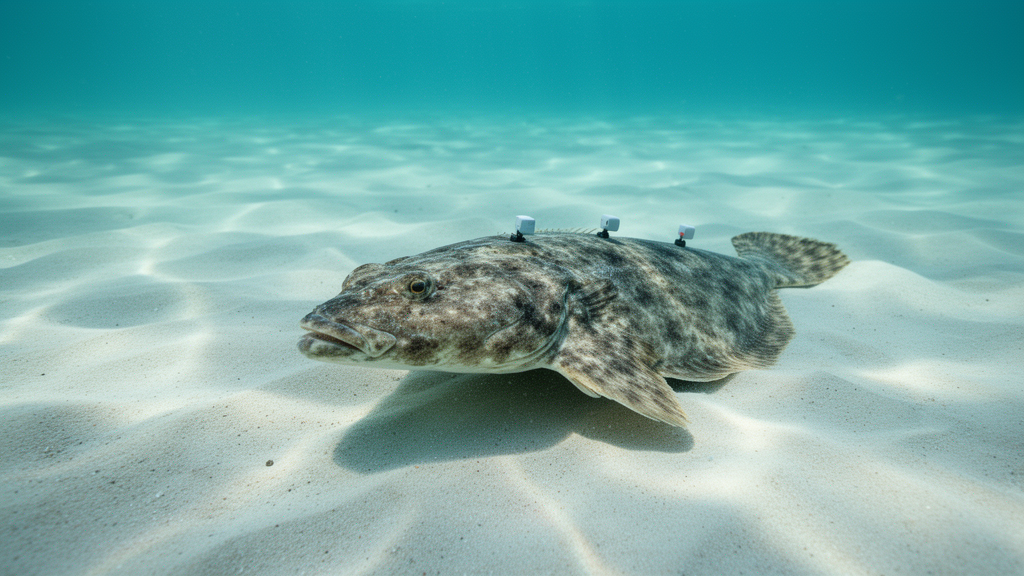
On the sandy floor of Jervis Bay, a fish long assumed to wander aimlessly across a seemingly featureless habitat has been caught moving with surprising purpose. A new study published in Animal Biotelemetry tracked 46 bluespotted flathead (Platycephalus caeruleopunctatus) with a fine-scale acoustic positioning system over 472 days and found that these ambush predators move in directed patterns within small areas, challenging the prevailing assumption that fish living on homogeneous soft sediment should drift across large expanses in undirected searches for scattered prey.
The receivers were arranged in an offset grid with 300 metre spacing at depths of 7 to 13 metres, covering a core internal area of roughly 78 hectares and a total detection footprint of about 202 hectares. Because the array sat in a no-take sanctuary zone, none of the tagged fish could be harvested during the study.
Bluespotted flathead are demersal predators that lie in wait on sand and mud, feeding on small fish, crustaceans and molluscs. They are among the most abundant soft sediment species in eastern Australian fish assemblages and an important commercial and recreational target in New South Wales, in some years the most abundant species in commercial catch. Marine soft sediments, the unconsolidated muds, silts and sands that make up more than 70 percent of the world’s seafloor, support some of the planet’s largest fisheries, yet the movement ecology of the fishes that live there has lagged far behind research on reef species. Movement theory predicts that animals in structurally homogeneous habitats should wander over larger areas to increase chance encounters with sparsely distributed resources, much as pelagic bluefin tuna do when searching for patchy prey.
To test that prediction, the researchers surgically implanted acoustic transmitters into fish captured by hook and line in three batches between September 2014 and December 2015. Each tag emitted a unique signal every 110 to 250 seconds, and whenever three or more receivers detected the same transmission, the fish’s position could be estimated with high precision. After filtering to retain only positions with a horizontal positioning error below 10, a step that kept 98.1 percent of estimates, and removing the first five days after tagging to exclude surgical stress, the final dataset comprised 28,149 positions from 38 individual fish.
The clearest result came from comparing real movement paths against simulated random walks, the standard benchmark for undirected movement. For 14 fish with long, uninterrupted tracking sequences, the observed paths showed lower mean square displacement than their paired random walks in 13 out of 14 cases, meaning the fish stayed clustered around a central activity area rather than dispersing. Their turning angles were not uniformly distributed either: instead of choosing directions at random, the flathead showed distinct peaks at 0 degrees and at plus or minus 180 degrees, favouring straight-line movements and abrupt reversals. A Kuiper’s test confirmed statistically non-uniform turning distributions for 10 of the 14 fish.
Having established that the movements were directed, the team then asked what drives their speed and extent. They built generalised additive mixed models linking movement speed, calculated from consecutive positions separated by a single transmission interval, and space use, measured as the area of the 95 percent isopleth of a kernel utilisation distribution within each three-hour period, to eight environmental variables: sea surface temperature, rainfall, atmospheric pressure, wave height, wind speed, wind direction, time of day and time of year, plus fish length. The speed model drew on 8,043 position pairs from 31 fish and explained 13.6 percent of deviance; the space use model used 1,524 estimates from 27 fish and explained 44 percent.
Temperature emerged as a key driver of speed. For each one-degree rise in sea surface temperature, expected movement speed increased by 8.2 percent, and when water temperatures exceeded 21 degrees Celsius, predicted speed was 1.62 times greater than below 17 degrees. As ectotherms, flathead face rising metabolic demands in warmer water, and the authors suggest the fish likely spent more time hunting and feeding during warm periods. Notably, temperature did not affect space use, so warmer fish moved faster but not further afield. Time of day mattered too: predicted speeds were about 10 percent greater at night and during crepuscular periods, peaking between 05:00 and 08:00 and between 18:00 and 21:00, with the lowest speeds in the early afternoon. Space use followed the same rhythm, running roughly 24 percent higher during dawn and dusk than in daylight, a pattern consistent with ambush predators hunting when they are least visible to prey.
Seasonality shaped both measures. Movement speed peaked in summer and dipped lowest in spring, while space use peaked in early summer at 2.53 times the winter minimum. Atmospheric pressure showed a subtler signature: it had no statistically significant effect on speed, though model predictions hinted at a weak negative association, and space use was 1.43 times greater during low-pressure periods than high-pressure ones. The authors speculate that falling pressure, often a precursor to storms, might increase turbidity and hunting opportunities for ambush feeders, echoing observations in grey reef sharks and summer flounder, though they caution there is no evidence the fish were avoiding any particular area. Wind direction modulated the effect of wind speed on movement in a small but detectable interaction: under calm conditions below 10 kilometres per hour, predicted speed was highest with westerly winds and lowest with easterlies, possibly reflecting shelter provided by coastal landforms to the west of the bay. Rainfall, wave height, wind speed alone and fish length showed no detectable influence on either speed or space use.
The findings reframe how scientists think about life on the seafloor’s great featureless expanses. If a sand-dwelling ambush predator moves in directed patterns within a small home range, then environmental gradients, of light, temperature, pressure and wind-driven water conditions, may constitute a form of habitat complexity in their own right, structuring movement even where no physical structure exists. The authors propose that biotic factors likely matter as well: seasonal prey abundance, metabolic demand and even the seasonal spawning migration that takes part of the Jervis Bay flathead population northward may explain the summer expansion in space use among the fish that remain, possibly through reduced competition. Testing these ideas will require long-term data on prey dynamics and feeding ecology that do not yet exist for the bay.
The study also carries caveats the authors are careful to flag. Position estimates were not continuous for all individuals, with days of data per fish ranging from 2 to 222, so some fish’s speed records may capture mainly active periods while others captured inactivity. Data gaps and reduced positioning accuracy near the array perimeter may have led to underestimates of space use, and some individuals may have ranged beyond the array’s limits altogether. Wave and sea surface temperature data ended on 31 December 2015 due to a planned cessation of the Waverider buoy network, cropping the tracking analysis to that date. The patterns observed reflect one species at one site under the specific habitat conditions of Hare Bay, and the authors call for replicate species and sites, denser receiver arrays, tags with built-in pressure sensors, and improved trajectory inference to clarify the trends. Even so, the message is striking: on a seafloor with no reefs, no kelp and no boulders, a flathead still knows where it is going.
Subject of Research: Fine-scale movement patterns and environmental drivers of bluespotted flathead on soft sediment habitat in Jervis Bay, Australia
Article Title: Environmental conditions shape the movement patterns of a marine ambush predator on homogeneous soft sediment habitat
Article References: Perkins, W. J., Saltré, F., Taylor, M. D., Fetterplace, L. C., Knott, N. A., & Peters, K. J. (2026). Environmental conditions shape the movement patterns of a marine ambush predator on homogeneous soft sediment habitat. Animal Biotelemetry, 14(1), Article 35. https://doi.org/10.1186/s40317-026-00496-8
Image Credits: AI Generated
DOI: 10.1186/s40317-026-00496-8
Keywords: bluespotted flathead, acoustic telemetry, movement ecology, soft sediment habitat, Jervis Bay, sea surface temperature, ambush predation, space use, marine fisheries, random walk, environmental drivers, New South Wales
News Source: Drew Townsend. (October 29, 2026). Acoustic tracking reveals ambush predator moves with purpose on featureless seafloor. Scienmag.



