• HOME
  • NEWS
  • EXPLORE
    • CAREER
      • Companies
      • Jobs
    • EVENTS
    • iGEM
      • News
      • Team
    • PHOTOS
    • VIDEO
    • WIKI
  • BLOG
  • COMMUNITY
    • FACEBOOK
    • INSTAGRAM
    • TWITTER
Sunday, August 2, 2026
BIOENGINEER.ORG
No Result
View All Result
  • Login
  • HOME
  • NEWS
  • EXPLORE
    • CAREER
      • Companies
      • Jobs
        • Lecturer
        • PhD Studentship
        • Postdoc
        • Research Assistant
    • EVENTS
    • iGEM
      • News
      • Team
    • PHOTOS
    • VIDEO
    • WIKI
  • BLOG
  • COMMUNITY
    • FACEBOOK
    • INSTAGRAM
    • TWITTER
  • HOME
  • NEWS
  • EXPLORE
    • CAREER
      • Companies
      • Jobs
        • Lecturer
        • PhD Studentship
        • Postdoc
        • Research Assistant
    • EVENTS
    • iGEM
      • News
      • Team
    • PHOTOS
    • VIDEO
    • WIKI
  • BLOG
  • COMMUNITY
    • FACEBOOK
    • INSTAGRAM
    • TWITTER
No Result
View All Result
Bioengineer.org
No Result
View All Result
Home NEWS Science News Biology

A webcam is enough to produce a real-time 3D model of a moving hand

Bioengineer by Bioengineer
June 8, 2018
in Biology
Reading Time: 2 mins read
0
Share on FacebookShare on TwitterShare on LinkedinShare on RedditShare on Telegram
IMAGE

Credit: Oliver Dietze

For the first time, the researchers will be presenting the program at stand G75 in hall 27 of the computer fair Cebit, which will take place in Hannover from June 11th onward.

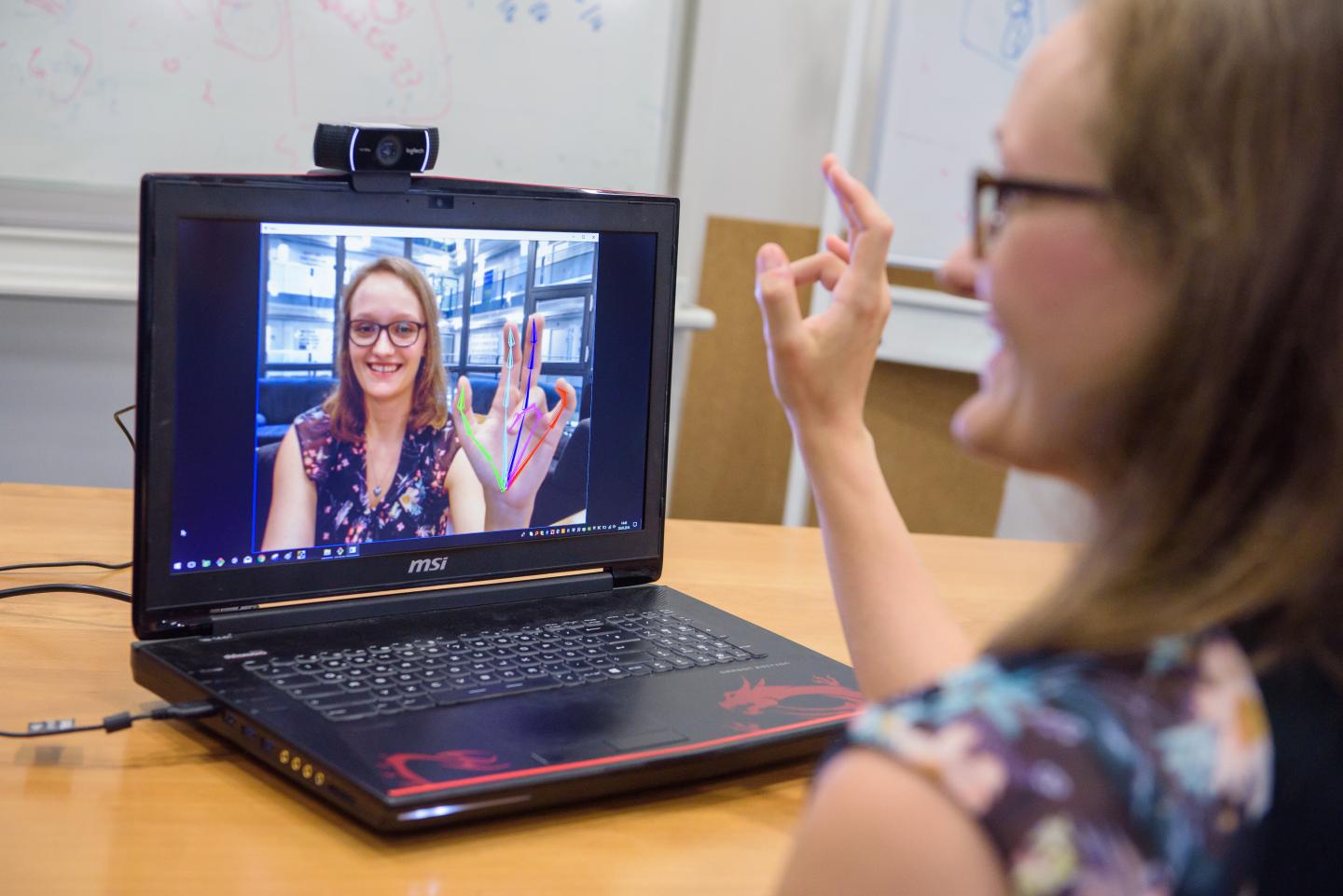
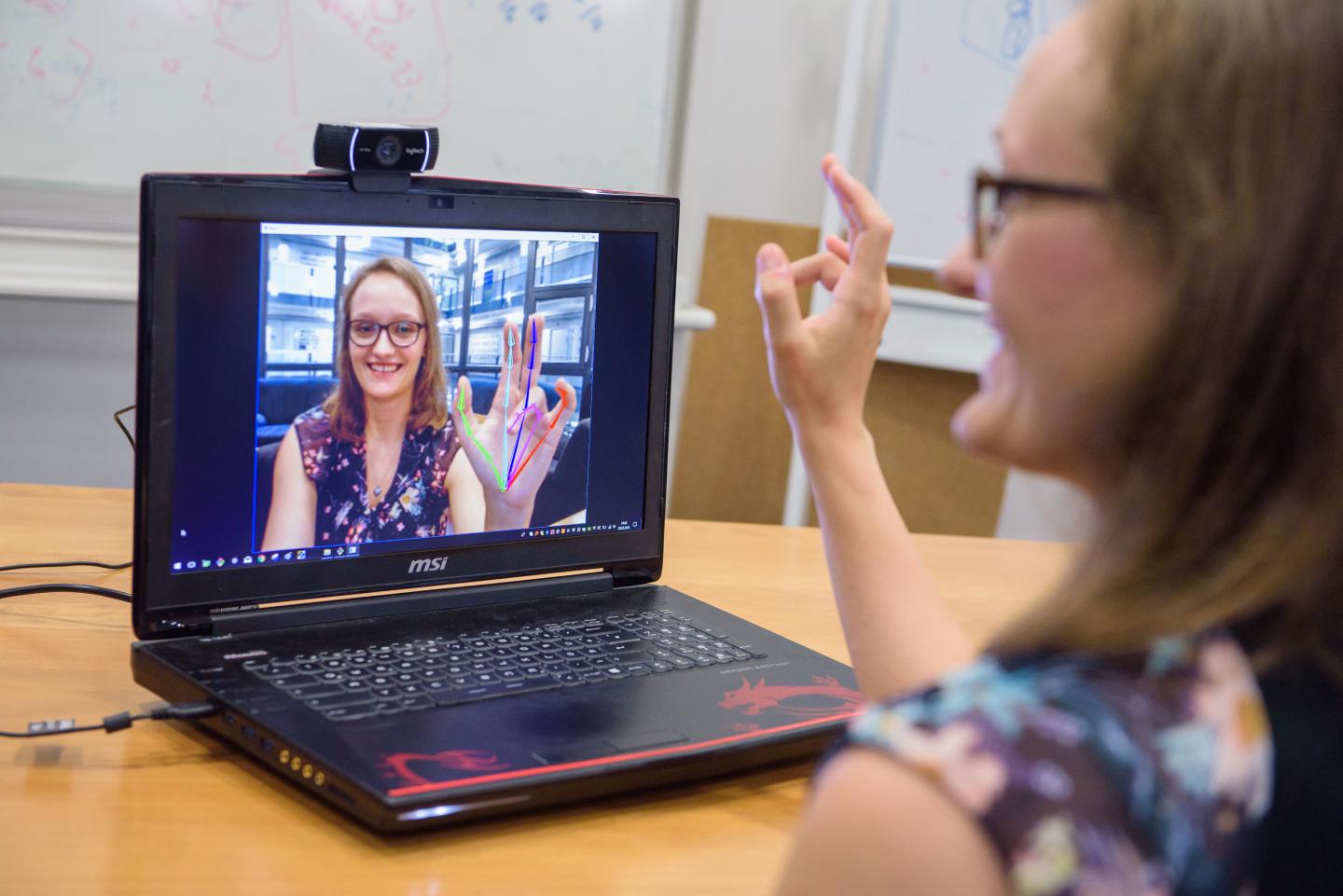
If the computer scientist Franziska Müller holds her hand in front of the laptop camera, the hand's virtual counterpart appears on the screen. Immediately this is overlaid by a colorful virtual hand skeleton. No matter what movements Müller's hand makes in front of the webcam, the colored bones of the model do the same. Müller demonstrates the software she developed together with Professor Christian Theobalt and other researchers from the Max Planck Institute for Computer Science in Saarbrücken, Stanford University and the Spanish King Juan Carlos University. So far no other software can do this with such a low-cost camera.

Since it works in almost every kind of filmed scene, it can be used anywhere, and thus trumps previous approaches that require a depth camera or multiple cameras. The algorithm, with which the software transforms the two-dimensional information of the video image in real time into the three-dimensional movement model of the hand's bones, is based on a special kind of neural network: a so-called "convolutional neural network" or CNN for short. The researchers have trained it to detect the bones of the hand. They have generated the necessary training data with another neural network. The result: The software calculates the exact 3D poses of the hand's bones in milliseconds. Even if some of them are occluded, for example by an apple being held in the hand, this does not affect the software. Only several hands working together still confuse the software. Solving this is the researchers' next goal.

###

More information:

http://handtracker.mpi-inf.mpg.de/projects/GANeratedHands/

Press photos: http://www.uni-saarland.de/pressefotos

Questions can be directed to:

Franziska Müller
Max Planck Institute for Informatics
Saarland Informatics Campus E1.4
E-mail: [email protected]
Phone: +49 681 9325 4057

Editor:

Gordon Bolduan
Science Communication
Competence Center Computer Science Saarland
Saarland Informatics Campus
E-mail: [email protected]
Phone: +49 681 302 70741

Media Contact

Gordon Bolduan
[email protected]
49-681-302-70741
@Saar_Uni

http://www.uni-saarland.de

Share12Tweet8Share2ShareShareShare2

Related Posts

Nationwide Study Tracks Hepatitis B Reactivation and Liver Dysfunction During Infliximab Treatment

Nationwide Study Tracks Hepatitis B Reactivation and Liver Dysfunction During Infliximab Treatment

August 1, 2026
Imaging Reveals How Brain–Body Interactions Shape Systemic Disease

Imaging Reveals How Brain–Body Interactions Shape Systemic Disease

August 1, 2026

Targeting Vascular–Musculoskeletal Links May Treat Sarcopenia and Osteoporosis

August 1, 2026

Supergene solves evolutionary mystery by controlling mirror-image flower development

August 1, 2026
Please login to join discussion

POPULAR NEWS

  • Older Adults’ Views on Managing Chronic Pain in Primary Care

    29 shares
    Share 12 Tweet 7
  • Bentham Science Launches International Journal of Wireless and Communication Engineering Innovation

    29 shares
    Share 12 Tweet 7
  • Study explores long-term care residents’ experiences transitioning to emergency departments

    29 shares
    Share 12 Tweet 7
  • KAIST develops treatment targeting cancer cachexia, a debilitating wasting syndrome

    29 shares
    Share 12 Tweet 7

About

We bring you the latest biotechnology news from best research centers and universities around the world. Check our website.

Follow us

Recent News

Older Adults’ Views on Managing Chronic Pain in Primary Care

Bentham Science Launches International Journal of Wireless and Communication Engineering Innovation

Study explores long-term care residents’ experiences transitioning to emergency departments

Subscribe to Blog via Email

Enter your email address to subscribe to this blog and receive notifications of new posts by email.

Join 85 other subscribers
  • Contact Us

Bioengineer.org © Copyright 2023 All Rights Reserved.

Welcome Back!

Login to your account below

Forgotten Password?

Retrieve your password

Please enter your username or email address to reset your password.

Log In
No Result
View All Result
  • Homepages
    • Home Page 1
    • Home Page 2
  • News
  • National
  • Business
  • Health
  • Lifestyle
  • Science

Bioengineer.org © Copyright 2023 All Rights Reserved.