• HOME
  • NEWS
  • EXPLORE
    • CAREER
      • Companies
      • Jobs
    • EVENTS
    • iGEM
      • News
      • Team
    • PHOTOS
    • VIDEO
    • WIKI
  • BLOG
  • COMMUNITY
    • FACEBOOK
    • INSTAGRAM
    • TWITTER
Monday, August 31, 2026
BIOENGINEER.ORG
No Result
View All Result
  • Login
  • HOME
  • NEWS
  • EXPLORE
    • CAREER
      • Companies
      • Jobs
        • Lecturer
        • PhD Studentship
        • Postdoc
        • Research Assistant
    • EVENTS
    • iGEM
      • News
      • Team
    • PHOTOS
    • VIDEO
    • WIKI
  • BLOG
  • COMMUNITY
    • FACEBOOK
    • INSTAGRAM
    • TWITTER
  • HOME
  • NEWS
  • EXPLORE
    • CAREER
      • Companies
      • Jobs
        • Lecturer
        • PhD Studentship
        • Postdoc
        • Research Assistant
    • EVENTS
    • iGEM
      • News
      • Team
    • PHOTOS
    • VIDEO
    • WIKI
  • BLOG
  • COMMUNITY
    • FACEBOOK
    • INSTAGRAM
    • TWITTER
No Result
View All Result
Bioengineer.org
No Result
View All Result
Home NEWS Science News Biology

A symbiosis in the open ocean

Bioengineer by Bioengineer
June 27, 2023
in Biology
Reading Time: 2 mins read
0
Symbiosis
Share on FacebookShare on TwitterShare on LinkedinShare on RedditShare on Telegram

A study explores the genetic expression of a photosynthetic symbiont that lives inside an abundant marine organism. Marine diatoms are responsible for one-fifth of global photosynthesis. Many are coastal, but diatom-diazotroph associations thrive in open ocean waters that are low in nutrients thanks to a symbiotic relationship between a diatom host and nitrogen-fixing bacteria. Rachel Foster, Enrique Flores, and colleagues collected the diatom Hemiaulus hauckii, along with the cyanobacterium Richelia euintracellularis, which lives inside the diatom’s cells, from multiple locations in the western tropical North Atlantic. Cyanobacteria are bacteria which can perform plant-like photosynthesis. As researchers are currently unable to grow Richelia euintracellularis in the laboratory, the authors explored the function of proteins found in the endosymbiont by expressing the proteins in model organisms, including Escherichia coli and Anabaena sp. One protein was found to split sucrose into glucose and fructose. The presence of a sucrose-specific solute binding protein, which participates in shuttling molecules across the cell membrane, suggests that the sucrose is provided to the bacteria by the diatom hosts. Other solute binding proteins were found that participate in the transport of amino acids (glutamate, phenylalanine) and a polyamine (spermidine). The expression of genes that encode these proteins was verified in wild populations from the Atlantic Ocean. According to the authors, the study paints a picture of a system in which the diatom supplies the bacteria with reduced organic carbon compounds to sustain a high rate of nitrogen fixation.
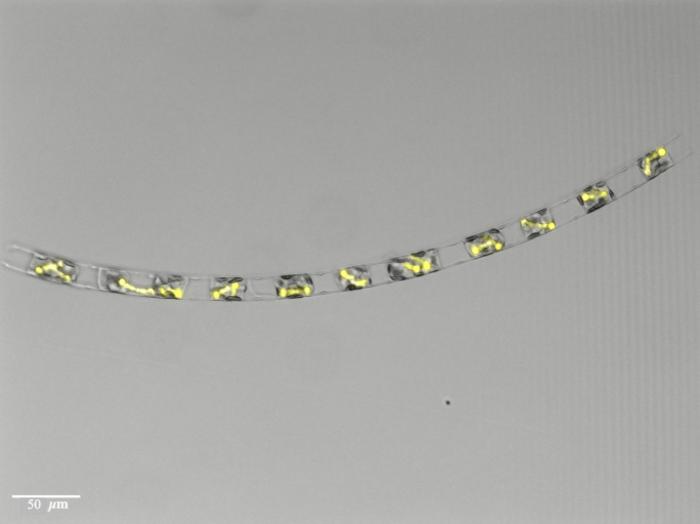
Symbiosis

Credit: Sepehr Bardi

A study explores the genetic expression of a photosynthetic symbiont that lives inside an abundant marine organism. Marine diatoms are responsible for one-fifth of global photosynthesis. Many are coastal, but diatom-diazotroph associations thrive in open ocean waters that are low in nutrients thanks to a symbiotic relationship between a diatom host and nitrogen-fixing bacteria. Rachel Foster, Enrique Flores, and colleagues collected the diatom Hemiaulus hauckii, along with the cyanobacterium Richelia euintracellularis, which lives inside the diatom’s cells, from multiple locations in the western tropical North Atlantic. Cyanobacteria are bacteria which can perform plant-like photosynthesis. As researchers are currently unable to grow Richelia euintracellularis in the laboratory, the authors explored the function of proteins found in the endosymbiont by expressing the proteins in model organisms, including Escherichia coli and Anabaena sp. One protein was found to split sucrose into glucose and fructose. The presence of a sucrose-specific solute binding protein, which participates in shuttling molecules across the cell membrane, suggests that the sucrose is provided to the bacteria by the diatom hosts. Other solute binding proteins were found that participate in the transport of amino acids (glutamate, phenylalanine) and a polyamine (spermidine). The expression of genes that encode these proteins was verified in wild populations from the Atlantic Ocean. According to the authors, the study paints a picture of a system in which the diatom supplies the bacteria with reduced organic carbon compounds to sustain a high rate of nitrogen fixation.


Journal

PNAS Nexus

DOI

10.1093/pnasnexus/pgad194

Article Title

Heterologous expression of genes from a cyanobacterial endosymbiont highlights substrate exchanges with its diatom host

Article Publication Date

27-Jun-2023
Share12Tweet8Share2ShareShareShare2

Related Posts

Methylation puts parasites in motion

Methylation puts parasites in motion

August 31, 2026
Desiccation promotes DNA damage and rifampin resistance in Mycobacterium tuberculosis

Desiccation promotes DNA damage and rifampin resistance in Mycobacterium tuberculosis

August 31, 2026

Gastrointestinal Parasitism in Cattle and Water Buffaloes in Pakistan: Prevalence and Associated Risk Factors

August 31, 2026

Development of HPLC–PDA method for steviol glycosides analysis in food matrices

August 31, 2026

POPULAR NEWS

  • β-Sitosterol from Ipomoea carnea Jacq. As a promising anti-inflammatory agent: Evidence from in silico modeling and in vitro validation

    29 shares
    Share 12 Tweet 7
  • Design, fabrication and characterization of a wearable Fiber Bragg grating sensor for cardiorespiratory monitoring using finger plethysmography

    29 shares
    Share 12 Tweet 7
  • KAIST opens the era of industrial-scale microbial foods, proposing growth strategies for the next-generation protein market

    29 shares
    Share 12 Tweet 7
  • Virologist awarded $2 million NIH grant to investigate how virus-infected cells live and die

    29 shares
    Share 12 Tweet 7

About

We bring you the latest biotechnology news from best research centers and universities around the world. Check our website.

Follow us

Recent News

β-Sitosterol from Ipomoea carnea Jacq. As a promising anti-inflammatory agent: Evidence from in silico modeling and in vitro validation

Design, fabrication and characterization of a wearable Fiber Bragg grating sensor for cardiorespiratory monitoring using finger plethysmography

KAIST opens the era of industrial-scale microbial foods, proposing growth strategies for the next-generation protein market

Subscribe to Blog via Email

Enter your email address to subscribe to this blog and receive notifications of new posts by email.

Join 85 other subscribers
  • Contact Us

Bioengineer.org © Copyright 2023 All Rights Reserved.

Welcome Back!

Login to your account below

Forgotten Password?

Retrieve your password

Please enter your username or email address to reset your password.

Log In
No Result
View All Result
  • Homepages
    • Home Page 1
    • Home Page 2
  • News
  • National
  • Business
  • Health
  • Lifestyle
  • Science

Bioengineer.org © Copyright 2023 All Rights Reserved.